
Times are tough for millions of Americans. There’s the affordability crisis making groceries, healthcare and other basic necessities inaccessible. There is also the looming threat of wrongful assault, arrest and even death by the hands of federal forces mobilized throughout the country. And amidst these tensions, studies show that over 50% of Americans are overwhelmed by stress and feel isolated.
In uncertain times, we often turn to distinguishing ourselves from others to give us a sense of power to feel more secure and have a stronger sense of control.
We’re split into in-groups and out-groups through political polarization, then believe that the groups we belong to are morally superior. In fact, many Americans see those with different opinions as inferior or even sub-human.
That being said, it is no surprise that the divide between Americans deepens each year as such polarization intensifies. However, the problem is not that we are agreeing less, but in the misconstrual of how we understand disagreement.
A study by Pew Research Center showed that 72% of Republicans and 63% of Democrats viewed each other as “immoral.” Polarization is not just dividing us, it is eroding our capacity for moral judgment, pushing us toward a culture where hate is instinctive.
Steven Greene, a political science professor, explained that social media has played a huge role in facilitating polarization. Algorithms are essential to how we understand ourselves; they curate feeds that serve to reinforce beliefs core to our identities and shape how we understand the world.
“It feels so good to think, ‘My side is always right and the other side is always wrong,’ ” Greene said. “And you have an infinite array of information to further convince yourself of that. There’s another really great idea called Identity Protective Cognition, which just means, look, you are literally seeking out, using your ability, your mental abilities, reasons to prove that your side is right, that your team is right and the other guys are wrong.”
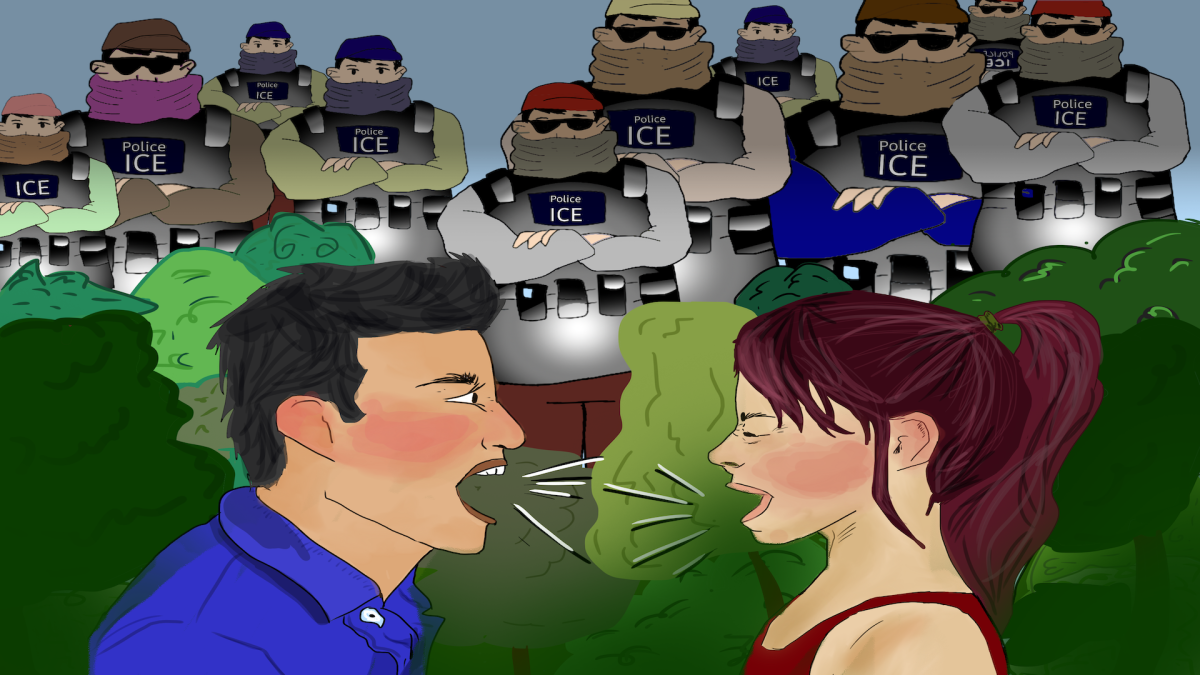
But polarization is no longer a matter of solely asserting power as much as wiping out the opposition. We are falling into a doom spiral where society has become less empathetic and more hateful. Operations by the U.S. Immigration and Customs Enforcement over the past year demonstrate the slow legalization of discriminatory and dehumanizing rhetoric.
While on one hand, there may be reasons that warrant concerns on immigration and the nation’s safety, anti-immigration claims were always grounded more on prejudice than on evidence.
We have reached a point where both citizens and immigrants alike are in danger from ICE’s raids and arrests. It is contradictory to combat the potential threat caused by immigrants by creating an even bigger one that is actively affecting people in our community. The status quo is shifting toward one in which violence and hate outweigh reason and empathy.
Greene explained it will be hard to combat polarization as people often resort to thinking in ‘good’ and ‘bad’ binaries in times of change and instability.
“It is human nature to see the world as ‘us’ versus ‘them,’” Greene said. “We are evolved to think fast and make quick snap judgments on everything for the most part, because you would be paralyzed if you weren’t … we [live] in a complex world.”
Nonetheless, accepting the current situation won’t solve anything. There is a solution, but it will take a lot of time and effort.
One way we can combat polarization and break out of this pattern is by training our minds to understand other perspectives. Critical thinking skills have been on the decline, and we need to cultivate them to see why others think in the ways they do. People’s beliefs are often shaped by experiences we have never lived.
Greene believes that one place we can start is in the classroom.
“I try and fix this [habit] one class at a time,” Greene said. “I assign articles like how politics makes us stupid and how to not let it make you stupid … on how our current ecosystem hijacks your thinking and how to not fall for that. And I’d like to think it makes some difference with my students,” Greene said.
That is to say, we must also recognize that being understanding does not entail agreeing with harmful beliefs or compromising our morals. Instead, it allows us to think more carefully instead of resorting to extremes, and to reevaluate our circumstances in a more constructive way.
Each time we encounter someone with differing views, it is up to us to make the difficult decision on how we are to characterize one another.
In some cases, people are genuinely spiteful and hateful, and the healthiest response is to take a step back and leave them be. In other cases, hostility can stem from ignorance or misinformation. We should extend our empathy and get to know one another, sharing our perspectives to understand different viewpoints and clear misunderstandings.
It is difficult to say which course of action is correct and if we are always going to be able to make the right decisions; however, political polarization has shown us that the answer will never lie in extremes and hatred, but in the effort to come together and see each other as people.