

In an ever-changing world of collegiate basketball, what does it take to get your jersey retired now? Does it take a record-breaking season? Do you have to take your team to a national championship? Do you have to stay your collegiate career with the college that recruited you?
Having your number raised to the rafters commemorates a player for the time and effort that they have given to a program, along with the success they helped contribute to. The banner links a player’s name and number to a program and legacy forever.
Before the transfer portal and “one-and-dones,” the standard for getting a jersey retired was simple. Stay for three or more years, be one of the best players in the country and contribute to winning.
T.J. Warren came into NC State as a true freshman and averaged 12.1 points per game, being a key player in the pack’s rotation. The next year, he broke out as a sophomore, averaging an ACC-leading 24.9 points per game. Warren also made the AP All-American second team, helping put the program in a better spotlight.
Instead of jumping ship to boost his draft stock and gain national exposure after his breakout year, Warren opted for the draft after his second year. Leaving for the draft as a member of the pack allowed him to forever be remembered as an NC State legend, giving fans another pro to root for.
Now, players who have a breakout season opt to transfer to gain more national exposure in hopes of trying to go to the NBA.
Much like Warren, Dalton Knecht had a breakout second year at Northern Colorado, where he averaged 20.2 points. Unlike Warren, however, Knecht opted for the transfer portal, where he ended at the University of Tennessee. In Knecht’s only year in Rocky Top, he made a huge impact, averaging 21.7 points per game, leading the Volunteers to an Elite Eight appearance and making the AP All-American first team.
However, one elite season doesn’t compare to the impact of a player staying loyal for multiple years to a program, so what would it take to get your jersey retired now? To compare the impact of a player staying multiple years with a program and developing into a star to a player being there for only one season, the player would have to have an all-time season both individually and with their team.
Individual success:
For a player to leave a big impact in such a short time, they need to do it in a big way. Not only does the player need to be one of the best in the conference, but they also need to be one of the best in the nation, a potential lottery pick. A player needs to be one of, if not the best, in the nation for them to leave an impact on the school, meaning an AP All-American first team or winning the Naismith Men’s College Player of the Year.
Team success:
For a player to have enough team success to get their jersey retired, they would need to lead a team above and beyond their expectations. If players head to a program with a rich history, winning a championship may be the only way for a player to make enough of an impact to get their number hung from the rafters.
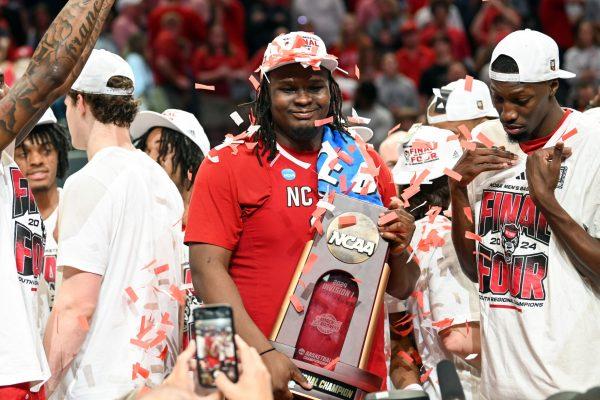
NC State’s own DJ Burns Jr. is an example of leading his team above and beyond expectations. The Pack entered the ACC Championship as the No. 10 seed and had to win it all to make the NCAA Tournament. It pulled off the impossible and won the ACC Championship, entering the NCAA Tournament as a No. 11 seed.
The Wolfpack had a long road ahead, and it looked like its luck would run out. But Burns stepped up in the postseason, averaging 18.3 points and leading the Pack to its first Final Four appearance since its legendary national championship run in 1983, leaving a long-lasting legacy as a member of the Pack.
Post-college success:
While colleges retire a player’s number for their contributions to the program, along with the impact and importance they leave, their NBA careers also have a big impact on whether a player’s number will be placed in the rafters.
If a player makes a lasting impact in the pros, continues to dominate and becomes an all-time great in the NBA, it is hard for a college program to ignore that. Not only would they be celebrating their college career, but also what they have accomplished, with the help of that college program.
The main purpose of a player getting their jersey number retired is to commemorate the impact that player left on a school. While there is no set formula for a number to be retired, it all depends on the impact. This impact can be felt in many ways, whether that is a championship, a record-breaking season or developing into a star with a program.