

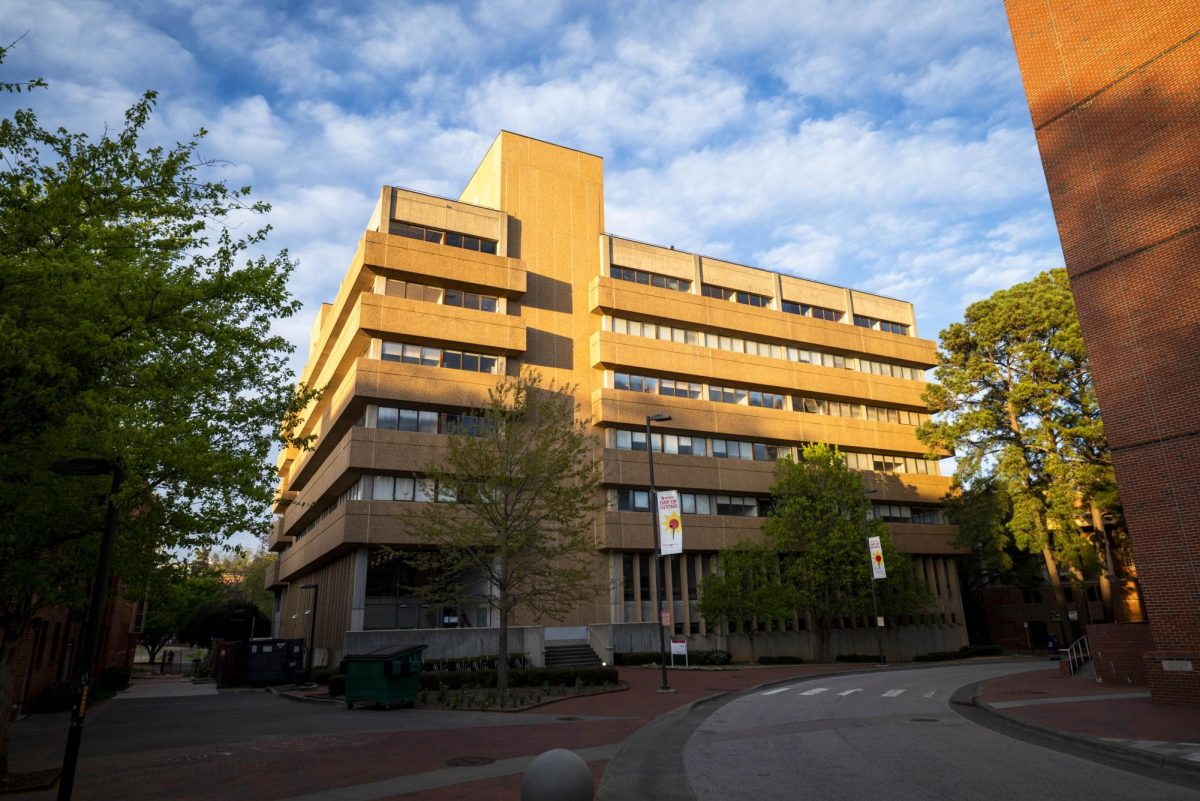
I came to campus in 2019 as an undergraduate studying psychology. The majority of my classes were in North Campus, with more than a few housed in the now-infamous Poe Hall. While the cancer risk obviously makes my memories a bit more complicated, I do still have a fondness for the building where I’d spent so much of my undergraduate career.
I’d frequently sit at the second floor tables next to big windows facing the Court of Carolinas to work between classes with an overpriced smoothie from the Pork City Java next door. The College of Education’s Media Center on Poe’s fourth floor had my favorite poster printer on campus and an incredibly friendly staff.
My experience taking courses in Poe Hall started pre-pandemic. The second floor lecture hall was massive, and I vividly remember taking Social Psychology with the unforgettable Rupert Nacoste in the Spring of 2020. As an Alumni Distinguished Undergraduate Professor who taught at NC State for over 30 years and a veteran from Louisiana — not New Orleans — Nacoste’s course changed my perceptions on interpersonal relationships, how we interact with one another and manage our own energy limits. His lessons resonate with me daily.
After coming back to campus in person, I took cognitive processes with Jonathan Kasko in Spring 2022. In Fall 2022, I took perception with Ralph Clark, a professor who noticed my articles in Technician during my first semester writing. That was one of my motivations to keep writing, to see how my words could impact people I knew and looked up to within our campus community.
In April of 2023, the College of Humanities and Social Sciences published an article about my academic journey, which the wonderful former dean Jeffrey Braden noticed. We met in his office in Poe Hall to talk more about our common interests, a conversation which still resonates with me years later and inspires me in my career goals and advocacy.
The next semester, I took health psychology with Vanessa Volpe in Spring 2023 and advanced methods in psychology with Daniel Grühn in Spring 2023 in Poe. As director of the undergraduate programs in psychology, Grühn read my name at graduation as I received my degree the following semester.
When the realities of Poe Hall’s PCB exposure came to light, these were the people I thought of. People who dedicated decades to the University and supporting its students, who made the building welcoming to an often overlooked humanities program.
After hearing of the closure of Poe in November 2023, the first emotion I felt was shock and disappointment. I was no longer able to go to my favorite study spots or catch up with my former professors in its hallways.
The thought that showing up and doing their jobs may have put these beloved and impactful people in preventable danger infuriates me.
I don’t think placing blame is the solution here — what’s done is done. The hours I spent inside Poe Hall cannot be taken back.
But there are other places on this campus which are being minimized to reduce the risk of another scandal. There have also been PCBs found in Lampe Hall, D. H. Hill Jr Library and several residence halls. Instead of jumping to assess and ensure other buildings are not exposing members of our campus community to PCBs or other carcinogens, renovations in buildings like Dabney have been controversial.
Personal choices can obviously lead to cancer development, like smoking cigarettes or drinking alcohol. Even microwaving food in plastic containers or driving your car can expose you to carcinogens. But the decision to go to work or attend your classes should not be exacerbating this risk without you even knowing about it.
I get administrators not wanting to cause a panic, and that we encounter carcinogen risks almost everywhere, but come on.
Our campus has a responsibility to support its community. The people inside Poe Hall are the reason I’m still at Technician with a platform to write about this, the reason I came back to NC State for graduate school at all.
Trying to dismiss lawsuits of those affected by PCB exposure shows that reducing backlash is more important than protecting the health of our campus. Instead of worrying about who is taking the fallout of these exposures, we need to be proactive about ensuring our other spaces aren’t unknowingly introducing similar dangers. Every building with risk of exposure should be thoroughly tested and responded to.
As a student who spent a decent amount of time in Poe, I know how significant any building can be to members of our campus community. But I know more about how significant every member of our campus community is. There’s no reason to protect the University’s reputation that’s worth student and staff lives.


