
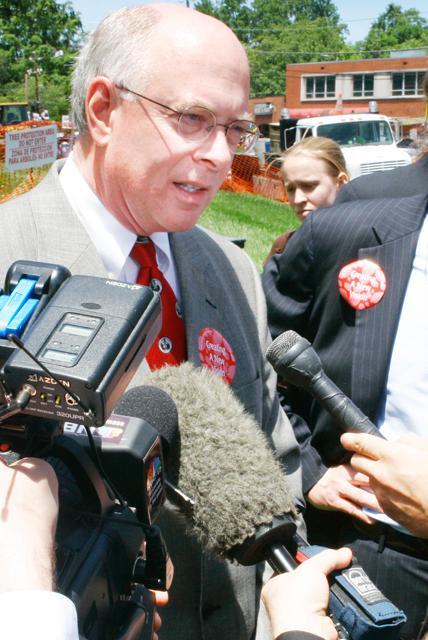
Former University chief executive James Oblinger was hired as president of the Murdoch research facility Murdock on Sept. 13.
Chancellor Oblinger resigned from his post at the University two years ago amidst much controversy regarding his hiring of the former first lady Mary Easley. Recently, however, he has been hired as the new President of David H. Murdock Research Institute on the recently organized North Carolina Research campus in Kannapolis , N.C .
The facility is part of an interdisciplinary program that hires 100 percent research professors who work in the health and nutrition areas. All the professors bring their staff of graduate students and lab workers and they hope to have more contributions.
Rod Gurganus , director of NC MarketReady , and one of Oblinger’s co-workers at Plants for Human Health, had only good things to say of his work ethic and personality.
“[ Oblinger ] was a good friend and mentor. Everyone really enjoyed working with him and he had a lot of connections,” Gurganus said.
Asked if he believed Oblinger’s past media scrutiny would have any impact on his future career with Murdock after he leaves his position with Plants for Human Health at the end of the month, Gurganus said “I don’t think so, a person’s past is his past and we’re all professionals doing our jobs and moving forward.”
Tara Vogelien , director for business and marketing at the Research Campus, described the 5-year old establishment as a “collaboration between six UNC academic institutions, including NCSU , and various private institutions — such as Dole, Murdock, General Mills, among others. It was established through a joint effort by the UNC General [Administration] and the campus developers, and we hope it will go on to be very successful.”
Oblinger started working on campus more than 25 years ago in various faculty and administrative positions until he became chancellor in Oct. 2004. He was known for being a hard worker and being able to get things done, and, therefore, the UNC Board of Governors unanimously voted him into the office of chancellor.
Near the conclusion of his time as Chancellor he got caught up political drama.
Mary Easley, who had been hired into a full-time position at the time, was to be paid $170,000 a year, which translated into an 88 percent pay increase, while the other state employees were to get a 1-2 percent pay increase as suggested by former Governor Mike Easley.
The Easleys believed it was a well-deserved salary hike due to the fact that Mary Easley was expected to take on many new responsibilities and therefore was essentially taking on a new position.
The former governor was persistent in defending his wife and believed sexism and a lack of understanding on part of the other disgruntled faculty members to be the reason his wife’s new position and corresponding salary were being harassed to such a degree.
Although members of the Board of Governors requested her resignation several times, she stayed firm in her position to continue with her five-year contract with the University.
The controversy soon led to the questioning of who had hired Easley into her position, and several e-mails between the former governor, Oblinger and the Provost at the time all seemed to point fingers toward the provost and Oblinger .
Oblinger also came under fire for increasing the severance package for the provost at the time the provost was resigning from his post.
In light of all the controversy around the subject, Oblinger resigned from his position as chancellor.
Soon afterwards, however, the University, led by the interim Chancellor Randy Woodard terminated Easley’s contract at an unknown expense and Easley was in effect fired from her position. Several other members on the faculty who worked alongside Easley or were somehow involved in their decision to hire her all stayed consistent in their opinion that they truly believed in her caliber and thought her a great asset to the University.
Even those who asked the first lady to resign attribute their requests to the situation and the amount of unnecessary, negative attention the University and some of their top-ranked officials were receiving from the public.
Oblinger then took a 6-month leave from his position in order to allow for the media scrutiny to settle down. Although he stepped down from his office of chancellor, he went back to work in the College of Agricultural and Life Sciences as a professor and researcher. More specifically, Oblinger worked in the research professor position with the Plants for Human Health Institute.
Steven Leath , UNC general administrative vice president for research, was specifically named as the person that initiated the idea to hire Oblinger .
After a five-year downward sloping streak at Murdock on the research campus, Oblinger is expected to bring a lot to the table in terms of fundraising for the institution, according to Leath .