

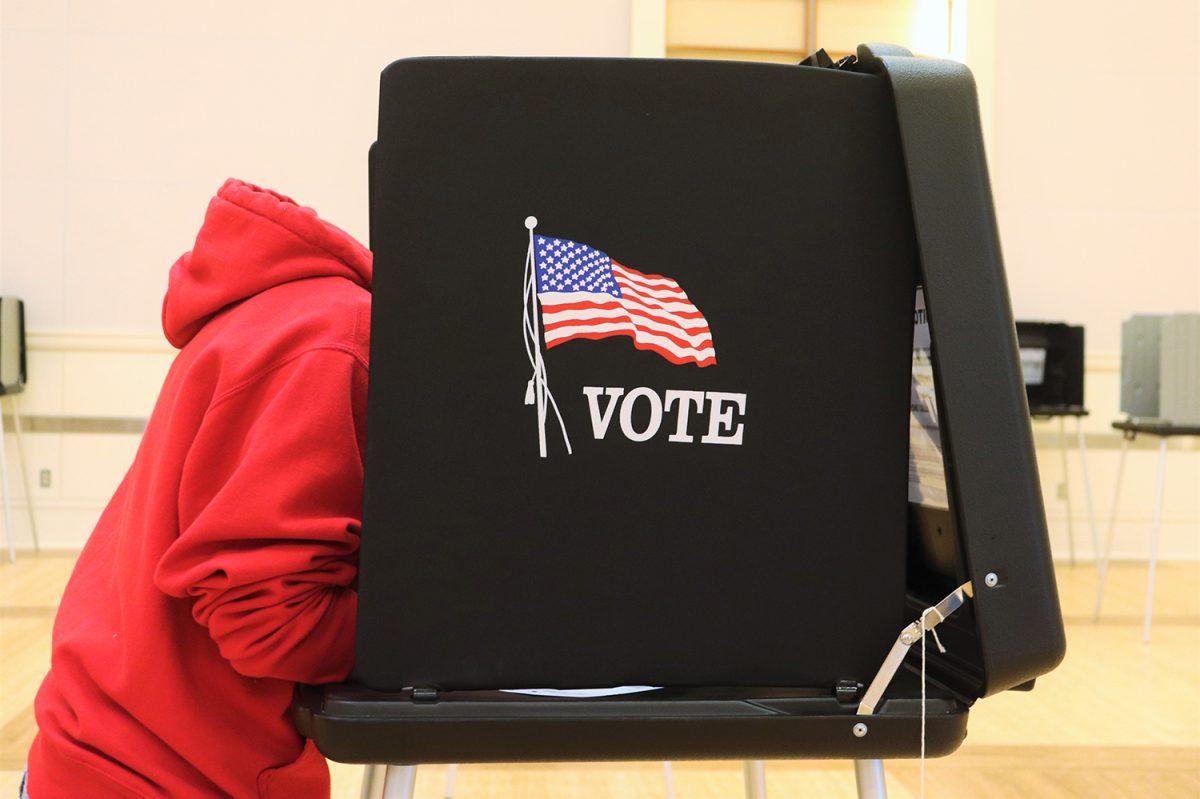
The Wake County Board of Elections voted unanimously to remove Talley Student Union from the list of early voting sites for the general election in a meeting on June 12.
The site was replaced by the NC State Business Services Center, located off Western Blvd. Several Democrats argued the move could suppress turnout among students due to the distance. Board Chairman Keith Weatherly, a Republican, stated that the change was made to help make the site more accessible for all voters in the area, especially those who need parking.
“We found it would be more accessible to a larger number of voters, who live in that area and who would likely vote in that area, to move it to the business center,” Weatherly said.
Weatherly provided the statistics the Wake County Board of Elections used in their decision, citing there are 86,909 registered voters within a 10-minute drive of Talley, and 139,500 registered voters within a 10-minute drive of the Business Service Center – over a 50,000-person difference.
Weatherly stated that Talley had limited parking spaces available to voters, whereas the Business Service Center will have much more availability, addressing the board members’ concerns over parking.
Weatherly backed up the need for parking availability with more statistics showing voters aged 18-21 who live within a 10-minute drive of either voting center only make up roughly five percent of the voting population.
Gerry Cohen, a Democrat on the board, disagreed, stating the Business Service Center is less accessible than the Talley Student Union, using voting data from 2016 when the Business Service Center was used, compared to years when Talley was used.
“ The site was much more constricted, and we have actual data comparing the turnout. So 11,000 at business services in 2016, and 21,000 at Talley in 2020 and 2024,” Cohen said. “So any argument that it’s not accessible is completely rebutted by the actual numbers, it’s the business services site that’s less accessible.”
Weatherly expressed concerns over non-student voters who had difficulty navigating and voting at Talley, but Cohen rebutted this and used statistics from past early voting at Talley, which showed that over two-thirds of the votes at Talley came from non-students.
“They say, ‘Oh, people in the community can’t get there.’ Well, in the last two elections, 2020 and 2024, only 30% of the voters at Talley were age 18 to 25, 70% were not students. So how they could say people from off campus couldn’t get there, when 70% of the people that have voted at Talley were not student age, is to me, just ridiculous to make that argument.” Cohen said.
Cohen also explained that he views a voting site on a college campus acts to serve a large number of people who don’t need parking, because they are students living on or near campus.
“ The problem is, the driving time is meaningless if you don’t have a car. It’s completely irrelevant to most undergraduates how long it takes to drive somewhere if you don’t have a car,” Cohen said. “It’s what’s called in Latin a non sequitur, true but not relevant.”
Another key point Cohen made was that the Business Service Center only allows for 21 voting booths, while Talley allowed for 27. Many students can remember long lines to vote at Talley, and fewer voting booths at the Business Service Center could make lines worse if turnout numbers are similar.
Cohen talked about the lines he saw when working as an observer at the Business Services Center voting site in 2016. “Enormous lines at Business Services in 2016. It’s just that Talley could process 20 to 25% more voters because the number of booths is the choke point,” Cohen said.
Cohen ended his argument with the idea that the removal of sites like Talley and other voting locations on college campuses across North Carolina is part of an anti-student sentiment when it comes to voting.
“I tried to make a case based on facts, but I believe there’s sort of an anti-student feeling. That’s the only way to explain it,” Cohen said.
While Democratic and Republican board members were split 3-2 on the decision to change the voting site along party lines, the board collectively declared the decision unanimous to speed up the process in time for elections.
Weatherly said if a split decision were sent to the NC Board of Elections, it could delay the process to get the site staffed and set up properly, which could have costly effects.
“It was agreed by the minority on the county board that it would be too long before we got a decision, it would be August before there would be a decision [at the state level], and the Wake County staff would have difficulty lining up workers for those sites and all, if we shuffled it at that point,” Weatherly said.
Cohen agreed with his fellow board members, stressing the importance of making sure whatever voting site was used would be running properly and given ample time to prepare.
Weatherly also said if the decision was sent to the State Board of Elections, he thought a similar outcome would happen.
“It was pretty well known it was going to be a slam dunk,” Weatherly said. “Whatever Wake County wanted, it was also going to be chosen by the final arbiter of the North Carolina State Board of Elections.”
However, Weatherly said this decision isn’t permanent for future elections. If a certain situation or board member calls for revisiting the matter, they can and will.
“For future elections, we’ll revisit this anytime, if the facts call for it. This is not a permanent decision by any means, and we’ll continue to revisit it as members of the board request it,” Weatherly said.