
Difficulty is almost expected in STEM classes. Students will openly admit they don’t understand calculus, chemistry or physics. They form study groups, attend tutoring sessions and joke about low exam averages. In contrast, when students struggle with writing or analysis, the reaction is very different.
Humanities courses are often thought of as easier, more intuitive and something you’re either “good at” or not. Struggling is not a moral failure, but in some classrooms, it can feel that way.
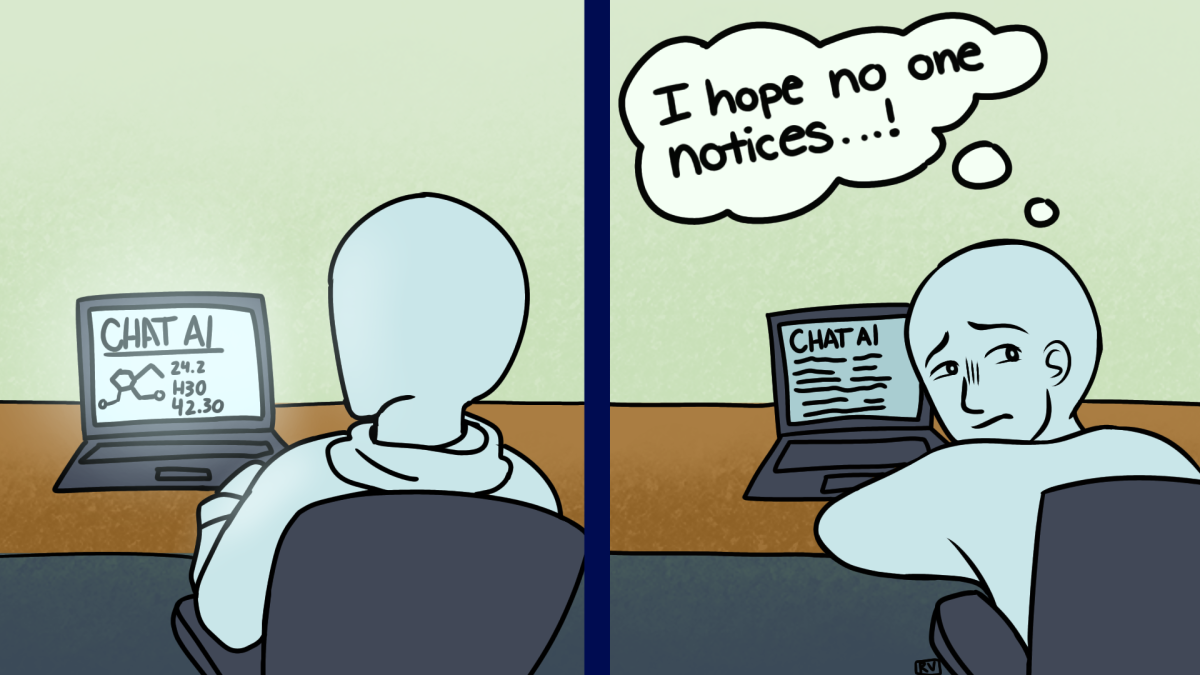
As artificial intelligence becomes more embedded in college life, a student’s discipline can impact how comfortable they feel admitting they need help. That perception can create a stigma and push students toward relying on AI instead of asking for support.
Paul Fyfe, a professor in the Department of English, program faculty in the Communications, Rhetoric and Digital Media PhD Program and Director of the Graduate Certificate in Digital Humanities, said many students arrive at college unprepared for the expectations of college-level writing.
“Writing instruction is not very well supported before you get to college and that’s a real challenge for folks coming in,” Fyfe said. “Another challenge is getting away from the structures in which we’re taught to write, like the infamous five-paragraph essay … it is useful to a point, like a crutch to get things up and running. But in college it becomes a constraint, and it can be a challenge to practice in a discipline where you feel like a novice.”
Writing isn’t about producing a single correct answer. It’s about brainstorming, thinking and revising, skills that are harder to quantify and easier to judge. When those skills are dismissed as basic or innate, students may internalize failure instead of treating it as part of learning.
Fyfe said AI tools complicate that process because they are designed for speed, not growth.
“AI tools are built for efficiency, but learning is about friction,” he said. “It is not about the fastest way to a definite answer, but about working through processes, and in that cognitive work, you build your brain. The problem we’re seeing is when AI enters the picture and starts offloading some of that cognitive labor that’s required for the process.”
When students feel pressure to perform rather than permission to learn, AI becomes a shortcut to avoid discomfort. Instead of drafting imperfect ideas or asking for feedback, students turn to tools that promise perfection with no effort.
But the pressures students face aren’t just about AI or personal ability. Fyfe pointed to larger structural issues shaping how students learn.
“There has been significant political pressure in defunding higher education and public education in North Carolina that has resulted in larger classes and people who have immense workloads and don’t necessarily have the bandwidth to deal with this extra thing that’s happening right now,” Fyfe said. “So AI is not necessarily the only cause of the predicament we’re in, but it has catalyzed a lot of existing infrastructural problems.”
These systemic challenges mean students aren’t simply seeking convenience when they use AI, they’re navigating under-supported classrooms and institutions.
Even when students try to use AI responsibly, shortcuts can be tempting, and the risks extend beyond individual learning. Fyfe quoted writer Ted Chiang, who described the process as a shortcut that can actually hinder personal growth.
“Using ChatGPT to do your homework is like bringing a forklift into the weight room,” Fyfe said. “You can move a lot of weight, but you’ll never improve your cognitive fitness that way. And ultimately, that’s one of the main reasons we come to college.”
Students don’t have to navigate these challenges alone. If you’re struggling with humanities, it’s okay to visit office hours or book an appointment at the on-campus writing center, whether as an undergraduate or graduate student.
Fyfe emphasized that the solution isn’t about banning AI or pretending it doesn’t exist.
“We need to disambiguate chatbots from machine learning applications that have, potentially, a robust role to play in different kinds of research.” Fyfe said.
If universities want students to engage honestly with AI, they need to address the stigma that makes humanities struggle feel shameful. Writing and critical thinking must be treated as skills to be learned, not traits students are expected to already have. Departments could further embed humanities into other disciplines, increase available faculty or mentorship support and highlight career paths that rely on humanities skills to show its value and normalize asking for help.
Until that changes, students will continue to turn to AI not to cheat, but to hide.