

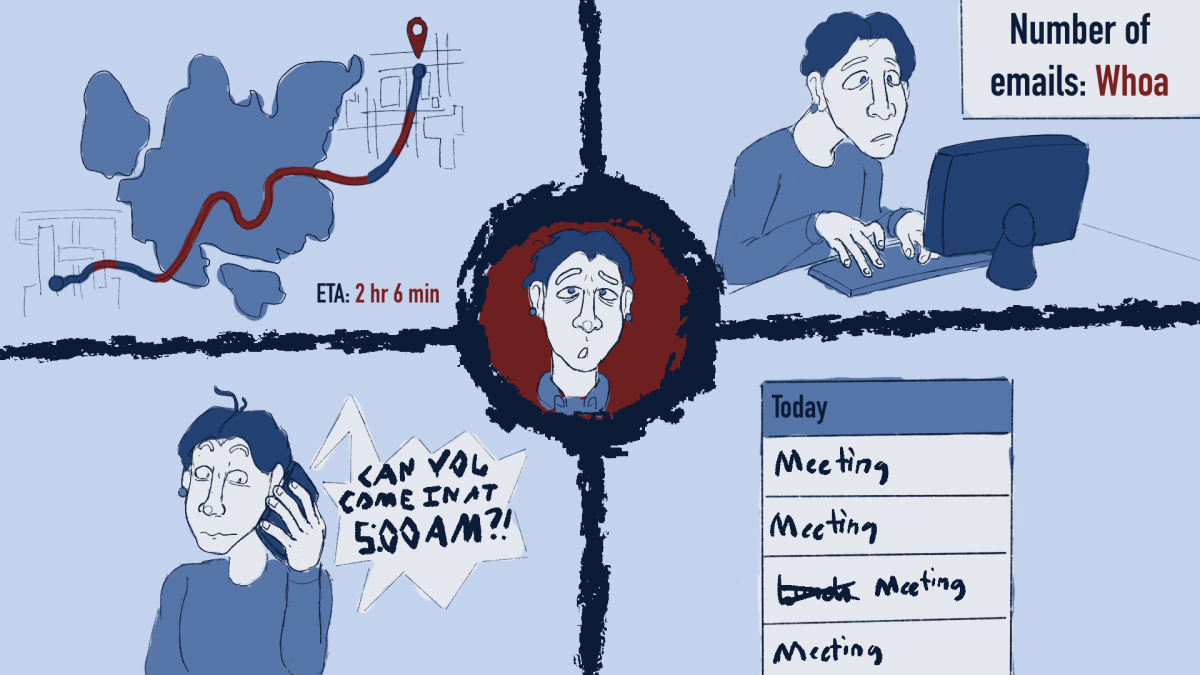
Want to work less and get more results? Sounds like a scam, right? Well, it may just be what Americans need to do to boost their productivity.
The philosophy of the work-life balance in the United States is problematic. We often view life outside of work, or even parts of our human selves as extra or unnecessary because they don’t directly translate into our work. However, the nuanced parts of ourselves, such as the playful or curious sides — even the joking side — can actually enhance our work quality.
To be clear, not working is not a solution. Not working can cause problems like loss of identity, financial insecurity and mental health struggles — but it is called work-life balance for a reason.
Our culture works too much. Nearly 66% of Americans say they have no work-life balance, with 48% believing they are workaholics. Overworking leads to exhaustion, brain fog, loss of interest in work, inability to relax and lowers productivity overall. Spending too much time at work means less time in personal life, leading to less rest and fulfillment.
Ian Siderits, a PhD student studying Industrial-Organizational psychology, said, “Culture [is] so performance focused that the only reason [it] will care about well-being is if you put the pill in a little sugary pocket, but it leads to performance.”
Taking meaningful breaks is important to resting the mind and creating meaningful synapses that allow for stronger connections and a more in-depth understanding of the content. An adequate break in life can prevent burnout from happening, and can create better job satisfaction overall and create a sense of fullness within a person.
Working too much can also increase cortisol, the stress hormone, which when chronically elevated can cause a host of psychological problems, such as emotional deregulation, hopelessness and anxiety.
Alternatively, having a healthy competition or small staff number in the workplace can enhance performance. Joking about content can also help us calm down and engage more.
I could go into detail about how non-professional parts of ourselves are useful, but the big picture is that all parts of our brain are crucial for our functioning, whether at work or outside of it. Chronically repressing ourselves will reduce our quality of life, and yes, our productivity at work.
“Less time working can actually be beneficial for the balance of people and for the work, you perform better,” Siderits said. “Practices that force more time in the office or force more interaction with the company [are] at the exclusion of employees’ ability to have a life outside of work.”
However, the four-day work week could function well. Employees that work one less day per week can be more productive and net more productivity, as seen in the UK, Japan and New Zealand.
“[When] your workforce is physically healthier, cognitively healthier, they’re more able to pay attention to their work to produce it faster,” Siderits said.
It seems clear that a split between work and life is crucially important, and there are times to be productive and times to rest — you absolutely cannot impede on either one. It is clear that a focus on quality of work rather than quantity of work is something that might be missing from current culture.
Americans have already vocalised that they prioritize work-life balance more than money, but there is more that could be done. As a culture, we could choose to work at places that have healthy work-life boundaries instead of those that don’t.
Companies should also meet their staff halfway and experiment with lessening work week hours. A better balance can improve productivity, benefitting profit margins. Experimenting with vacation time and more engaging ways of content delivery could benefit well-being and productivity for workplaces.
It’s in a company and an employee’s best interest to have a better work-life balance — one wants productivity and the other wants stability. Even though employers and employees may be at odds over wages, they do have a common end goal, and constant stress is unnecessary. Understanding that our well-being is valuable and crucial to our work and is the first step.


