

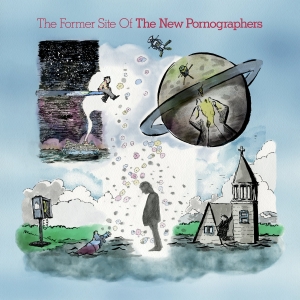
Have you ever been in a “Pure Sticker Shock” at the price on your head? Grapple with how little you matter in our great big world? That’s part of the idea behind A.C. Newman’s writing on “The Former Site Of,” an indie rock album whose title calls back to signage posted around a man-made lake in New York that was once the site of a small town.
If you’re familiar with The New Pornographers, its 10th album is appropriately titled. The band’s usual quick hooks and power pop are at the bottom of the lake, and all that’s left afloat is soft and airy meditation. A princess stuck on a sinking ship, a lesson in picking flowers for the dead, a meeting with a cancer patient. If this all sounds a little sad, it’s supposed to be.
We’re invited to look at things as they are, and a subtle sense of doom hangs over the music. Beginning with “Great Princess Story,” Newman announces tenderly that it’s “quite a view from my deck chair / Sailor on this ship of doom.” There is a strong narrative intent throughout the album, but the writing is opaque, enigmatic. The music builds atmospherically, and the lyrics leave you pondering them for hours — or days.
“Ballad of the Last Payphone” is a cryptic farewell to the endling of that ancient device. Put up in a museum with no fanfare and quickly stolen away. “Did you get a good look at their face?” No, who could be the thieves?
Only us, with our transient world. “They’re not strangers, they rarely are.” We move quicker and quicker through trends and technology, and it’s hard to stop once “it’s terminal velocity.” Singer Neko Case’s bittersweet vocals are a funeral dirge for all that we throw into the lake or put in a museum. “Nothing major man / It’s just the last payphone,” she says ironically, or not.
The band does take one step toward its previous style with “Spooky Action,” a truly catchy pop description of a satellite’s trip around Saturn. A guitar quickly strums above a warm hum and the gentle pattering of drums. A bouncing melody describes the “labor of moonlets,” and the imagery becomes more and more dramatic. “Titan, the famous giant, the burning god.” A gorgeous visual for something so far out of reach.
Back on Earth, there are more important things to worry about.
“I’m just trying to keep the lights on,” Newman sings on “Votive,” echoing the thoughts of millions. A haze of synths platform the song, which is named for a kind of candle. His hands are desperately cupped around a flame. “Has it already gone out?” Stress keeps you focused on yourself. “I didn’t see you there,” Case repeats, dozens of times. It’s hard to think of other people when your flame is flickering.
Although the messages are dire, the album’s lush, opulent textures dull their edge. It’s easy to sit back and let its calm, rolling compositions wash over you.
“Why am I taking so long buying flowers / When I could not do it and say that I did?” Newman almost whispers on “Wish You Could See Me I’m Killing it.” By the time we get ourselves together, not everyone gets to see us killing it: “No one’s keeping score out in the graveyard.” Is it heather or bougainvillea to throw on the grave?
But there’s something to be said for being your best self when no one is watching. Lavender or delphinium? “Not the person you’d remember,” but someone they could be proud of. The flowers chosen for the song are dreamy. Baby’s breath, aster.
At some point, you’re immersed in the album’s strange mid-tempo menagerie of sound. It’s comfort that’s reaching your ears. Just so, the more comfortable you are with reality, the easier it is to live in.
An extreme example comes on “Bonus Mai Tais.” Two friends meet for drinks while a gentle, dazzling tone rises and fades over and over. One friend has cancer. “You splurged and bought a new TV / said ‘Hey, you can’t take it with you!’” Would you worry about the same things you do now if you had a terminal diagnosis?
Wouldn’t you order another cocktail? “You have to use Curaçao, orange juice is frowned upon.” The other friend doesn’t understand this flippant, resigned approach, “Knowing d— all about such things.” There is strength in seeing things as they are, but that doesn’t change the anguish in Newman’s voice as he sings about a dying friend’s drink tab.
A mandolin guides the album’s conclusion, the title track. It’s jammier and exciting by the end, but it starts slow. And quiet. “Our land, oh, our land, it is sinking.” Newman is back to whispering, saying goodbye. One by one, he addresses the characters from the other songs on the album. “All of them shadows / That reminded me of mine.”
“Was I a good captain, as the vessel went down?” Newman asks earnestly at the gates of Heaven, trumpets sounding. Nothing — worry, joy, pain — lasts forever. Pull up a deck chair, sip on a Mai Tai and enjoy the view.