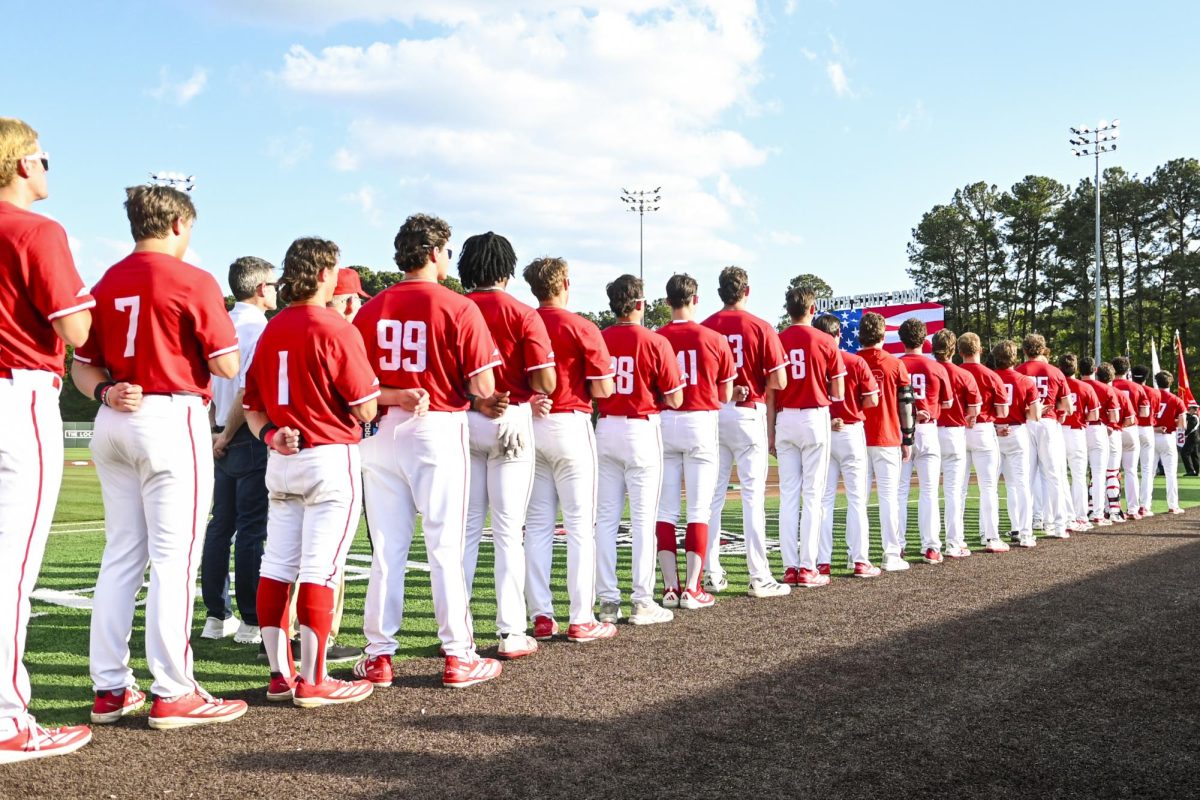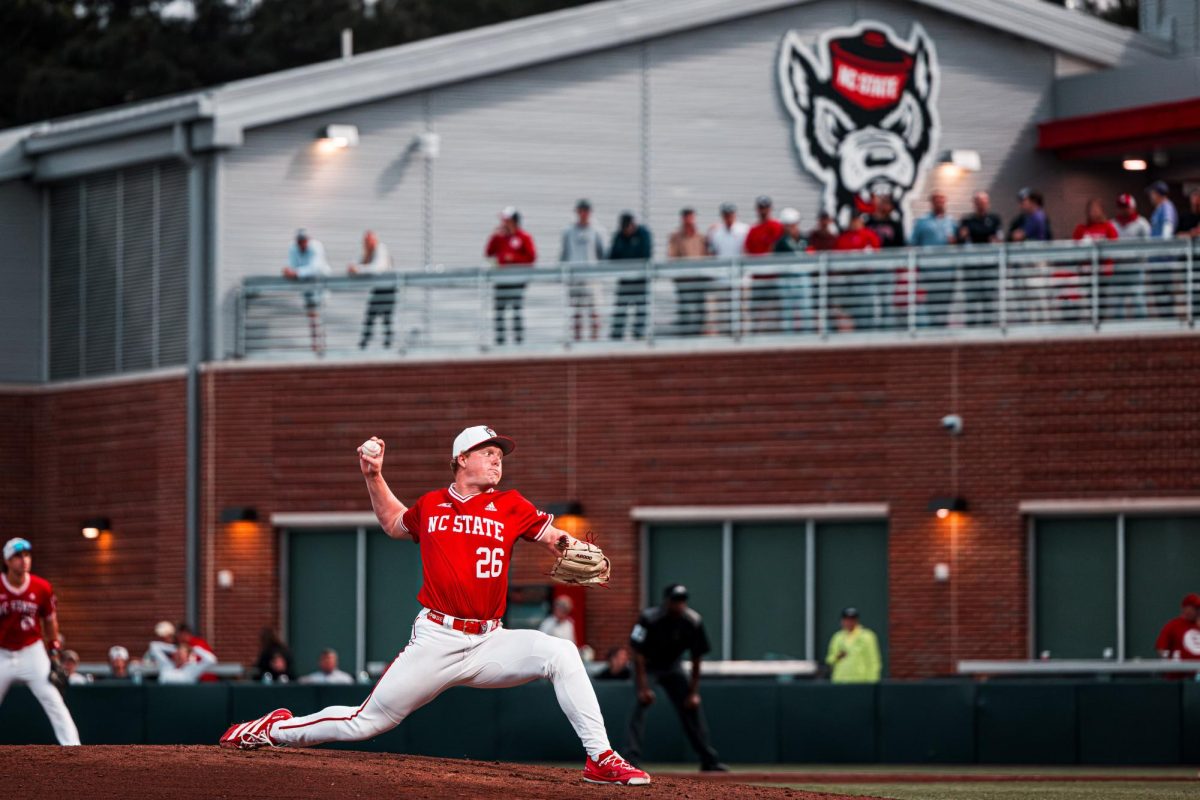

If you’ve ever listened to Andrew Sanders call NC State baseball games on the radio, you’ll have heard him reference Trackman statistics on balls and strikes.
Trajectory tracking systems such as Trackman are used broadly in college baseball — but, unlike in the pros, they do not dictate the actual competition. What’s stopping college baseball from implementing that technology in a more direct way? And what does college tennis’s slow adoption of tracking technology suggest about the future of automated officiating?
The MLB first introduced “robot umpires” in the form of a player’s challenge at the minor league level in 2022, and brought it to the big leagues for 2026. Under the Automatic Ball-Strike Challenge System, each team can challenge any ball or strike until they unsuccessfully challenge two calls.
That system is very similar to professional tennis, where players get three challenges per set on line calls. That technology was implemented in professional tennis in 2006, but in the present day, the challenge system is all-but eliminated as almost every tournament has moved on from line judges and adopted automatic line calling.
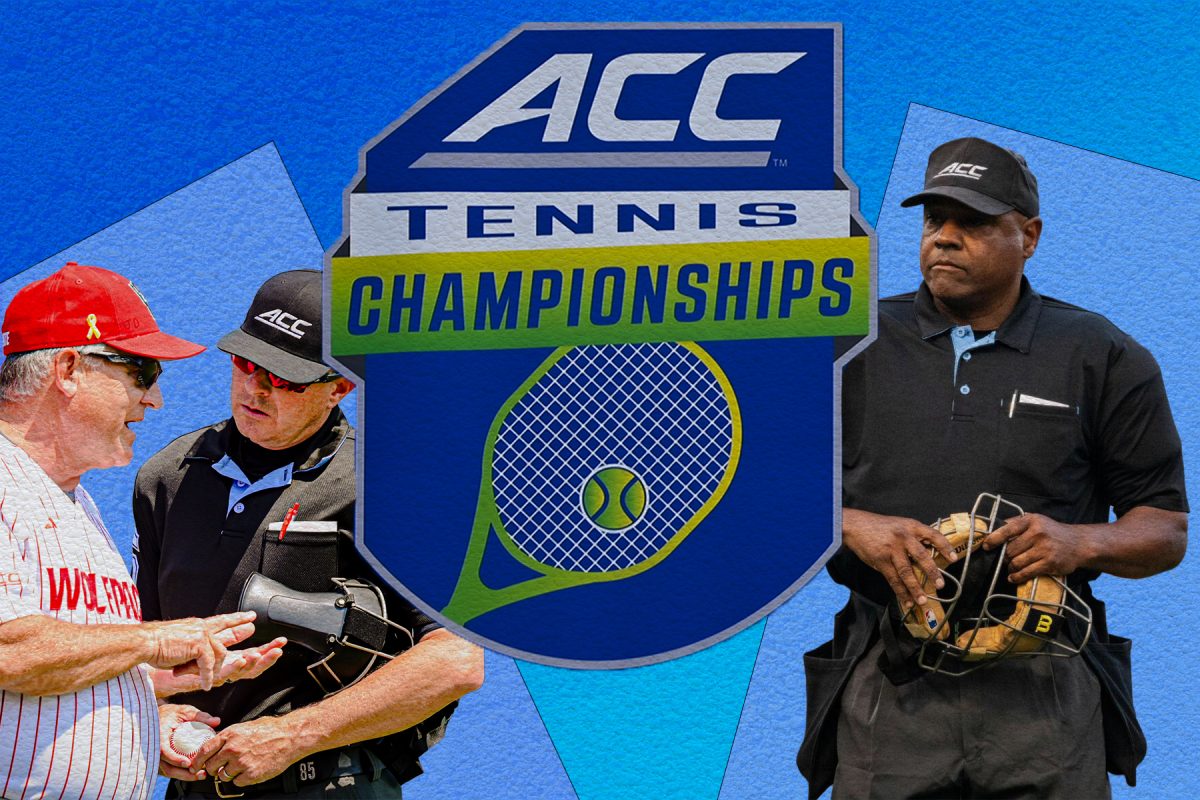
Automatic line calling has made its way down to the college ranks, with the Intercollegiate Tennis Association approving its use in college play for 2025 and big tournaments such as the ACC Men’s and Women’s Tennis Championships and ITA Indoor Championships making use of the technology.
Its adoption has been mostly smooth, but there are still kinks to iron out. A big problem came up in the ACC Women’s Tennis Championship semifinals when No. 28 sophomore Mia Slama was two points away from beating No. 2 ranked Tar Heel Reese Brantmeier and sending her team to the final.
Brantmeier hit a ball toward Slama’s side and the ball was called out. Brantmeier challenged the call, and chaos ensued as the automatic line calling system went down. According to protocol, the officials had two minutes to get it back on or they had to make a ruling themselves.
“That ball was out,” women’s tennis head coach Simon Earnshaw said after the semifinal match. “The chair official saw it out as well and they just challenged just for the hell of it because there were a couple of calls with the machine in that match where I don’t know what was going on. I mean, we can’t see everything, but these were clear errors … So there was sort of this mentality to just challenge, so they just challenged, and the [system] went down.”
The officials came to a decision and play resumed after a long break was taken to get the line calling system back online. Slama was awarded the point despite the hiccup and went on to win the match for the Wolfpack.
The high-stakes sequence demonstrated one problem with automatic officiating technology. If you’re gonna use it, it needs to be as reliable as it is accurate.
Another barrier preventing more widespread adoption outside is its cost. The Hawk-Eye system that is key to the MLB’s Automatic Ball-Strike Challenge System costs a fortune, and even PlayReplay — a cheaper alternative used for college tennis — isn’t exactly affordable.
“I just wish it wasn’t so bloody expensive,” Earnshaw said. “[PlayReplay] has a monopoly on this, Hawk-Eye is super expensive. And it’s better than this one, because you get a lot of good metrics on it. This one will do it as well, but it’s crazy how expensive it is. It’s like 50 grand a year … Until there’s a few more companies doing it, it’s priced [too high].”
Cost implications aren’t the main thing keeping electronic strike-zone calling out of college baseball, though, as most schools invest more heavily in baseball than tennis.
“[Trackman] is pretty widespread at this point,” said Joshua Fisher, NC State’s director of baseball analytics. “Everyone in the ACC and SEC has it … I’d expect most teams in the Big 12, Big Ten, most of the teams we played in the midweek, UNCW, ECU, UNCG, all those kind of schools that we play all have them. There are still programs that don’t. There are programs that use other alternatives. But at this point, it is fairly widespread.”
In order for it to be sanctioned for every game, robot umpires would have to be universal for all of the NCAA. Full-scale implementation is unlikely since there are so many programs in the lower portion of Division I that don’t have large budgets. However, certain conferences could adopt the system for in-conference games. The ACC already has a contract with Trackman through 2027 to grade its umpires.
“I don’t see it happening in the next couple of years, but it’s certainly possible that in 10 years, we could be looking at a fully automated home plate umpire,” Fisher said. “That requires a certain amount of infrastructure, I think you could see it on a conference level. Like in ACC games only, that kind of thing … You have to know every player’s exact height. Major League Baseball came in and measured every player. So there’d have to be a governing body that does that.”
A barrier that might fly under the radar is the need for a high-quality videoboard.
“You’d have to have a scoreboard with the capability to display something like that or at least a press box that can get the information back to the field where someone does challenge,” Fisher said.
One possibility is just implementing the technology for the conference tournaments, similar to college tennis. The Durham Bulls and Charlotte Knights — whose ballparks often play host to the ACC baseball tournament — already have the technology installed, making the transition easier. However, changing the rules just for the final few games of the season may not make a lot of sense when umpire accuracy is good enough.
In tennis, navigating the difference between regular season and tournament line calling creates tough decisions for players.
“It puts the players in weird situations where there’d be times where they want to challenge, and maybe [the coaches] don’t want them to,” Fisher said. “And it makes it tough to develop a strategy that’ll work if you aren’t able to do it for the full season. So I am against implementing new rules for the biggest parts of your season.”
With the existence of a highly accurate system to call balls and strikes and the infrastructure to implement it, it’s only a matter of time before the college game adopts a challenge system. The question is: Will the ACC be the first conference to make that jump?