
NC State’s Board of Trustees voted unanimously Friday morning to increase student tuition and fees.
A 3% increase in tuition was approved across the board, meaning undergraduate resident tuition will increase by $196, graduate resident tuition will increase by $307, undergraduate non-resident tuition will increase by $945 and graduate non-resident tuition will increase by $936.
The board also approved increased premium tuition for students in particular programs, as well as increases to charges for on-campus dining and on-campus housing. The tuition increase for in-state undergraduate students will be the first since the 2017-2018 undergraduate year.
The board unanimously approved all of the student government’s recommended fee increases, including a $5 increase for student center operations, a $13 increase to the educational and technology fee, a $4 to the student transit fee and a $1 increase to the student government fee, totalling $23.
Student government voted to recommend all fee increases aside from the education and technology fee. A student media fee failed to pass student government at their Oct. 8 meeting, and was not taken into consideration by the Board of Trustees.
As the meeting began, Ed Stack, chair of the Board of Trustees, reminded the public attending the meeting that despite being an open meeting, the audience did not have an opportunity to engage with trustees or ask questions.
Chancellor Kevin Howell highlighted efforts to expand educational access to North Carolinians, including the Wolfpack Connect program, enabling transfer students from all North Carolina community colleges to receive guaranteed admission to certain programs at NC State, provided they meet certain requirements including a 3.0 GPA.
“Our mission is to make sure we provide education and research for the people of North Carolina,” Howell said.
Howell also reiterated his focus on students, a theme also found at his installation ceremony, aiming to ensure NC State is both highly accessible for those seeking education, while also accepting the highest-quality applicants.
“Number one priority, it’s always about our students,” Howell said. “It’s a lot of work, as a board, to make sure our doors are swinging wide open.”
Lewis Owen, dean of the College of Sciences, spoke during the meeting and urged a moment of silence for Natalie Duque-Wilkins, an assistant professor in the College of Biological Sciences. A driver in a Ford pickup truck killed Duque-Wilkins while she was crossing the street Tuesday evening. Owen emphasized her work on the intersection of emotion and biology, the “Neuroimmunology and Mental Health” capstone and her impact on students.
Isaac Carreno, NC State’s student body president, also spoke at the meeting, addressing recent town hall meetings regarding the fee increases and highlighting public engagement. Carreno also urged support for Pack Essentials and Feed the Pack, providing resources for students with food or needs insecurity.
“It is incumbent upon us that we are making sure students are able to succeed, emboldening Pack Essentials,” Carreno said.
Carreno also discussed the success of the Ticket to Tables program, allowing students to forgive up to $60 or less in parking tickets in exchange for an equivalent food donation, which ended last month. The Pantry Bowl, a competition between the food pantries of UNC and NC State for who will receive the most donations ending on Nov. 30.
Carreno emphasized that he aims to “deliver tangible results that students can feel,” and he hopes for student government to support students in challenging times and insecurity.
Prior to the meeting, the subcommittee on Equality Policy Certification gathered to receive a compliance update and discuss ongoing efforts to meet UNC system-wide diversity and inclusion requirements. University general counsel Allison Newhart briefed trustees on recent initiatives, including a comprehensive review of campus website content for language consistent with UNC Policy 300.8.5.
Newhart said her team has been working to identify noncompliant language in university webpages, academic programming, survey protocols and grant proposals, and that all units have been “extremely cooperative” and have updated everything that was required.
During the subcommittee meeting, multiple members expressed concern for the amount of time and funds devoted to compliance. Newhart said efforts are underway to balance thoroughness with efficiency, as automation tools are being explored to ease manual workloads.
The subcommittee plans to focus its next session on the university’s centers, aiming to provide trustees with data on the activities, resources and usage of these centers.
“One area of focus, again, based on the subcommittee’s recommendation, will be the student centers,” Newhart said. “And we hope to come back next time with some more data about the types of activities and resources that they’re providing and the uptake and use of those.”
A small group of protesters attended both meetings, gathering in a corner of each room with cardboard signs urging the university to divest from fossil fuels.
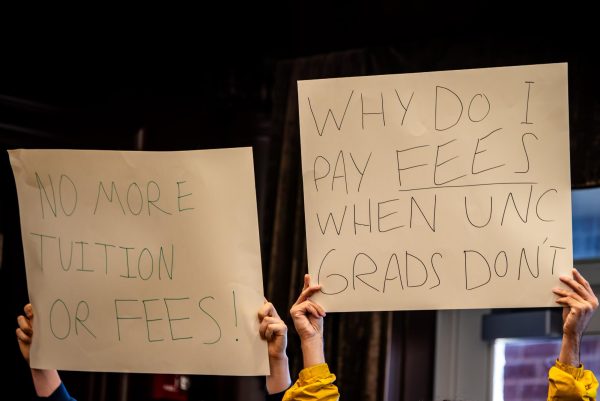
Noah Liguori-Bills, a Ph D. student in marine, earth and atmospheric sciences and one of the protestors, said he and the rest of the protesters present were representing the divestment coalition — an alliance made up of separate organizations on campus, including Students for Decarbonization, the Young Democratic Socialists of America, UE 150 Graduate Workers Union, Campus Community Alliance for Environmental Justice, Students for Justice in Palestine and the Dissenters.
“[These organizations have] this common interest of divesting money out of programs that hurt students and putting it into places that can help students,” Liguori-Bills said.
On top of protesting NC State’s investments in the fossil fuel industry, Liguori-Bills said he was protesting the treatment of graduate students on campus, particularly in response to the increase in student fees, for which he demands remediation.
“Honestly, I don’t expect that it’s going to happen in this meeting, but it is a very achievable goal in both cases, because UNC-Chapel Hill is a school that’s under the same UNC system as NC State and their graduate student union was able to win full remediation for all student fees for all graduate students,” Liguori-Bills said. “So all graduates right now at UNC Chapel Hill are fully reimbursed for student fees. And the way that they were able to do that is by building these long-term campaigns that ended in a grading strike or a grading work stoppage.”
During the Board of Trustees meeting, Liguori-Bills raised his hand to ask Carreno a question as he concluded his presentation, but wasn’t called on. In an email statement to Technician, Liguori-Bills said he intended to ask Carreno what feedback he and the Student Senate collected from the student body on the proposed fee increases.
Liguori-Bills said the nature of NC State’s Board of Trustees meetings is inaccessible, with the Dorothea and Roy Park Alumni Center being a ways away from any academic buildings, and lacks an opportunity for public comment, which was offered at his alma mater, the University of Connecticut.
“The other thing that I notice about these meetings is that, you know, we’re here, 25 minutes away from the nearest bus stop,” Liguori-Bills said. “This building is not accessible to students, and these meetings start at 8:00 a.m. in the morning, which is not accessible to anyone. Although these meetings are public in name, they are gatekept in practice.”