
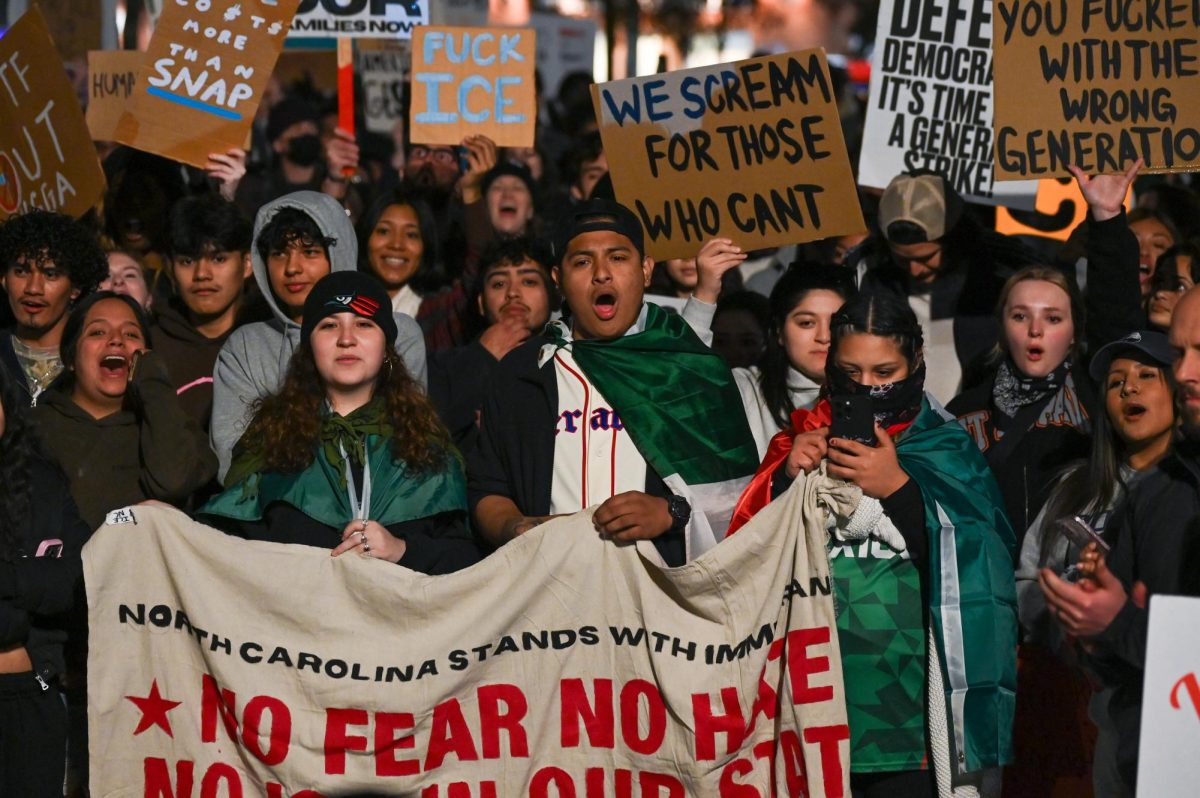
Federal immigration agents began operations in Raleigh on Tuesday, eliciting responses from local leaders, NC State community members and legal experts. The deployment follows a similar, controversial operation in Charlotte over the weekend that involved aggressive tactics and numerous arrests.
Raleigh Mayor Janet Cowell confirmed Monday night the presence of U.S. Customs and Border Protection (CBP) agents in the city, stressing that Raleigh Police are not participating in immigration enforcement efforts.
In a statement issued Monday night, Gov. Josh Stein criticized the actions of federal agents and called for peace in the city, prompting residents to record evidence and report to local law enforcement if anyone sees “something wrong.”
“Once again, I call on federal agents to target violent criminals, not neighbors walking down the street, going to church or putting up Christmas decorations,” Stein wrote. “Stop targeting people simply going about their lives because of the color of their skin, as you are doing in Charlotte.”
The Department of Homeland Security indicated over 130 people were arrested during the initial two days of “Operation Charlotte’s Web,” a federal deployment targeting individuals with alleged criminal and immigration violations. The operation’s enforcement style, according to multiple reports and videos, included breaking car windows and forcibly detaining individuals, some of whom later turned out to be U.S. citizens.
Rep. Phil Rubin, a Democrat who represents northwest Raleigh and formerly served as a federal prosecutor, was among the first elected officials to voice concern after learning of the deployment in Raleigh. He described the federal operation as unusual and lacking coordination with local authorities.
“What’s going on is not normal. I worked with federal law enforcement for years. This is just not the way that this works,” Rubin said in an interview with Technician. “Every bit of it is weird. The fact that they didn’t talk to our law enforcement and work as partners is weird. The fact they’re coming from outside — most of the federal law enforcement we would work with was based here.”
Rubin said he was concerned over the tactics seen so far, and for the lack of pushback from The Department of Homeland Security.
“Now, seeing this get way worse than anything we’d have ever seen when I was a prosecutor, and that it is tolerated by the DHS, that they’re saying this is okay for them to act that way — I just want people to know that is not business as usual,” Rubin said. “It’s not the way they should behave. Terrorizing communities is not keeping them safe. And I think that’s sort of obvious to anybody who’s paying attention.”
Rubin said federal agents are creating “an environment of fear” through their methods of operation.
“After we get through this period, we’re going to have to talk about a new relationship between the federal government and the states, where the federal government cannot abuse states in this way,” Rubin said. “It is not lost on me that what ICE is doing is exactly why the Fourth Amendment was written. Like what was happening during colonial times was that British soldiers were going and walking into people’s houses and searching to harass them to create an environment of fear.”
Rubin also placed the deployment within what he sees as a broader political strategy. Federal agents have been deployed in Democrat-led cities, such as Los Angeles, Chicago, Charlotte and now Raleigh.
“But if you look at The Department of Justice very explicitly targeting people for political reasons and basically saying that’s what they’re doing, then it’s really hard not to entertain the thought that that may be exactly what they’re doing,” Rubin said.
At the time of publication, the Wake County Republican Party has not responded to requests for comment.
Hoang Lam, an immigration attorney with NC State Student Legal Services, shared insights on how heightened ICE activity has affected the campus and local community.
“I have had U.S. citizens discussing with me about the need to carry proof of U.S. citizenship,” Lam said. “The purported purpose of the enforcement, or at least one of the purported purposes, is to locate criminal immigrants. I have not seen any substantiated evidence that those who have been arrested are all criminal immigrants. And I am very concerned that those who do not fall into that category are netted and detained in the process.”
Lam said that many enforcement actions rely on racial profiling.
“A recent Supreme Court temporary order allowing ICE to do immigration enforcement targeting immigrants based on the way they look, where they work, where they congregate, the way they speak English,” Lam said. “That temporary order, although temporary in nature, has given ICE much latitude in carrying out enforcement in a way that is really racial profiling.”
Lam advised students and community members on practical steps for safety. He recommended U.S. citizens carry proof of citizenship such as a passport at all times. Noncitizens in lawful status should carry their immigration registration documents, such as green cards or paperwork. For undocumented individuals or those without protections, such as DACA, he said the best advice is to remain silent during ICE encounters and seek legal aid.
Multiple outlets have confirmed the presence of agents around Raleigh, most notably in Southeast Raleigh and in the Crossroads Shopping Center in Cary. Lam said he heard from fellow immigration attorneys that agents had conducted operations at Grand Asia Market. He said members of multiple communities may be facing anxiety.
“I have heard from students at NC State with much anxiety as to what’s going on and what they should do to protect themselves, including those who are maintaining their immigrant statuses,” Lam said. “So the fear is unprecedented.”
Community members reported possible ICE activity through iceinmyarea.org, including several reports on NC State’s campus Tuesday. Technician investigated multiple reports and found unmarked white vans with N.C. license plates at the listed locations. The reports remain unverified.
Regarding federal jurisdiction, Rubin said federal agents like ICE and CBP do have full jurisdiction nationwide to enforce federal law, which includes immigration law.
“They do have the jurisdiction to come down here and do that,” Lam said. “What they don’t have the authority to do is violate constitutional rules. Their authority stops where the Constitution prohibits something. And so there are a lot of things they’re prohibited from doing. What we can’t do, we don’t have the power in the state is pass a law saying like, ICE can’t come here. We don’t have the authority.”
Rubin said that while the state cannot stop ICE from operating, there is hope for legislative and legal reforms down the line to better define the relationship between state and federal powers, but he said
“But again, I know that like that’s not always satisfactory because I’m talking about what we’re going to do in a few years when we fix this, and folks are like, can’t we kick them out now? And I wish that we could. And I wish that we could make them do their law enforcement in a safe, sane and public protective way. We don’t have power.”
The NC State Student Senate is preparing a resolution, the “Defend the Pack Act,” to publicly condemn the deployment. The resolution calls for university leadership to actively protect student rights and support affected students.
Warwick Arden, executive vice chancellor and provost, issued a statement to university deans, directors and department heads, saying the University is aware of and is monitoring the situation. He also reminded leaders that certain student information cannot be released without a subpoena under the Family Educational Rights and Privacy Act.
“Do not release any information about students, faculty or staff without first consulting with the Office of General Counsel (OGC) to ensure we follow university policies, state and federal laws,” Arden wrote.
Student journalism outlets, including Technician, are not required to provide immigration authorities with unpublished materials or student source information, according to guidance from the Student Press Law Center. The SPLC notes that student journalists have no obligation to voluntarily disclose notes, recordings or identities to federal agents, and that any request for such information generally requires a subpoena or judicial order.
The ACLU’s “Know Your Rights Guide” outlines legal protections for interactions with law enforcement.
Residents seeking legal or translation resources may contact the civil rights nonprofit Siembra NC’s hotline at 336-543-0353.