
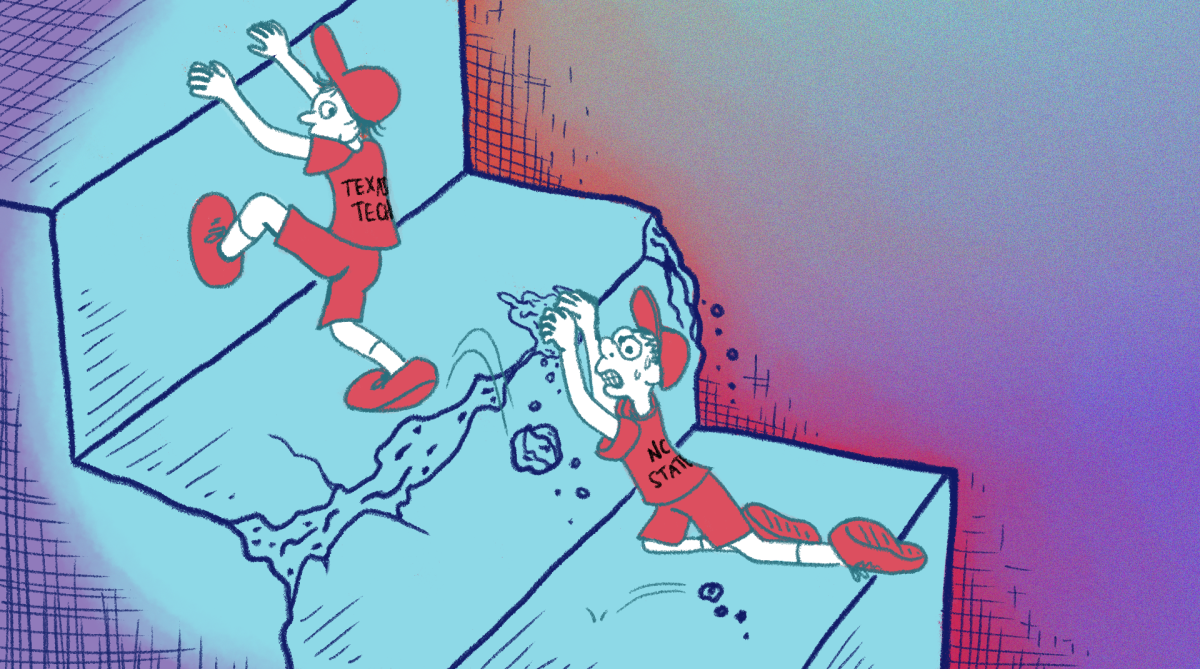
The middle class was once the safest place in college football. Safe bowls, safe jobs, safe losses. Now, it’s the most dangerous place a program can live.
In the new economy of college football, the third loss is no longer just a setback — it’s often a verdict. Under a structure reshaped by NIL, the transfer portal and an expanded playoff, there is no longer space for “good enough.” Programs are either investing toward the top or drifting toward the bottom, a separation that is happening rapidly. NC State, entering bowl season at 7-5, exists in the most unstable place the sport now offers: The shrinking middle class.
For the Wolfpack, that unstable middle has defined the entire 2025 campaign. A 3-0 start stirred a familiar early optimism, just enough promise to suggest relevance and just enough belief to keep the ceiling in sight.
But by the time the Wolfpack was pummeled in South Bend, Indiana, the path it has walked for more than a decade reappeared: competitive, capable, but removed from anything that reshapes a season. That night, I wrote that NC State didn’t just lose to Notre Dame — it quit. And I don’t use that word lightly. The score was ugly, but the body language was worse to anyone watching. Everything after that was window dressing — maintenance, not momentum.
The irony is that NC State hasn’t seen itself as a middle-class program.
“We’re one of five programs over the last four years that have won eight or more games in college football,” said head coach Dave Doeren at the 2024 ACC Kickoff. “We’ve sustained a level of competitive greatness that not many people have been able to do. With that being said, we want to win a championship. … What we did last year and the year before and the year before is good. Winning nine games is good. We don’t want to be good, we want to be the best at what we do.”
Two years later, that is the precise tension of the Wolfpack’s 7-5 reality entering bowl season. It’s not failure, and it’s not collapse. This fall, NC State beat a then-No. 8 Georgia Tech team that came into Raleigh undefeated. But it also lost to winless Virginia Tech. It’s not building toward transformation. Wins keep the floor stable, and losses enforce the ceiling.
This is where the middle class becomes most uncomfortable: When it proves it can last but not rise.
If you want to see what escaping the closing middle-class trap looks like in real time, pay attention to Texas Tech.
For the previous three years, the Red Raiders were roughly in the same place NC State occupies now. Head coach Joey McGuire went 33-17 with two bowl wins, staying competitive but not threatening the perennial elites. That ended this offseason. According to On3, the 2025 Tech roster carries a price tag north of $28 million, making the program the second-highest spender in college football behind its in-state counterpart Texas Longhorns.
The driving force? An aggressive NIL strategy orchestrated by billionaire booster Cody Campbell and one of college football’s largest NIL pools.
The payoff has been stark. Going into the Big 12 Championship on Saturday, Texas Tech sits at 11-1 and is top five in scoring, yards and turnovers both offensively and defensively. Those investments — in roster, NIL and a $242 million football center — created margin. Where many middle-class programs stagger after a few losses, the Red Raiders have all but clinched their first College Football Playoff appearance.
Texas Tech didn’t get better slowly. It didn’t wait for its moment, it paid for one — and then backed it up on Saturdays. But not everyone is candidly tickled by the pay-to-win philosophy.
“Good for them. Hell, if I had Cody Campbell, I’d be doing sleepovers at his house,” said an anonymous Big 12 coach in July to The Athletic. “‘Hey, best buddy. How can I help you?’ You sh—in’ me? I don’t blame them. If you’re gonna buy a player, buy the right one. And they bought some good ones.”
College football once worked the same way. The middle class created continuity, predictability and the illusion of upward mobility. Texas Tech has revealed that the sport no longer runs on economic stability. It runs on venture capital.
Only a narrow group of programs, fueled by billionaire donors and national brands, can play at full speed. Everyone else operates like a cautious small business, where ambition is expensive and hesitation is fatal. The divide is no longer about coaching or development, but instead about who can absorb risk and who cannot.
For those who cannot, the cost of standing still compounds quickly. Rosters are no longer built — they are leased. Breakout players become portfolio assets. Depth becomes fragile. Every developmental success becomes a retention battle. These programs function as minor-league options for the real contenders. They protect the floor. The sport only rewards the ceiling.
This is the space NC State now occupies. Not underfunded. Not overextended. But rather, structurally boxed in. Financially competitive enough to survive, but not positioned to force its way upward without a philosophical shift in how it competes. That is the defining anxiety of the modern college football middle class: security without mobility.
And this is where the burden shifts — not to the sideline, not to the stands, but to the institution itself.
On Sunday, that institutional commitment became official. NC State announced that Doeren will return for a 14th season.
“Dave has built a program that is centered on culture and player development — on and off the field,” said athletic director Boo Corrigan in a statement sent to The Associated Press. “You can see his passion for this program and the student-athletes in how hard our team plays and competes. I look forward to continuing to find new ways to support him and the football program.”
Philosophy isn’t just a game-day mindset anymore. Every middle-class program now faces the same choice: protect what it’s built, or risk everything to become what it has never been.
This is the part of the equation that no halftime speech can solve. Texas Tech did not escape the middle class because it took several years building culture and developing. It decided the middle was no longer acceptable and then aligned its financial will with that belief. The spending followed the rhetoric, and the results followed the spending.
That leaves NC State in a gray area between effort and appetite, risk and reward but also with continuity secured. The program is healthy and has been to 11 bowls in 13 years under Doeren, but it’s also stalling, going 52-47 in ACC games and averaging a recruiting rank around 40th during the CFP era. And in the modern economy of college football, stalling is not neutral. It is regressive. How much risk is the university willing to absorb for a ceiling that has stopped moving on its own?
Before the season, Doeren framed that ceiling plainly.
“I had a lot of goals when I got here, and I’ve accomplished a lot of them,” Doeren said. “But there’s still meat on the bone. 10-plus wins, winning the ACC, being in the playoffs, these are all things that I think — and know — that we can do with the right players and right staff.”
It was aspirational then but it is a diagnosis now.
This season revealed exactly how much meat still remains and also how little of it was actually within reach under the NIL model. That tension is now structural. It belongs less to the head coach than to the people who determine how aggressively this program is allowed to compete in the new economy.
In today’s college football economy, belief without aligned investment is no longer ambition — it’s limitation. And the quiet truth facing the Wolfpack is this: The middle class no longer affords programs the luxury of deciding when they’re ready to rise. It moves on without them.