
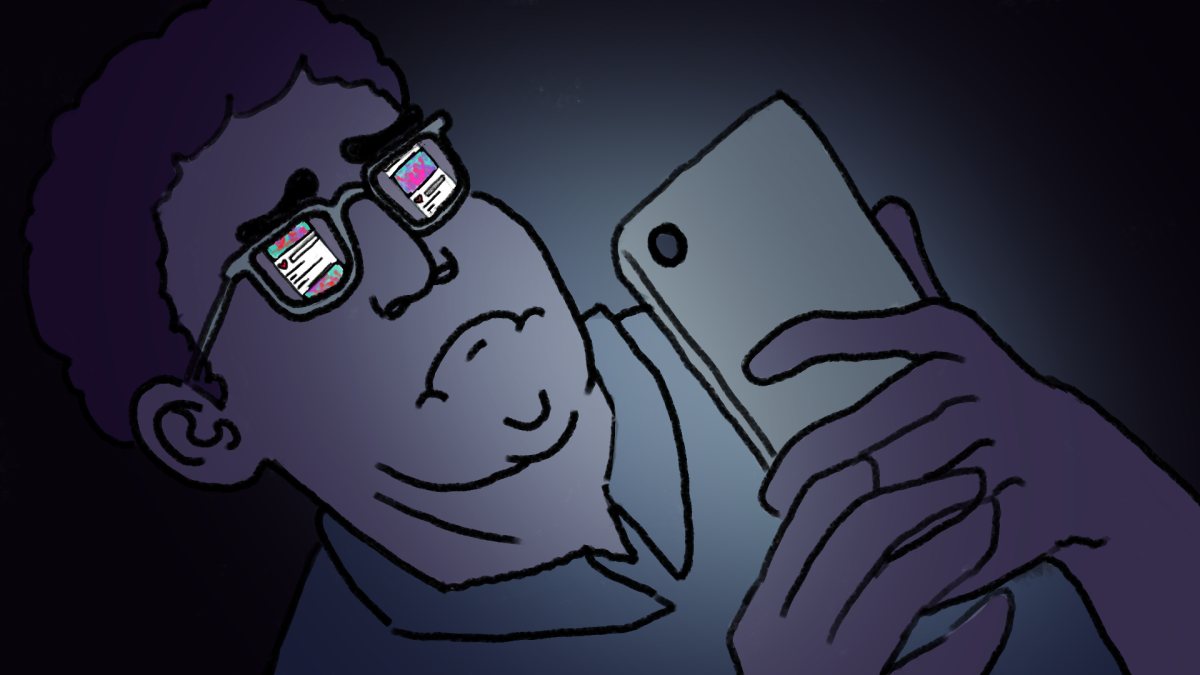
The growth of social media is causing students of all ages to adopt an asynchronous form of communication, which experts say makes connections less impersonal and influences their social identity. This technological form of communication could have major implications for how students connect and create relationships.
Tugce Ertem Eray, an associate professor of public relations, said the digital age is making people lose sight of the importance of face-to-face communication.
“We lose the interpersonal communication skills because we’re losing the face-to-face interactions. When we had the face-to-face interactions, we could interpret the nonverbal cues, because nonverbal cues are really important in interpersonal communication,” Eray said. “Like the tone of voice, the facial expressions or the body language. But, these are essentially helpful for creating empathy or for conflict resolution.”
Aleena Biswas, a third-year studying electrical and computer engineering, said without face-to-face interaction, it’s impossible to read nonverbal cues and body language, thus leading to a greater chance of miscommunication.
“It’s hard to read what people are thinking on the screen. You don’t have the face-to-face conversation, and that’s the best thing that helps during conversations that are really dense,” Biswas said. “And the thing is, because they are behind the screen, I think they’re a lot more confident that they won’t get backlash.”
Asynchronous communication is any communication where the sender and receiver are not communicating at the same time. Eray said this form of communication is the root of some students’ mental health struggles.
“With the asynchronous communication… [students] become more depressed because they feel more socially disconnected. And the depression makes them less interested,” Eray said. “So it’s kind of a circle because you feel you don’t have the communication channel, and you feel depressed and you feel lonely, disconnected. And then, because of the depression, you don’t connect with people.”
Eray said that because of this shift in communication styles and loss of face-to-face communication, students have lost the necessary skills to be empathetic, making them lonelier.
“We’re disconnected from each other, we don’t engage. And because of that, we don’t have those spontaneous conversations that we used to have…or we’re not feeling that we belong somewhere, because of that,” Eray said. “We feel lonelier. And that’s why we cannot develop empathy; we cannot create skills.”
Negativity is rampant on social media. Biswas said students have trouble expressing opinions in-person because of the fear of being judged or having altercations with others because of their opposing views or opinions.
“When someone says something on the other side of the aisle that you don’t agree with, how do you not just scream? It’s not a screaming match, it’s not a debate. It’s a conversation,” Biswas said. “No one’s right or wrong. We’re just saying what we believe. And I think people don’t understand that there are two sides to [a conversation], or there’s not just two actions. There are multiple sides to a conversation.”
Biswas said conversations online allow people to hide behind their screens and promote negativity.
“[Conversations online] get heated really fast. For no reason, people will be like, ‘you dumb idiot,’ cussing them out for saying one little negative, biased thing that maybe wasn’t 100% true,” Biswas said. “It gets from zero to 100 really fast.”
Humans are social creatures by nature, learning from and adapting to each other. Eray said, without the basic socialization between humans, there is nothing to be discovered.
“We shouldn’t put aside how important face-to-face interactions are. As human beings, that’s how we grow. We need to learn from each other. We need to communicate with each other, and we need to form relationships with each other,” Eray said. “If we rely on these technologies too much, we’re not using those opportunities that the face-to-face interactions create.”
Biswas said things online are not always what they seem, rather they are a carefully crafted algorithm that feeds the user exactly what they want to see.
“You can never really acknowledge that you have these conversations with people face to face… It’s just the algorithm finding the things that you want to see, and you’re finding the people that you agree with online,” Biswas said. “If you listen to [others] stories and you listen to what they have to say… that is really who you are.”
Eray said that in her classroom, she encourages students to leave the technology at the door and instead be present in the moment.
“One thing I tell my students is to come to the class and then put their phones away. Like, it’s okay not to look at your phones for 45, 50 minutes. Just be present here. Enjoy these personal interactions that we have,” Eray said. “Enjoy these real-life discussions that we’re having in the classroom. It’s 30 minutes, maybe 45 minutes, and then you can go back to your phone. That’s okay. But when you’re in the classroom… just enjoy this.”