Artificial intelligence is being used to aid university admissions decisions and often the writing of academic essays. As AI tools like ChatGPT, Gemini and OpenAI evolve, experts say the necessary skills needed to develop academic writing are at risk.
Alice Cheng, an associate professor in the Department of Communication, said AI has some useful benefits like proofreading and summarizing large documents, but if used too often, it could cause vital writing and critical thinking skills to be weakened, or even lost.
“You could use the AI for proofreading and polishing of your articles or your writing… If you rely on the AI for writing always without your own creative thinking and writing skills trained, then you’re going to fully rely on AI for writing, and your own writing skills cannot be practiced,” Cheng said. “We have to pay attention to academic integrity, authorship, originality, transparency and disclosure. That’s all the things that could help us to identify that we’re using AI for support, or we’re using AI heavily or fully relying on it.”
Lauren Land, a second-year studying history, said AI has changed how students think about academic writing.
“[AI has] changed the way that everyone thinks about writing because, now, someone can put a prompt into AI and get an outline or an essay; it just changes how someone might go about their work,” Land said. “It does have benefits, like checking grammar and things like that. But overall, you lose the ability to think rationally for yourself.”
Land said AI has decreased the quality of students’ academic writing.
“I think [AI] is already showing a decline in people’s ability to think for themselves and be able to write an argumentative essay for themselves,” Land said. “Taking the time to do the hard things and actually thinking. Sometimes it’s annoying, but it’s not gonna hurt you.”
Cheng said AI can be a helpful tool to complement a student’s work, but the students must create the work first.
“How can the AI complement the humans’ work? And how can humans monitor decision-making in the AI-human communication loop,” Cheng said. “To steer, play an important role in decision-making.”
NC State has no single, University-wide rule against the use of AI and generative AI tools like ChatGPT, Grammarly and Gemini.
Cheng said AI is unreliable and often produces sources and references that are not real.
“I have lots of students who rely on AI for generating or referencing their sources. And some of them do not really look at their paper, [they] just use it based on an AI recommendation, and then copy and paste the reference there,” Cheng said. “However, those references are fully fake, and they are wrong … students need to go to the original source, and they have to think about the original source and read and think and reflect inside instead of fully relying on AI to provide a simple reference.”
Cheng said AI in academic writing isn’t a bad thing when used correctly.
“AI, in academic writing, is absolutely valuable when it enhances learning and thinking, but problematic when it replaces student agency and responsibility and intellectual effort,” Cheng said.
Land said AI can have some benefits, especially at a STEM university, but restraint and regulations are needed.
“There are a lot of good things that AI can do, especially in the STEM fields,” Land said. “I would say [AI should be] regulated more. In actuality, it should have been regulated across the board a long time ago, not just by academia.”
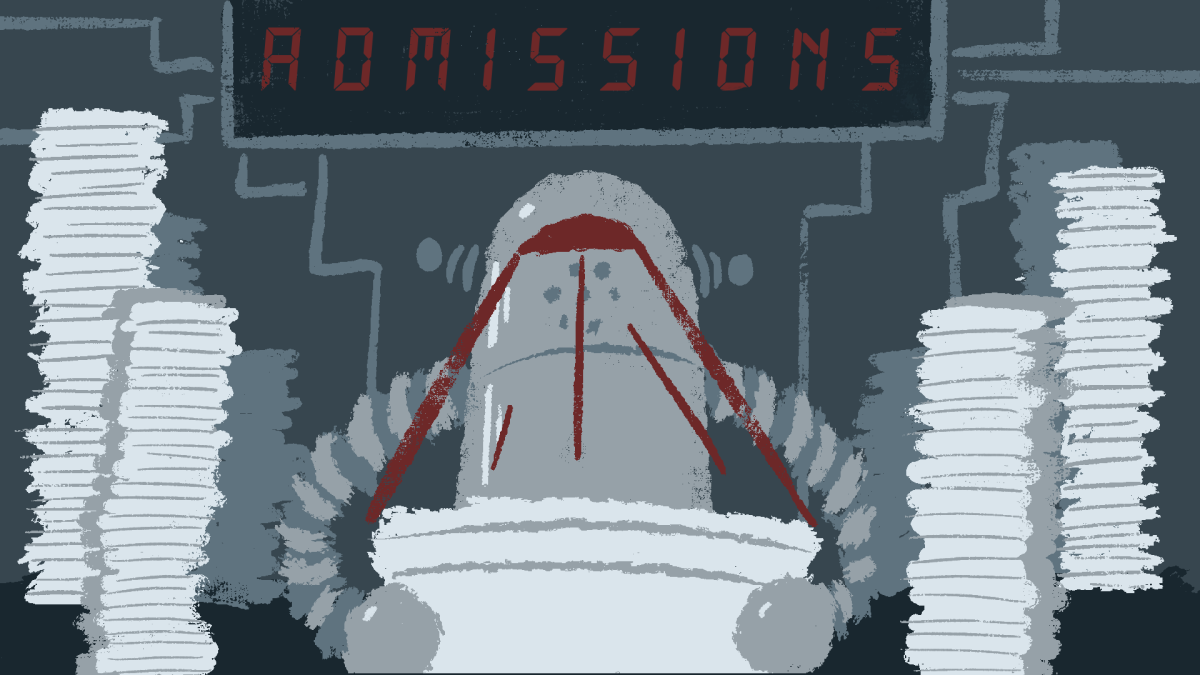
Artificial intelligence is everywhere within academia, including in University admissions.
In an email statement to Technician, Don Hunt, Senior Vice Provost of enrollment management and services, explained how NC State uses AI as a tool during the admissions process. He said AI supplementary, but an admissions professional makes the final call.
“At a high level, NC State’s use of AI in admissions is focused on supporting process improvement and operational efficiency,” Hunt said. “Admissions decisions themselves are made by our admissions professionals.”
The University Records Office would not further disclose what AI tools are used in the aid of admissions when Technician inquired via the University’s public records request.