
Artificial intelligence might feel like a distinctly recent topic, but for some academics, the fears shadowing today’s chatbots have been alive in literature for centuries.
“I think one thing people have been very busy doing forever, it seems like, is trying to insist upon a definition of humans that separates us from other things,” Timothy Stinson, an associate professor of English who studies medieval literature, said.
For Stinson, that anxiety long predates computers. He traces it back to questions about humans and animals, from biblical and classical stories to medieval monster tales where wolves talk, corpses walk and boundaries between human and nonhuman keep breaking down.
“If we’re just animals, it upsets our notion of ourselves as created in an image of God and having souls which people think animals don’t,” Stinson said. “ … If we’re just another type of mammal, furthermore, we came from mammals, then what about us being created in the image of God and so forth?”
That unease resurfaced when Charles Darwin challenged Victorian ideas about human uniqueness, Stinson said, and it echoes again when people watch AI write poems, draw images or imitate therapy sessions.
“One of the reasons AI is so disturbing to a lot of people is that some of those markers that we have of humanity and that we code are entirely not technical, such as speech-apparent thinking — it’s not exactly what’s happening,” Stinson said. Can AI write poetry? Can AI play chess? Can AI produce visual art? These are things that we see as quintessentially human.”
Stinson said he sees a throughline from medieval monster stories to modern AI debates in how they treated anything that crosses a “category boundary,” whether between human and animal, living and dead or human and machine.
“Anytime you do that, people become anxious and there’s a lot of persecution, usually,” Stinson said. “And that’s what I mean when I started this by saying, I think that this AI is frightening to a lot of people because it’s crossing this boundary into the human that it shouldn’t be able to. There should be this clear delineation between the machine and the human.”
Paul Fyfe, a professor of English who works in both 19th-century British literature and digital humanities, tells his students that AI’s roots run at least two centuries deep.
“The goal is in some ways to recast the history of artificial intelligence as not just a product of ChatGPT in 2022 or even Google’s transformer technology in 2017 or even coincident with the computer era starting from Turing but farther back, even before computers,” Fyfe said. “My argument to students is always that technology does not create our history.”
Fyfe charts a “200-year genealogy of representations of machine intelligence in literature,” starting with Mary Shelley’s “Frankenstein” and running through Victorian fiction, early 20th century stories and contemporary AI narratives in his senior seminar “Humans, Machines and In Betweens.”
Fyfe teaches Thomas Carlyle’s 1829 essay “Signs of the Times,” which described Britain as living in a “mechanical age,” reshaping how people work, feel and even think.
“He argues that men are grown mechanical in hand as well as in heart, which is to say that mechanization is something to do work, but also a kind of state of mind,” Fyfe said. “He was really worried about this. You start seeing this in wondering if how our brains work are also potentially material or mechanical or subject to a set of repeatable processes, or if all we are is like a bunch of sensations and language and meat and electricity.”
Fyfe said 19th-century readers were already wrestling with several ideas that still structure AI debates today. One is automation and replacement, fears that machines will take over and leave workers behind, which he links back to the original Luddites, textile workers who destroyed machines in the early 1800s.
Another is what Fyfe calls the “anthropocentrism by which AI is defined,” which is the assumption that machine intelligence should be judged on how closely it resembles our own.
“Why should it be so? Why should machine intelligence always be measured to the degree that it resembles ours?” Fyfe said. “You can also go back to Frankenstein; why does he decide, ‘I’ve learned the secret of how to animate matter and I’m going to start by making a man.’ No, you don’t. You start with frogs, you start with rats. But no, there is this persistent anthropocentric interest in, how is it like us? Or how can it imitate us?”
John Kessel, a retired professor of English and creative writing who has taught science fiction at NC State for four decades, said it is nearly impossible to teach science fiction “without running into the concept of the intelligent robot.”
Kessel said “robot” comes from a 1920 play entitled “R.U.R. (Rossum’s Universal Robots)” by Czechoslovakian writer Karel Čapek.
“It raised the issue of right away the idea that artificial intelligence or intelligent robots, humanoid robots, could they, are they human? How do we know what makes something a human being? Do they have emotions, or are they just simulations? And then in the end, what is our relationship to them? Are they servants or are they a threat?” Kessel said. “Really, this idea that we might create intelligent machines that may replace us has been around a long time.”
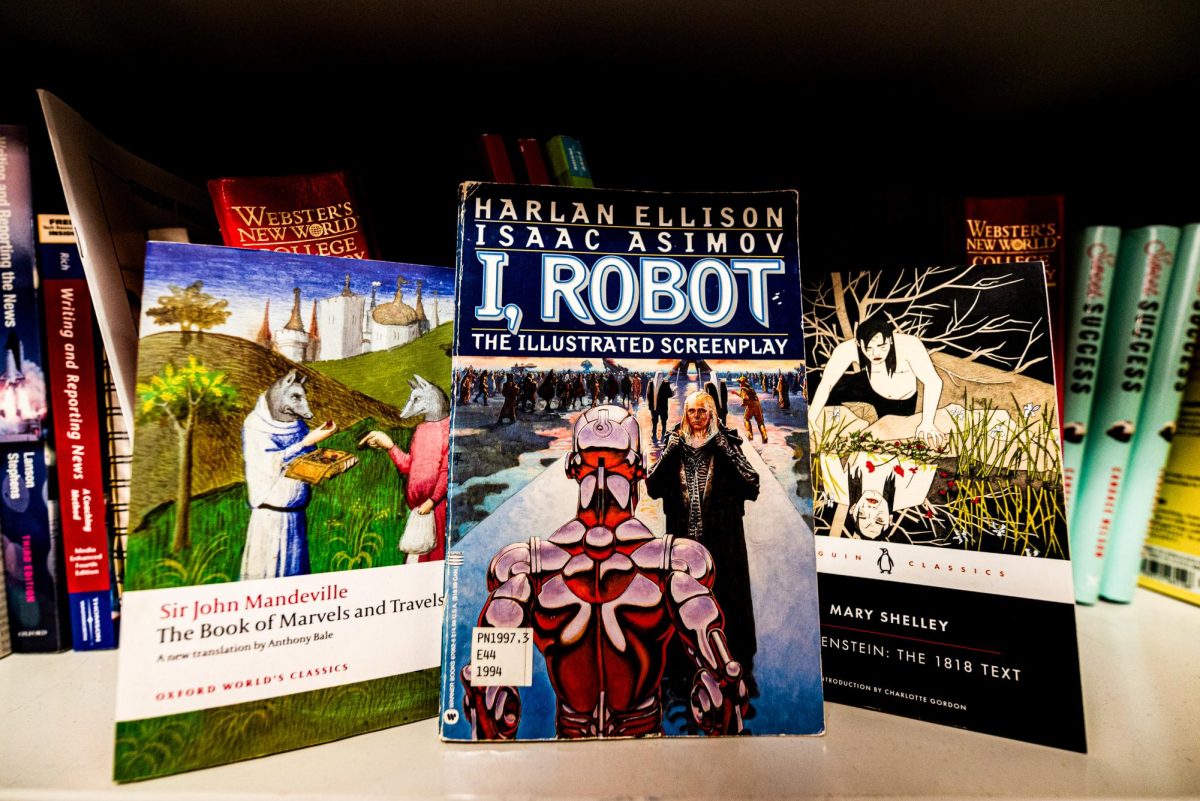
From Čapek to Isaac Asimov’s “I, Robot,” Kurt Vonnegut’s “Player Piano,” William Gibson’s “Neuromancer” and Harlan Ellison’s “I Have No Mouth and I Must Scream,” Kessel said science fiction has long used AI to ask questions about labor, autonomy and power, using robots and AIs to depict real-world situations without invoking other topics.
“I think a lot of the issues in human history that have been associated with slavery and enslavement are [that] science fiction enables you to engage with those issues without having to deal with, say, racial issues,” Kessel said. “You just put it in terms of a robot and then what questions arise from that? So that I think in a way, science fiction often is a way to try out ideas in a way that gets us away from the social issues that we have connected with them. And it makes us able to about them abstractly, but the issues are still the same.”
Kessel said Asimov tried to imagine a world where robots could never harm humans through his “Three Laws of Robotics,” then spent much of his career writing stories about how those laws might fail. In the final story of “I, Robot,” “The Evitable Conflict,” Asimov imagines vast machine systems quietly steering the global economy.
“What they discover is that this AI that’s running them all is following the first law (a robot must not injure a human being), but has interpreted it in terms of the human race,” Kessel said. “The robot is doing what’s best for the human race as a whole, but that involves sometimes doing things that will harm individuals.”
Kessel said that tensions feel close to real-world debates about AI in healthcare, policing, social media and war.
“If we do have AIs that reach artificial general intelligence and we give them power over various things, even if we try to program them so they can’t do negative things or destructive things, to what degree can we, do we control that?“ Kessel said.