
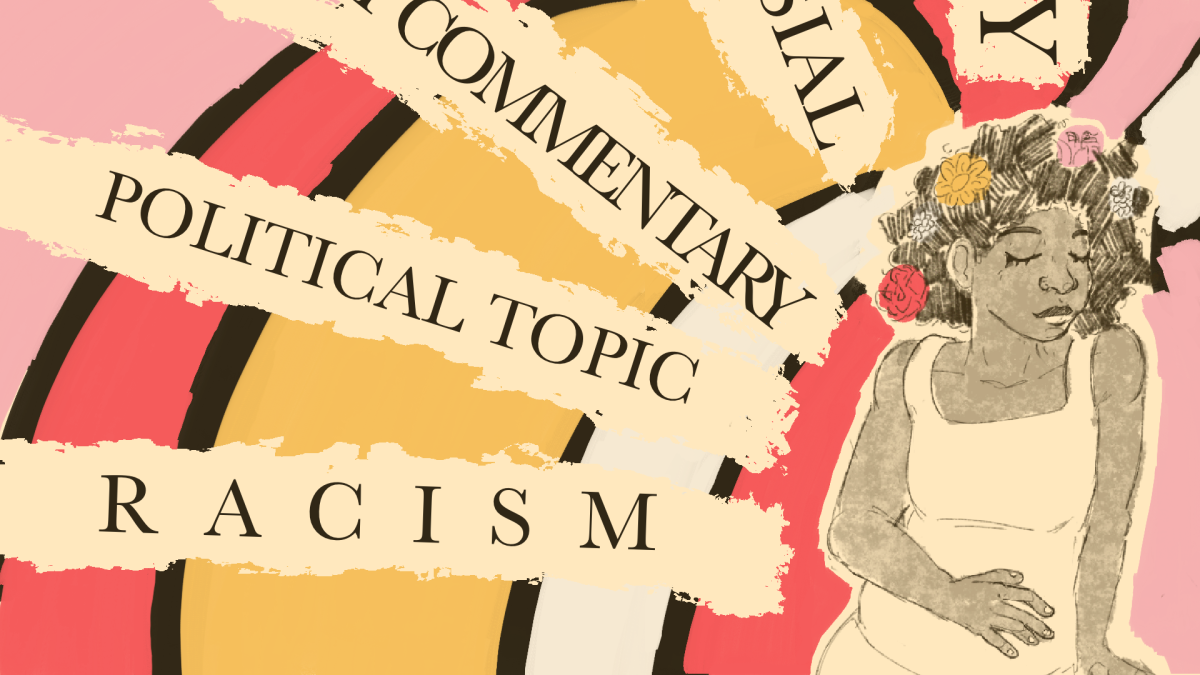
Self expression for Black Americans comes more socially and politically loaded than it is for others. Their expression often hinges on the responsibility of tying themselves to a political agenda in order to navigate and cope with an unjust world.
The historical connection between racism and Black history has led to the politicization of Black identity, but Black individuals should not be pressured into becoming a symbol for equality. That risks reducing them to one.
W.E.B Du Bois’ theory of double consciousness describes how Black Americans often see themselves from two conflicting lenses: their own, informed by their presence within their racial communities, and via the expectations and prejudices of a racist society. These expectations shape how Blackness is understood through whiteness, and sets a standard on how it should be performed.
Kerra Bolton, writer and award-winning filmmaker whose work is centered on race, memory and legacy, reflected on her experiences with double consciousness when she was younger.
“There was this notion that if you were excellent, if you got good grades and you conformed around societal expectations, then your excellence would protect you from racism,” Bolton said. “There was an added psychological pressure that you had to be better … I ended up becoming a perfectionist and I felt like there was no room for experimentation.”
Nobel Prize winning author Toni Morrison shared about an experience exclusive to Black writers in her book, “Playing in the Dark: Whiteness and the Literary Imagination.”
“Whether they were wholly uninterested in politics of any sort, or whether they were politically inclined, aware or aggressive, the fact of their race or the race of their characters doomed them to a ‘political-only’ analysis of their worth,” Morrison wrote.
Morrison calls out a persistent yet hidden aspect of the Black experience. Society imposes an internalized colonial mindset onto Black individuals by interpreting Black identity from a purely political lens instead of a personal or creative one. This forces Black Americans to become symbols of racial narratives instead of allowing them to frame their identities on their own terms.
Bolton said that it took her a long time to grow out of this toxic mindset she was pressured into to reclaim her sense of identity and purpose.
“I thought that it was up to me as a smart, Black, young person … to improve the community,” Bolton said. “That’s a lot for one person. That’s a lot for 400 plus years of history. So I just was like, let me just do what I can in the spaces where I can, and that’s enough. I don’t have that responsibility because it’s not mine to have.”
Being a community symbol is a commendable role to take on. We cannot downplay the massive role advocacy has played in making society acknowledge and combat racial discrimination, but we still have a long way to go. Consequences of the past still linger through systematic racism.
Part of the problem is that we may be settling for less. We believe that acknowledging the past equates to progress. When we openly discuss and confront racism, it manifests in subtler ways, such as normalizing expectations based on preconceived notions.
While it is incredibly important to reflect on and honor the past, we can only go so far with having these conversations without remaining stuck in Black trauma in the name of progress. Black History Month is an opportunity for policy and systemic change.
Bolton explains that we have reached a point where we must move on to making use of what we have learned from Black history through community building to better dismantle systemic racism.
“There are amazing Black people just walking around and no one ever acknowledges them,” Bolton said. “If you can’t name a Black friend or coworker who has made your life better or who you respect, then maybe you should do that instead of worrying about the past.”
Black History Month is a time for us to recall and rethink how we understand and tackle racism. We need to move beyond performative acknowledgment and recognize what ways we may be able to remember the past and learn from it without living in it and expecting the Black community to do the heavy lifting.
Instead of placing the responsibility only on Black individuals by expecting them to be tied to an agenda, we should share the responsibility as a society by challenging biases. We should create spaces where Black identity is not reduced to social issues instead of personhood.