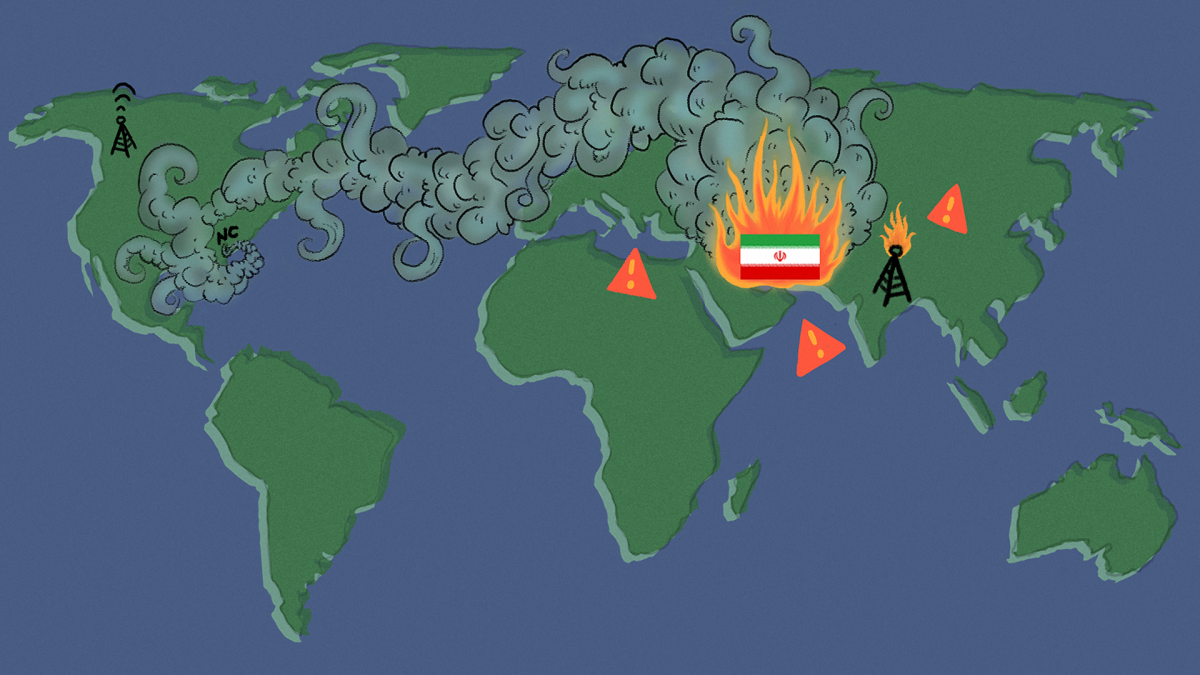
NC State is home to thousands of international students, including those whose home countries are involved in international conflicts and targeted legal restrictions by the Trump administration. Iranian students are faced with the challenge of balancing their academic and everyday lives while monitoring and worrying for their loved ones across the world.
Communication limits
Shadi Hajiabbaszadeh, a second-year studying electrical engineering, grew up in Iran and has been living in the United States since 2023. She has visited home only once since, and all of her family, friends and connections remain in Iran. Since Israel and the U.S. started bombing Iranian cities on Feb. 28, contact has been limited.
“The first thing that happened, and the first thing that everyone expected to happen, was the internet to go off,” Hajiabbaszadeh said.
As of March, the only way to contact Iranian civilians is by phone calls coming out of the country, which civilians must pay the government for and are presumed to be monitored. Hajiabbaszadeh said many people in Iran are already in tough economic situations, so the expensive calls are not feasible.
While they used to video chat often, Hajiabbaszadeh now waits to get limited calls from her parents.
“I did not notice how this, just like seeing my family, video calling them, was such a big part of my day until it was taken away from me. Every day, I’m just waiting for their call just to hear their voice,” Hajiabbaszadeh said.
Hajiabbaszadeh said the stress of worrying about her family impacts her every day. The uncertainty of the situation and limited contact mean that a scheduled call is the most important part of her day and the source of anxiety.
“When they don’t call at the usual time, I literally cannot do anything. The only thing that I can do is sit down. I cannot study. I cannot eat. My thoughts start racing, and I would think of the worst thing that can happen to them,” Hajiabbaszadeh said. “It’s just a lot to think about and worry about on a daily basis.”
Political turmoil
The political situation in Iran is not simple. The Islamic Republic of Iran has been the functioning government since 1979, with three branches and an executive leader. The theocratic system holds regular elections, however they are not considered fair, and the Iranian people have long expressed discontent, resulting in widespread protest movements nearly every year.
In January 2026, millions of Iranians protested on the streets of the capital city, Tehran, in the largest mass movement in 30 years. In the span of two days, the Iranian government killed over 30,000 civilians in an effort to suppress the uprising, according to TIME.
“[Iran] is one of the countries where the people and the government are very different from each other, right? The gap has just been growing throughout the years,” Hajiabbaszadeh said.
Another Iranian student, currently completing an internship in Raleigh, spoke on the condition of anonymity out of concern for safety. They said there are many mixed opinions about the ongoing war being waged in Iran. Hatred for the oppressive government means that signs of its fall, such as the killing of Supreme Leader Ayatollah Ali Khamenei by U.S.-Israeli strikes in February, are also signs of a brighter future.
“How can you be sad? They are the worst human beings. They are cruel. But at the same time, it’s your family there under attack, under bombing,” the anonymous student said.
The U.S.-Israeli strikes began in February and have continued through March, though the explanations for U.S. involvement in the region have been unclear. Some attacks have raised concerns about civilian harm. On Feb. 28, the U.S. hit an elementary school, which resulted in the deaths of 168 people, according to Amnesty International.
“When innocent people are being bombed, I’m worried, of course. President Trump is saying we will target the power plant, unconcerned about my families, my friends and my people,” the anonymous student said.
Still, the student said they maintain faith in the president’s ability to control the situation and hope he will put an end to the regime. That hope, they said, is the only thing that makes the situation bearable.
“Maybe I’m so naive, I don’t know, maybe I’m stupid. But this hope makes me feel alive,” they said. ”If I don’t have this hope, I have nothing. I just hope that this government goes.”
Hajiabbaszadeh said watching the news unfold in Iran has been difficult, and her feelings about the current war are also complicated, fueled by dissatisfaction with the U.S. government, desire for the end of the Islamic Republic and fear for her loved ones.
“You cannot just sit there and see your city on fire and be happy,” Hajiabbaszadeh said.
Visa concerns
Effective Jan. 1, President Trump fully suspended travel from nineteen countries, including Iran, meaning immigrants and nonimmigrants are not permitted to enter the U.S. These same countries are also subject to a pause by the U.S. Citizenship and Immigration Services, in which the department stopped processing any changes in visa status.
These legal changes mean that students can no longer be granted status as workers in the U.S., and they also cannot leave and come back. Since Jan. 21, the Department of State has also stopped issuing new visas for Iranian nationals.
Hajiabbaszadeh said she has stopped applying for internships because she would not be able to work without a new visa. For students graduating and entering the workforce, they are in a much trickier situation.
“It’s very stressful for many people because with the war going on and with the loss of their status, they cannot go back home, but they cannot really go anywhere,” Hajiabbaszadeh said.
Moving forward
Hajiabbaszadeh said, above all, Iranians just want to live their lives under a peaceful government. The war is the result of years of suppression and international tensions, and it is not the will of the people it is impacting most.
“If we had a normal democratic government, which is something we all hope for, this didn’t even need to be a thing. This whole conflict and war, this is just something that was forced upon Iranian people,” Hajiabbaszadeh said.
Information about negotiations between Iran and the U.S. has been unclear, with contradictory information coming out of the U.S. government. The frustration and worry are a constant part of life for these students and anyone with loved ones in Iran and will be until the conflict is resolved.
“You would see literally one street away from your house being attacked, and you cannot call and see if your parents are alive,” Hajiabbaszadeh said. “That’s just a constant fog with me, and on a daily basis, it just drains me. You have to just constantly be worried, and there’s absolutely nothing you can do.”
Hajiabbaszadeh said being a part of the Iranian Student Association was vital to her transition into life at NC State and that she has continued to rely on it.
Maintaining a support network has been essential for these students to have an outlet. The anonymous student said they are coping with the lack of contact with family by seeing Persian friends regularly.
“It’s taking off so much pressure. At least we come and talk together, we discuss what’s happening on the same day, and at least we cry together. It’s better than nothing,” the anonymous student said.