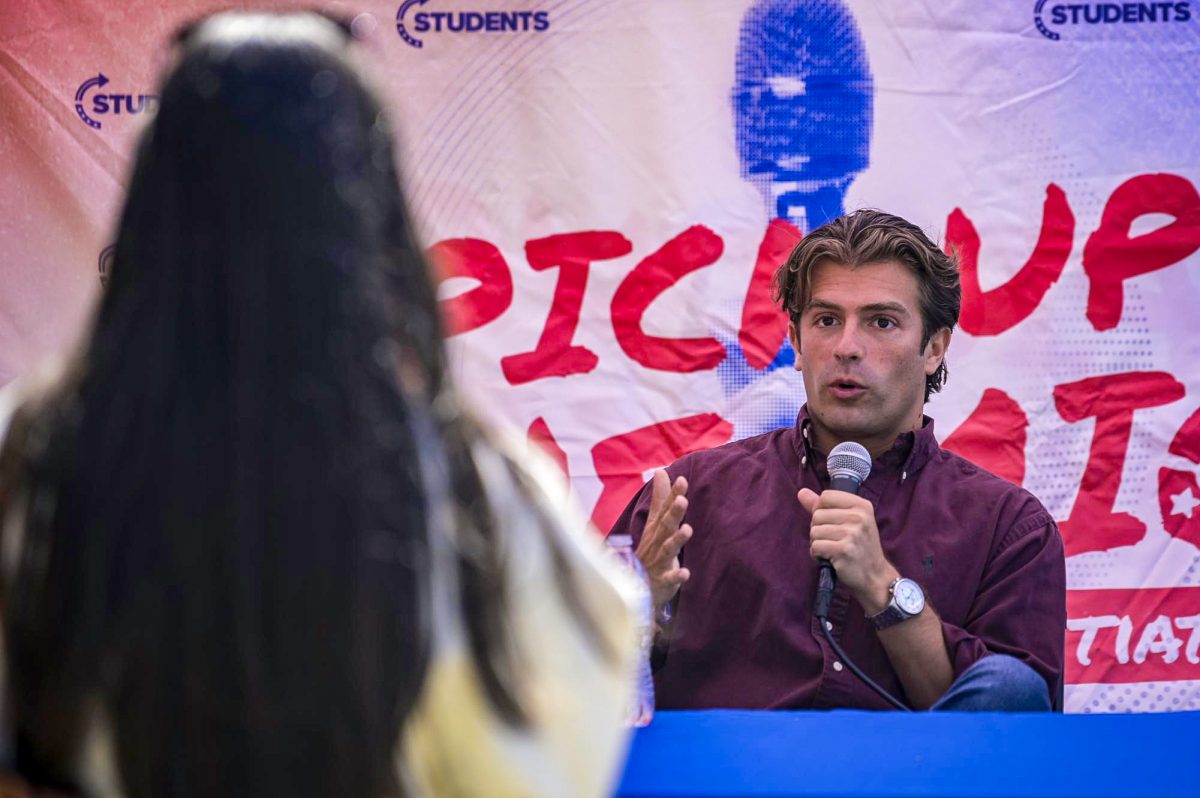
Students and community members gathered on Harris Field Monday morning as NC State’s Turning Point USA chapter hosted conservative commentator Will Witt for a “Prove Me Wrong” debate, inviting attendees to challenge his views on a range of political and cultural issues.
The event, part of a format popularized by Turning Point USA speakers like Charlie Kirk, allowed students to step up to a microphone and debate Witt directly on topics including diversity, equity and inclusion, religion in government, U.S. foreign policy and the death penalty.
While several students challenged Witt’s positions, some attendees said the audience seemed more supportive than oppositional, shaping the tone of the discussion.
The conversation opened with a dispute over diversity, equity and inclusion. Witt said he believes DEI is “racist” and argued that it pushes universities and employers to judge people by race rather than merit. He linked that view to affirmative action, saying such policies suggest Black and Hispanic people are not as smart as white and Asian people and give some students an artificial “leg up.”
Abbott Sherwin, a third-year studying electrical and computer engineering, who questioned Witt, pushed back, arguing that DEI is meant to account for broader context, not simply hand out advantages based on race.
Witt did not move from that position.
“Right, but we’re not talking about a holistic view. We’re talking solely based on people’s race,” Witt said. “That is what it was. That’s why they lost. That’s why it’s no longer happening. Because it was racist. Because it was saying ‘White people, Asian people, you are scored lower solely based on the color of your skin.’”
Danny Schiff, a first-year studying business finance, told Witt that he believes “there should not be a separation between church and state.”
“My belief for a government system is that their primary purpose is to enforce moral laws,” Schiff said. “Because my morality in particular comes from religion, it is impossible for me, as a tax-paying citizen, to separate my moral beliefs that come from the church from what I want implemented in the government.”
Witt said he partially agreed with Schiff’s perspective while emphasizing the importance of religious freedom.
“I do believe in the fact that anyone with any religion should be able to practice it in the United States,” Witt said.
The event also touched on the political climate around Israel and Palestine. Witt said he is not a strong supporter of Israel and believes the United States spends too much money on backing the country. He said he opposes a war with Iran and thinks America should focus on domestic problems before engaging in more overseas conflict. Witt said he took issue with a student saying “Free Palestine,” as he argued that such calls often amount to supporting the destruction of Israel.
“When people say ‘Free Palestine,’ it usually means like a death to Israel, a disillusion of the state of Israel and all death,” Witt said.
The student, who identified as Syrian, pushed back, saying Palestinians face discrimination and illegal occupation and that calls to free Palestine are about freedom, not violence.
The exchange grew tense when Witt said Palestinians were “not the best culture over there in the Middle East,” then later said, “America is the greatest culture in the world.”
Witt was also asked about his opinions on President Donald Trump and said he holds a “lukewarm” view, though he supported Trump in the 2024 election.
“I think the biggest thing is probably the fact that he gave so many people a voice who didn’t have a voice before,” Witt said.
Witt also pointed to what he sees as unresolved issues surrounding the investigation into the Jeffrey Epstein files, saying he wants greater transparency.
“One of my biggest gripes is with the Epstein files,” Witt said. “I really wish that [Trump] would investigate the people in the Epstein files.”
Sherwin interjected, saying, “Like himself?,” arguing that Trump’s past associations with Epstein were already publicly known before the 2024 election. Witt said he had not seen sufficient evidence of wrongdoing.
“There’s no substantial proof of anything like that with Donald Trump,” Witt said. “If that came out, here’s what I’ll say, let me think. If something about Donald Trump were to come out in that way, I would be first in line to say the exact same thing, as you should be investigated just like any of these other people.”
After his time at the mic, Sherwin said he felt the DEI discussion did not fully reflect what he had wanted to talk about. He said he felt “tripped up” by the subject and that he would have preferred to focus on “actual current issues.” He also said DEI is “kind of beating a dead horse” and may not affect as many people as some conservatives suggest.
Sherwin was also skeptical of the format itself. He said he did not think the event was truly designed to change minds.
“I feel like the point of these things is presented as changing people’s minds, ‘prove me wrong.’ But I feel like the actual point is to get clips to put on TikTok and ‘own the libs’ or whatever,” Sherwin said. “Sometimes I kind of feel bad if I participate in that kind of thing. I don’t really think his goal is to change my mind. I don’t really think he was particularly open to having his mind changed.”
Sherwin said that many of the people in attendance already seemed to support Witt, which made the event feel less like a genuine debate and more like a performance. He said he wished more students with opposing views had shown up to push back.
Schiff said he appreciated the opportunity for open discussion.
“I think it’s great for inviting open conversation onto our campus. Unfortunately, we live in a society where disagreement is a huge problem,” Schiff said. “And rather than trying to talk about that and find equal grounds and respect people for being humans, we just belittle people down to their opinions and target them for that. I think we have so much in common as a human race more than we do not in common.”
Paul Lewis, a third-year studying mechanical engineering and vice president of the chapter, said the event’s primary goal was to have meaningful discussion.
“The stuff you see that goes viral is, of course, people with very different viewpoints who come and just like to troll and do stuff like that,” Lewis said. “Obviously it’s going to garner social media attention because it’s funny, and that’s not the main goal. That’s what goes viral, but the main goal is to have a real discussion.”
Beyond the discussion itself, the event spawned broader considerations around safety and political discourse on college campuses. In September 2025, Turning Point co-founder Charlie Kirk was assassinated at Utah Valley University at a similar “Prove Me Wrong” event.
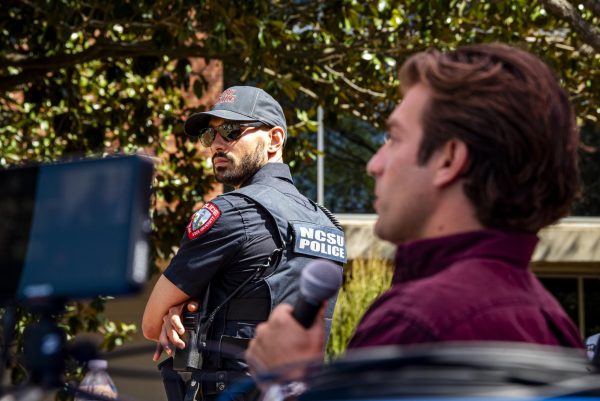
Lewis said Turning Point worked with the University to plan for security. Conversations included coordination with multiple departments and discussions about emergency response and crowd management.
The chapter also considered how to handle potential protests. Rather than separating demonstrators, as offered by university security, Lewis said they prefer allowing direct engagement.
“We want our protesters to be able to come speak to us because it’s always possible that maybe their idea is right and they just need to voice that opinion, and voicing it from an enclosed box from across the field is not a viable option,” Lewis said.
The event included an unarmed “private security team” deployed by the national organization and a handful of NC State police officers.
Lewis said the goal was to create a space for conversation at a time of heightened political division.
“Where conversation or discussion ends, violence begins,” Lewis said. “ … the reason that you have to have these common ground events is to show each other that we agree on so much more than what we disagree on.”