

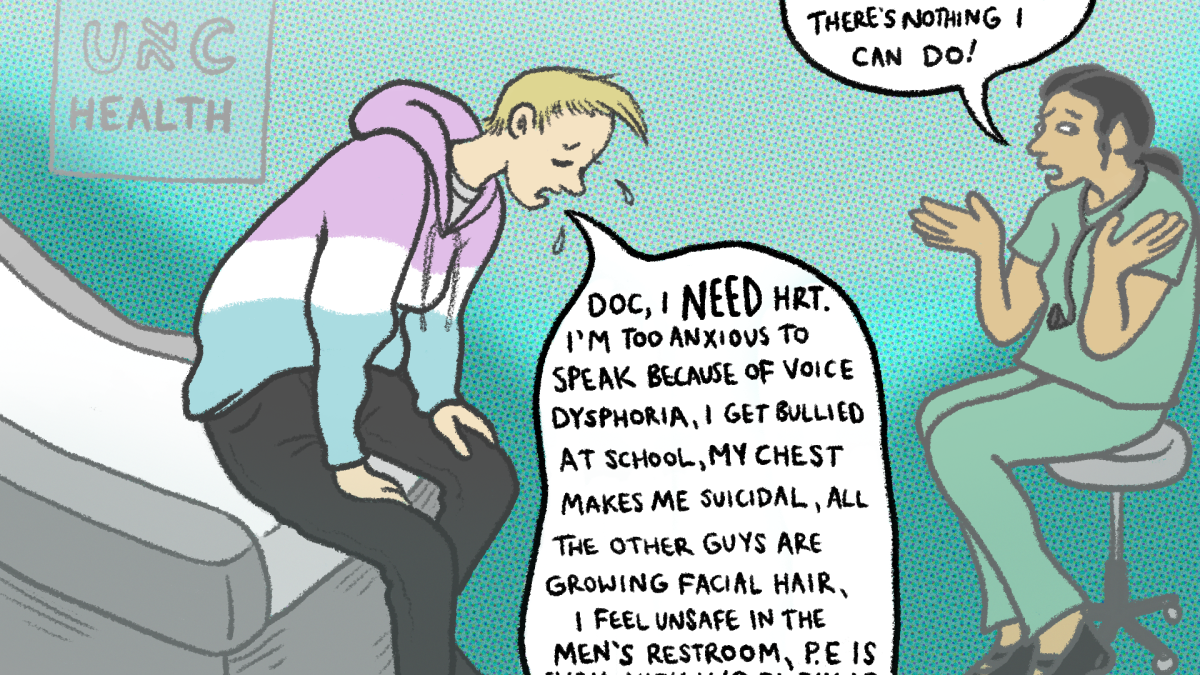
UNC Health has stopped providing gender-affirming care to transgender individuals under 19, exceeding state law that sets the ban at under 18. This decision, made active in January, led to the halting of ongoing care and will have lasting repercussions on trans youth and young adults in the state.
Samantha Jackson is the communication director at Equality NC, a non-profit organization working to make North Carolina safer for the LGBTQ+ community. Jackson said the action disrupts healthcare systems and creates confusion among professionals.
“Stripping the legal rights of 18-year-olds, folks who are actually adults, creates a fractured healthcare system where some adults have medical care and access and others are shut out,” Jackson said.
Transgender youth lost access to gender-affirming care in the North Carolina House on Aug. 16, 2023, when the House voted to pass Bill 808, which prohibits the prescription of puberty blockers, hormone therapy and surgery. The bill also prohibits the use of state funding for any “trangender-related procedure,” which includes families insured by Medicaid.
Though Democratic Governor Roy Cooper vetoed the bill, the House was able to override his veto with a majority vote, putting the law into place. Though several lawsuits have been filed by the families of trans youth, the ban remains in place against the recommendations of medical professionals.
Jackson called the move by UNC Health, which exceeds the state ban on care for minors by raising the age limit to 19, a “cowardly” response to the current federal climate. The action was put in place without an official public statement and was broken by local news outlets.
“UNC Health basically chose to comply with Trump’s already aggressive executive orders to end gender-affirming nationwide, even before they were legally required to do this,” Jackson said.
A second year studying fisheries, wildlife and conservation biology who wishes to remain anonymous, started his medical transition as a teenager. He went to a gender clinic in North Carolina specifically for adolescents, and it took over a year to get from booking an appointment to starting testosterone.
“There’s a common misconception that when minors go to seek healthcare, they are doing vaginoplasties on 5-year-olds. That’s not happening,” the student said. “Before they start arguing that [care] shouldn’t be given to minors, they actually understand what’s happening when a minor goes to a gender clinic.”
The conversation around trans medical care can make it seem overly accessible and simplistic. In reality, the wait lists to receive care from public institutions, like UNC Health or Duke, are months long, and the options for care are anything but straight-forward.
Similarly to bans on abortion, official laws often do not take into account the nuance of medical considerations. The student said broad legislation is not effective in a field where each treatment is so personal. When seeking gender-affirming care, hormones and surgeries are considered alongside other less permanent options, taking into consideration cost, lifestyle, individual desires, appearance and previous health concerns.
“I want to emphasize how nuanced and personalized this healthcare really is. I think it’s being portrayed in a bad light a whole lot, as a joke …” the student said. “It’s not something that is a one size or one situation fits all, especially for minors. Some people pursue hormones, some people just pursue hormone blockers. Some people pursue surgeries and some don’t.”
The student said there are many people relying on their ongoing care, such as hormone replacement therapies, to maintain their physical health. The restrictions on gender-affirming care, a category that doesn’t have a hard definition by medical standards, take healthcare out of the hands of qualified professionals and put patients at risk.
Since getting a total hysterectomy last summer, the student relies on his prescribed testosterone as his primary sex hormone. Without constant access to refills, he is at risk for a litany of ailments, such as osteoporosis, heart and bone issues and neurological conditions.
A large part of the conversation around gender-affirming care for minors is mental health, and for good reason. Transgender minors have been shown to have high rates of suicidal ideation and attempts, which have been shown to increase after the passage of anti-trans legislation. For many like this student, a life without medical transition is unthinkable.
“Even with social transition and being able to change my name and change my hair … even with all of those things, I think that the actual healthcare aspect of it has been the most important and affirming for me,” the student said.
The student said he can’t imagine what his life would have looked like had he not had access to gender-affirming care from a young age. Though he is now a legal adult, the growing number of anti-trans bills passing throughout the country continues to incur uncertainty.
“It’s sort of unfathomable, but it’s starting to be a personal worry because it seems like it just keeps hitting closer and closer to home,” the student said.
The student said the ban is not just the concern of trans people but of their entire communities. While trans people might be feeling increased apprehension about the future, local support systems are what could make all the difference.
“I don’t think that anybody can feel comfortable until all of their friends, all of their classmates, are provided the equitable resources they deserve,” the student said.
Jackson said the policy change is a consequential action from UNC Health and contributes to the broader national climate.
“We believe that policies like this basically create a culture of fear. It signals to students and our youth, to our trans and queer community, that UNC Health is prioritizing extremism over the safety of our community,” Jackson said.
Equality NC is working to combat anti-trans policy through political action, which includes lobbying, candidate endorsement and voter registration. Jackson said electing pro-equality leaders is how meaningful protections are achieved.
“When UNC Health shows us they’re willing to shut some of us out, they show that they’re willing to shut all of us out. And that’s why, especially this year, we’re out there organizing to show the community that we have the political strength to protect our rights,” Jackson said.
For trans people, their gender-affirming healthcare can be a lifeline. The student said whether a trans person is years into their hormone treatment or seeking care for the first time, taking away the option to access healthcare is terrifying.
“That situation — being deprived, all of a sudden, of this healthcare — is genuinely the worst nightmare of most people who are in my situation,” the student said.