

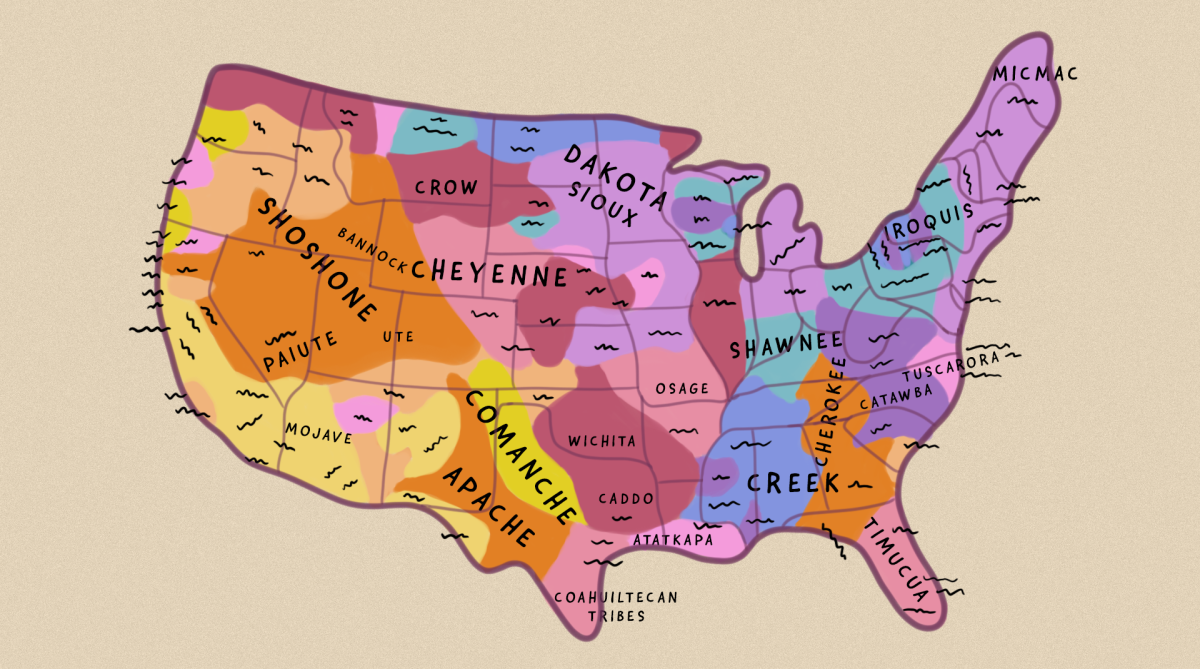
Attached to any number of emails or speeches, you may have stumbled upon statements called land acknowledgements. The statements aim to recognize and attribute respect to Indigenous history and the ancestral lands of Indigenous people but are commonly criticized as performative and unsubstantial.
NC State’s land acknowledgement recognizes eight tribes whose historic land the University sits upon, and says the institution “share[s] an ongoing responsibility to safeguard these lands and to respect the sovereignty of the tribes and Indigenous nations residing in North Carolina.”
Ryan Emanuel is an associate professor at the Duke’s Nicholas School of the Environment. He is from the Lumbee tribe, located in central Robeson County, Southern North Carolina, and was previously a professor at NC State.
The first chapter of Emanuel’s book, “On the Swamp: Fighting for Indigenous Environmental Justice,” explores what he believes land acknowledgements ought to be and the role they play in how we think about land.
Emanuel said the statements should affirm existing relationships and collaborations between an institution and the Indigenous people it impacts.
“Ideally, a land acknowledgement should be a way for institutions to publicize this relationship, not for PR purposes, but to emphasize that these kinds of relationships matter and they are a priority for the institution,” Emanuel said.
When these statements are repeated so many times, however, they can lack substantial meaning and often have little connection to the practical empowerment of Indigenous voices, Emanuel said.
Kurt Naquin is a doctoral student studying parks, recreation and tourism management and is a member of the Houma, a group indigenous to Louisiana. Their work and research center on how cultural initiatives in that area maintain Indigenous identity in the context of climate-related displacement.
Within academic contexts, Naquin said erasure of Indigenous history already happens due to the types of knowledge, practices and research we focus on. They said universities are not doing enough to combat institutional suppression of Indigenous voices in this area.
“You might have a conference here and they might do a land acknowledgment, but they’re going to continue advancing colonial scientific practices,” Naquin said. “That’s one point of contention I have about land acknowledgements: The context isn’t just the land, it’s also the dominant culture in which we operate.”
Emanuel said short statements for these kinds of acknowledgements are often lacking in nuance or detail. There are long and complex histories of colonial projects that acknowledgements don’t always actually acknowledge, Emanuel said.
Naquin said statements are incomplete if they do not recognize the history of colonialism. Without this context, the statements do not realize the depth and historical significance this history has to many people.
“If there was more dedicated conversation in whatever context the land acknowledgment is given, I feel like that would be a lot more effective. Otherwise, it feels like a footnote that no one reads,” Naquin said.
Emanuel said although the statements are a start to local empowerment, it is much more meaningful for institutions to form relationships with surrounding Indigenous communities.
“The process involves stepping back from this written document and asking yourself, who are the Indigenous peoples to whom this institution has a connection, or should have a connection?” Emanuel said. “Well, let’s think about the nature of that connection, and explore that some more, pursue it and take whatever actions are needed to heal any brokenness in that relationship.”
As a land-grant university, NC State was founded on land granted to North Carolina by the federal government under the 1862 Morrill Act. The law was intended to establish agricultural and mechanical schools around the country. Still, it also resulted in Indigenous land being sold and profited from with no or little reparations or payment to the people who resided there originally.
The values suggested by land acknowledgments need to be put into practice by ensuring that current actions are not contributing to harm against Native American communities in and around the University, Naquin said. In the present day, Naquin said there is a long history of exploitative research practices that have not benefited its Indigenous participants.“I think all research institutions have a moral imperative to realign the way they fundamentally do research in order to support indigenous sovereignty, especially if they’re doing land acknowledgments,” Naquin said.
If universities, like NC State, are lacking Indigenous representation among staff, faculty and students, Naquin said their statements do little actually to increase Indigenous presence and engagement.
“In some way, it makes me feel like [acknowledgements] keep indigenous history as history, in the past,” Naquin said.
There is a middle ground between ignoring Indigenous issues and going overboard with performative acknowledgements being recited at every meeting, Emanuel said. Acknowledgements can be healthy and supportive tools for keeping Indigenous issues at the forefront of public consciousness.
Emanuel said that the words should be paired with respect and action. He compared land acknowledgements to the abstract of a research paper — something written after the research has been completed, and only a summary of the complex information.
“When you think about being a guest in someone else’s home, you carry yourself a little differently,” Emanuel said. “I think about Indigenous peoples in North Carolina — I can only speak for myself, but I talk to a lot of people in tribal communities, so I’m comfortable saying this — and many of us want to be treated with the respect that’s due to a host.”
To learn more about the history of Indigenous people at NC State, view this University Libraries timeline featuring archive materials.