


Danish artist Thomas Dambo installed five troll sculptures in Dorothea Dix Park at the end of October. Dambo has created 171 trolls that can be found in countries all around the world, and now North Carolina has the largest North American installation.
Dambo’s mission is to make his audience more aware of the environment around them by encouraging exploration. His sculptures are purposefully hidden in forested areas, so the viewers have to seek them out.
Nick Smith, chief of staff for the Dix Park Conservancy, said that Dambo and the conservancy worked together to reflect Dambo’s vision for the trolls — a vision centered on encouraging people to explore the environment around them. Dambo’s sculptures are intentionally tucked into forested areas so visitors have to seek them out, and despite Dix Park’s urban setting and its proximity to downtown Raleigh, the park’s wooded areas offered the perfect setting for the trolls.
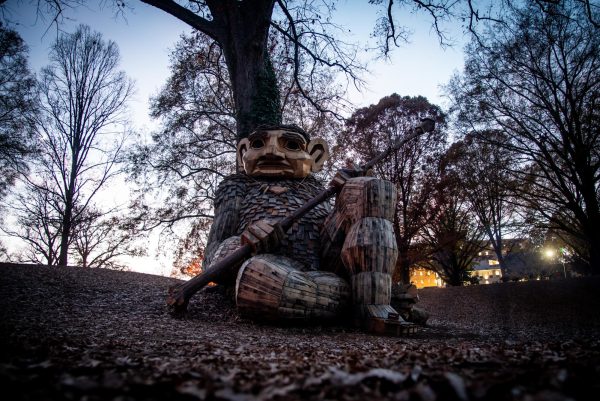
“The master plan, which the conservancy has supported financially, but also supports conceptually, has the campus transforming and removing a lot of that built space and renaturalizing, regreening a lot of these areas,” Smith said. “This specific project is highlighting the natural areas that exist already.”
Patricia Morgado, an architect and associate professor emerita of architecture, said that urban environments in the United States lack shared public spaces, and the introduction of interactive sculptures such as Dambo’s are important in a community space.
“There’s less spaces for gathering in an urban environment, and so Dix Park is a huge contribution to the city,” Morgado said. “And now these sculptures, it’s really starting to engage the public to this part of the city, and with that bringing a positive impact on the citizens.”
People who visit the trolls at Dix Park are welcome to touch them and climb on them. Morgado said that in the case of Dambo’s sculptures, there is a unique opportunity for an interactive experience that sets them apart from other art installations.
“I think that sculpture in public spaces, especially something like [Dambo’s], where you can touch it. You can sit on it. You can sit next to it. It activates a space,” Morgado said. “In the case of his work, it’s also so playful that I think it brings happiness to the city.”
In order to make the project possible, the conservancy recruited over 350 community volunteers to help with construction over the course of three weeks. With over 44,000 hours of volunteer time, the group was able to successfully set up the troll statues.
“We wouldn’t have been able to safely do this without other volunteers. And we had such an overwhelming response to folks that were interested and wanted to come out more,” Smith said. “The atmosphere and the community support, folks were just excited to work and work hard. I think you can feel it in the final product.”
The trolls are also made out of locally sourced materials. Smith said his and Dambo’s team used materials from two reclaimed tobacco farms and farm fencing. They also got reclaimed materials from Habitat for Humanity and Raleigh Reclaimed to source the wood for the five trolls.
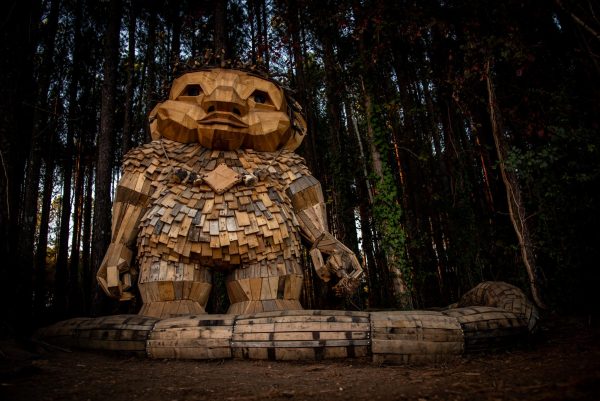
Dambo’s usual method for building his sculptures is by using recycled materials that are supposed to break down over time.
“This is a long-term temporary installation, which means we want them to be here close to a decade,” Smith said. “We also know that natural materials will be exposed to the elements and will not last forever. That’s not what the artist wants.”
To accompany his environmentally conscious efforts, Dambo creates a story surrounding all of his troll sculptures. The trolls in Dix Park are called Mother Strong Tail, Daddy Bird Eye, Dix, Dax and Dux. They are also related to the other two trolls in North Carolina.
“They have one main purpose, and that’s to protect the grandmother tree, and that’s a magical tree. It was the first tree of all the forest, Smith said. “So they exist in the hidden and forest areas of Dix Park, looking out over downtown to protect the grandmother tree from their foe, humans, who often are destructive in nature for their own purposes.”
Since the arrival of the trolls, Smith said Dix Park has seen an increase in visitations. Not only that, but visitors are encouraged to explore the natural areas where the trolls are, promoting recreation and healthy habits.
“The troll bump in terms of interest is real,” Smith said. “I haven’t walked this long in years, is what we hear. And the squeals of joy when they discover, they turn the band or they enter the forest and see the trolls. That’s what we do it for.”