

Orange-robed Buddhist monks, some only with socks protecting their feet, walked up Fayetteville Street on Saturday as freezing wind whipped through downtown Raleigh and the first drops of a winter storm began to fall.
By the time they reached the North Carolina State Capitol, the “Walk for Peace” had covered roughly 1,800 miles in 91 days.
The monks, who are Theravada Buddhist monastics from a Texas temple, began their 2,300-mile pilgrimage in late October, walking across 10 states toward Washington, D.C. They follow strict vows as renunciants, eating one meal a day, abstaining from alcohol and family life and treating food as “medicine” to sustain their practice.
“These are very strict monastics,” said Levi McLaughlin, a professor in NC State’s Department of Philosophy and Religious Studies who studies Buddhism and religion and politics in Asia. “If you take the vows that these particular monks have taken, you eat one meal per day and you have to eat it before midday.”
The monks’ path into North Carolina has unfolded under sharp swings in weather. Organizers told the crowd at the Capitol that they walked through 98-degree heat in Texas and Louisiana, including six days of rain out of nine in that state.
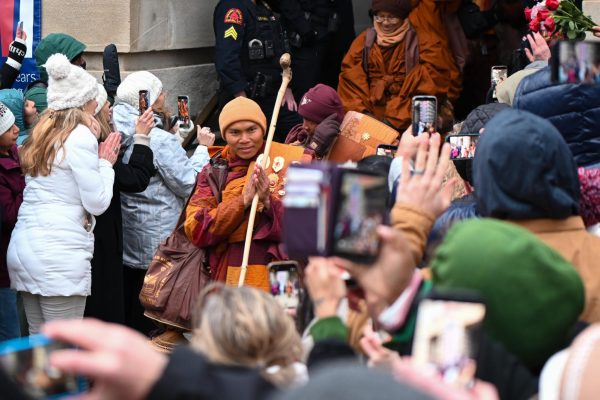
“Now, here in North Carolina, we have a different set of challenges,” a spokesperson for the monks said. “Today, the weather is getting too bad. The impending snowstorm may affect the rest of the path of this journey. However, the venerable monks are determined to continue the journey.”
McLaughlin said the walk fits into a longer history of Buddhist public protest, from monks’ self-immolations during the Vietnam War to more recent sacrifices in solidarity with Tibetans.
While the “Walk for Peace” avoids naming specific policies or governments, McLaughlin said it still responds to the current political atmosphere.
“I think you’d have to characterize the walk itself as a political response and that it’s perhaps not as pointed to a specific government or policy, more generally bringing attention to the horrible conditions in which we live and the importance of peace as a guiding principle,” McLaughlin said.
McLaughlin said what has surprised him the most is how North Carolinians have met the monks.
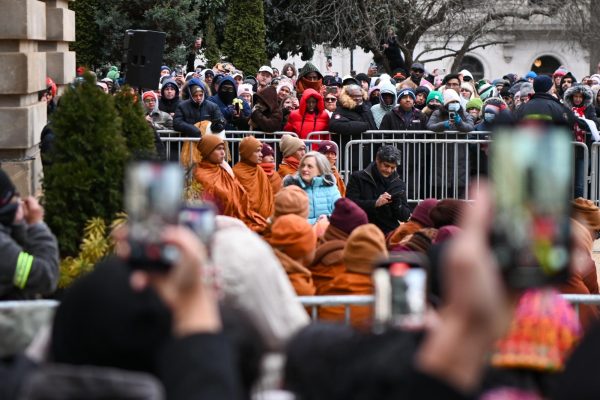
“You might think there would be a level of cynicism or xenophobia that might greet a bunch of Southeast Asian monastics walking along highways in the American South,” McLaughlin said. “That doesn’t seem to be the case at all. It’s really remarkable. I think the positivity with which they’ve been received is really striking and I think very heartening.”
Raleigh Mayor Janet Cowell and Gov. Josh Stein, who were standing side-by-side with the monks, framed the event as both a civic welcome and a reminder of the residents’ responsibilities to each other.
“On behalf of the city council of Raleigh, all the city staff and all the people of Raleigh, it is with joy and gratitude that we welcome you into our city,” Cowell said. “Your commitment to the practice of peace in body and spirit reminds us all that we, too, can make such a commitment. Your example inspires us to develop a practice of inner peace which radiates out to our community and the world around us.”
Stein told attendees the “Walk for Peace” has become a welcome uniting moment in a period of political tension.
“We live in a time of partisan rancor and political discord,” Stein said. “These days, people of all stripes are feeling under attack, whether it’s by what they see on social media, what’s going on in their personal lives or the number at the bottom of their grocery bill. That’s what makes your message more important than ever. It goes beyond faith or politics.”
Stein said he hopes North Carolinians will hold onto this feeling of unity, long after the monks have finished their walk.
“We don’t want to feel on guard against our neighbors. We want to come together,” Stein said. “Thank you for reminding us of that. I am inspired not only by the monks, but also by the thousands of North Carolinians who, over the past week, have turned out to honor the ‘Walk for Peace’ and have been moved by its purpose long after these monks have left North Carolina. May we all carry this spirit forward in our own lives into caring for our neighbors and seeking mutual understanding rather than division.”
Both Cowell and Stein issued proclamations recognizing January 24 as “Walk for Peace Day” in Raleigh and North Carolina.
For local Buddhist communities, the “Walk for Peace” has become both an external symbol and an internal challenge.
Teshin Matthew Sweger, guiding teacher at the North Carolina Zen Center, a Buddhist center that follows the Japanese Zen practice in Pittsboro, said the “Walk for Peace” is showing Americans that there is another way to live, beyond day-to-day stress and obligation.
“We’re taught we have to grow up good, get an education, get a job, pay bills, you know, do this, do that, and it’s just a go, go, go, go, go, go mentality. And so, seeing these monks and just their poise and their centeredness, experiencing that, that we don’t have to be just a cog in the wheel, we don’t have to just be on the hamster wheel constantly. And I think we’re longing for that as a people because we’re overworked,” Sweger said.
Sweger compared the monks’ presence to a story from the Buddha’s life, when the young, future Buddha encountered four sights: old age, sickness, death and a wandering mendicant.
“And that fourth sign, I think, is really important because it showed the Buddha to be that there is this other way of doing life, to confront suffering, to go towards his own awakening and his own enlightenment and his own peace,” Sweger said. “And so I think these monks doing the walk are that for us, they are our own fourth sign.”
Venerable Bhikkhu Pannakara addressed the crowd at the Capitol after Stein’s remarks, telling locals that world peace starts within the individual.
“If we cannot have peace for our own world, there will be no world peace,” Pannakara said. “If all of us here in North Carolina can have peace in each and every single family, this whole State of North Carolina will be at peace.”
Pannakara walked listeners through a simple mindfulness meditation, asking them to follow their breath like a “gatekeeper” at the nostrils and to notice each thought as a “monkey mind” jumping away before gently returning attention to the present.
Pannakara urged attendees to adopt a daily ritual when they wake up.
“Every morning when we wake up, please remember my statement that you have to write this down with a pen and a paper: ‘Today is going to be my peaceful day,’” Pannakara said. “ … And then read it over and over with our eyes. Read it out loud to the universe to tell the universe that today is going to be my peaceful day. So that no one in this world can mess it up except ourselves. We are the only ones who can mess our days up. No one else.”
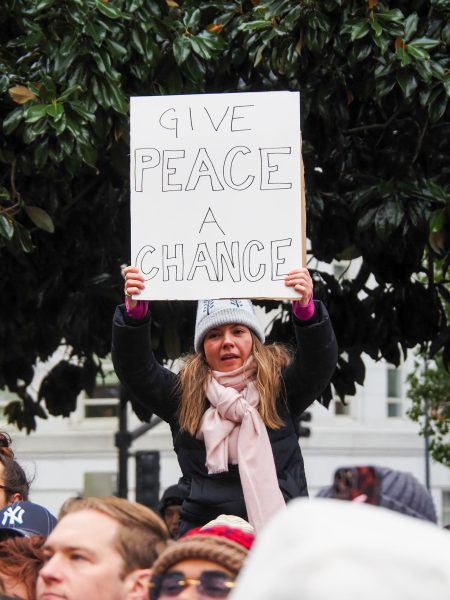
Pannakara said he hopes the monks’ march, which serves as a spiritual practice for themselves, inspires onlookers to make lasting change in their lives, making this moment more than just a fleeting memory.
“This is not something that we brought to you, we brought it to this nation or to this world. We also practice for our own peace. And we are here just to [bring] the key for all of you to open that box where you have locked peace and happiness in it for a long time. And you have left it somewhere and forgotten it. We are here just to hand you the key. But the person who [has] to unlock it, which is yourself.”
Caroline Alexander contributed to this reporting.