
When the University reopened on Jan. 28 following closures resulting from the year’s first significant wintry mix in Raleigh, many students who commute expected that navigating roads with scattered ice and snow would be the most difficult part of getting back to class. For those who park at on-campus locations like the Coliseum deck, though, there was a new roadblock.
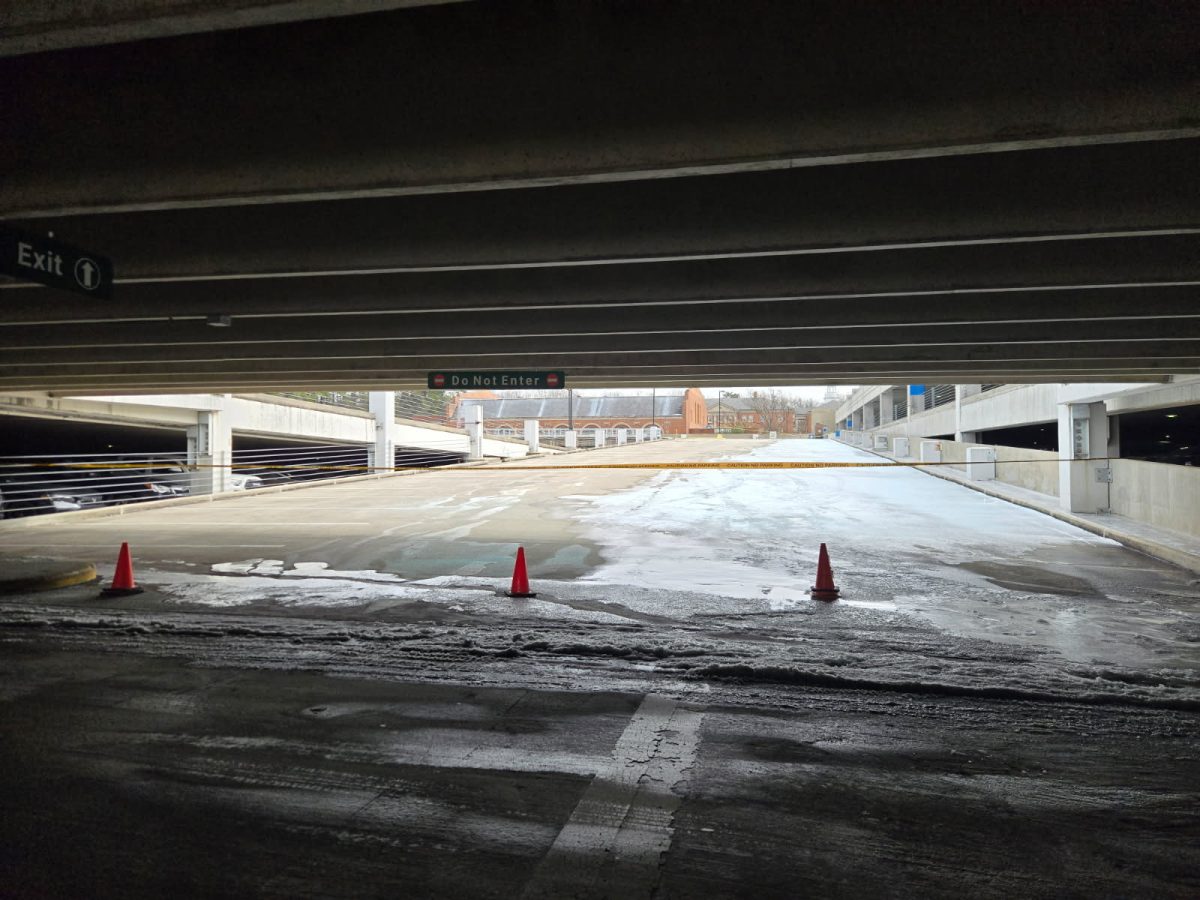
Campus transportation closed the upper level of the parking deck due to the threat of ice and unsafe driving conditions, decreasing available parking while crews worked to clean and de-ice the deck.
Many students who park in the Coliseum deck reported not being made aware of this closure prior to arriving at an already overfilled parking deck, forcing them to seek out other options to park before their classes.
Emmie Cumby, a third-year studying business administration, was one of those students affected by the closure. She struggled to find a spot in the Coliseum deck, where she pays for an annual parking pass, and eventually ended up paying for parking at a different location.
“I work and I commute, so I have to park in the parking deck, and recently, with them closing off the top floor, especially on Thursdays when I have later classes, it’s been harder to find a spot.” Cumby said. “It’s been making me not quite late to classes, but getting there right on time.”
Cumby believes this is a sign of a larger issue regarding the fixed amount of student parking on campus as undergraduate enrollment continues to grow.
“This isn’t necessarily just a characteristic of the snow, it’s kind of just how this works, which is unfortunate,” Cumby said.
Pen Hunter, a fourth-year studying environmental science, was also affected by the limited parking and said they also ended up paying for parking at a different location after having little luck at finding a parking spot.
“On Wednesday, I got a text from my friend who’s like, ‘oh yeah, good luck parking.’ I got there and I think I spent like 10 or so minutes looking for a spot and then I was like, oh, I’ll park in the public parking area, it’ll be fine,” Hunter said.
Hunter said the situation felt very first-come, first-served, which felt wrong considering they had already managed to obtain a parking pass at the beginning of the year.
“What really bothered me the most was that it just seemed like it was a you snooze, you lose situation with coming to campus, like if you get to campus and all the spots are gone, it’s like, well, sucks to be you,” Hunter said.
Demar Bonnemere, communications manager for the transportation department, offered solutions to the parking problems, emphasizing students are able to use the OnCampus app and transportation website to check parking availability across campus before they arrive.
“We have what we call Parking Logix installed at the Coliseum Deck, which gives us an available space count. When we have to take spaces offline, so say we took off the top of the Coliseum deck and just throw out a number, say, it was 50 spaces, we will adjust that number.” Bonnemere said.
Students who download the free OnCampus app are able to see the active number of spaces available in the parking lot in real time and an indicator of how busy the area is. The parking data is also used by the University to coordinate event planning, looking at which days are the busiest and which lots see the most usage.
Bonnemere said that when the University operates in Condition Two, parking enforcement is scaled back, making parking easier when the University operates under suspended operations.
“So if we’re in Condition Two, we kind of relax enforcement,” Bonnemere said. “Meaning, the students, they can park out of zone and not get a ticket, as long as they’re not in a reserve, fire lane, kind of those areas that are enforced twenty-four-seven.”
Kofi Thomas, the facility planning manager for the transportation department who oversees the external operations team, said that over five tons of rock salt were used inside the parking decks after the last two winter storms. The operations team is restocking and continuing to be prepared for future weather conditions.
“We’re just waiting on some more [rock salt] to come on in just in case we do have some inclement weather and I hope that we don’t, it just stays nice and warm,” Thomas said. “Although we’ll be prepared to make sure those areas are safe.”
While parking issues due to closures may persist, Bonnemere emphasized how the University must focus on the safety of people who are parking and driving. If a location is not safe to use yet, it needs to be closed, Bonnemere said.
“We just want to make sure that we’re putting students, faculty, anyone that parks there in a safe position. You don’t want somebody to park, get out of the car, slip and fall. So [we take] a little extra caution to make sure we get the areas clear and safe before we reopen,” Bonnemere said.