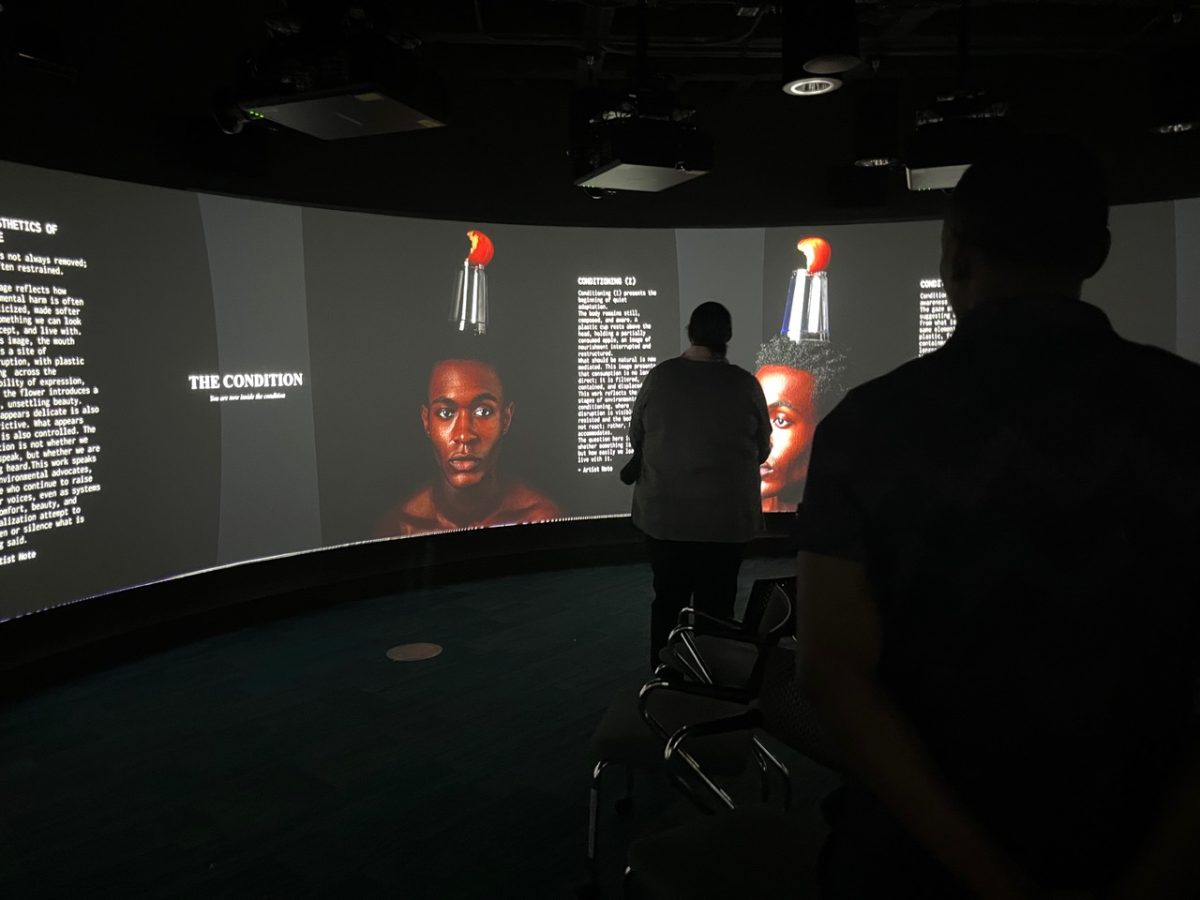

The fourth annual Symposium on Afrofuturism and Diasporic Scholarship was hosted in Witherspoon Student Center on Feb. 19. It featured a range of student presentations and keynote speaker David Washington.
This year’s theme was “We are the Architects, We are the Future,” reflecting the importance of celebrating Black history and Black futures.
“You will be immersed in future-making, research and seeing yourself as a living archive,” Angela Gay-Audre, the director of the African American Cultural Center (AACC), said in their introductory speech. “With that, I hope that as we move through this day, that you see yourself as a butterfly: imperfect, yet glorious. Unfolding and creating for yourself.”
The symposium was financially supported by NC State University Libraries, the Integrative Humanities and Social Sciences Department, Multicultural Student Affairs, the Office of Undergraduate Research, the NC State Black Graduate Student Association and the Career Development Center.
Austyn Kobs, a graduate student studying English, introduced Washington with a long list of accolades and qualifications, including five different degrees. Washington earned his PhD from NC State and is a former faculty member and assistant dean.
Washington spoke about the process surrounding his Amazon bestselling graphic novel, “Black Defender: The Awakening,” and how his success can serve as a model for future Black scholars and artists.
“Black Defender” centers the fictional Dr. Chris Withers, a highly successful Black man with a great family and career. Withers is thrown into vigilantism due to a dramatic loss, but the story remains focused on real world moral issues. Washington said he wanted to, above all, create a superhero that his kids could look up and relate to.
“I truly believe that every child should be able to see themselves in their universe, because when you can see yourself in your heroes, you get an insight into what you can be and what you can do,” Washington said.
The panel discussion was moderated by Felix Morton IV, another highly-accredited scholar who specializes in mental health and cultural media studies pertaining to Black experiences. Their conversation featured topics such as creative process, the nature of storytelling, entrepreneurship and the importance of accurate, nuanced representation.
“That’s what I wanted to do with ‘Black Defender’ as well: show that there are other forms of Blackness, other ways in reality that we can be seen, versus every Black man has to be a drug dealer in every story,” Washington said. “No, it doesn’t have to be that way. In fact, that’s not the reality that all of us live in.”
Washington also spoke about how his experience learning and teaching in academia prepared him to tackle such a big project, offering advice to the audience on managerial skills and what it takes to get a project done.
“We got to move forward,” Washington said. “Yes, it’s nice to say, ‘someday we’ll get that done,’ but ‘someday’ will not bring your vision to life. You’ve got to get in a position of saying, ‘Tuesday at 3 o’clock, we are going to move this out of the front door,’ right?”
Above all, he said community and a love for his family is what motivated him to complete a project so far out of his normal pursuits.
Wynter Douglas is the Librarian and Library Coordinator at the African American Cultural Center. They help students navigate research and the vast resources at the AACC. They spoke at the symposium about upcoming programming and said they were excited to feature a local author as the main event.
“[Washington] uses all of his experience from being so decorated and accredited to create this book that shows Black heroes and what a Black future can look like,” Douglas said. “It really embodies Afrofuturism by showing community being rooted in cultural and familial practices.”
Following the keynote panel, Washington answered questions from the crowd and hosted a book signing with free copies of “Black Defender.” Then, participants in the symposium were invited to view student poster presentations. The day was an interdisciplinary celebration of diverse scholarship and supporting upcoming Black students.
“It’s Black History everyday, 365 days out of the year, but February through the end of the semester, you can find some wonderful events in the African American Cultural Center,” Andaiye Qaasim said, the student affairs specialist at the center.
The AACC also offers many programming series throughout the year. In collaboration with the LGBT Pride Center, Women’s Center, Multicultural Student Affairs and the NC State Libraries there is a semester-long book club on “Song in A Weary Throat” by Pauli Murray, and sessions are ongoing and open to all.
Diaspora dinners is another series of events hosted by the AACC celebrating the diversity of the African diaspora with themed meals. The next meal is at the AACC on Feb. 27 at 3 p.m.
Another event to close out February is the Open Mic Event being hosted at the AACC, where students are invited to sign up to perform and create in front of a live audience on Feb. 26 at 6 p.m.
“I would say a big theme of a symposium is to celebrate where we are now and where we were in the past, but also in the future,” Douglas said. “So, although it’s in Black History and Futures Month, it does not relegate it only to this February.”