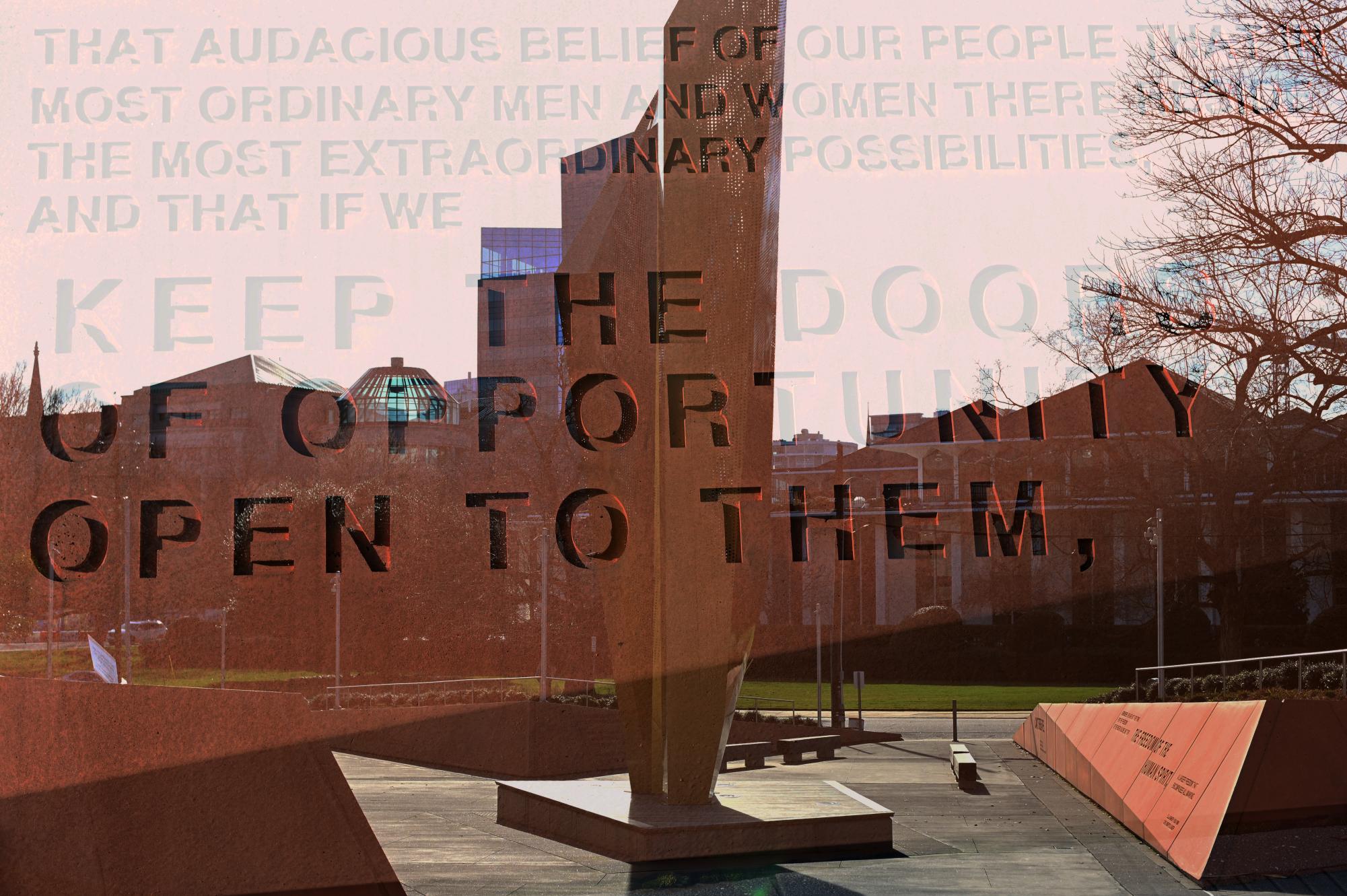
In Raleigh, new monuments to Black history are rising on timelines that stretch decades beyond the moments they commemorate.
North Carolina Freedom Park, which opened August 2023 and is located next to the state legislature, is one of the newest. The park centers on Black North Carolinians’ struggle for freedom, but its story starts long before the 45-foot steel “Beacon of Freedom” was erected.
“I would describe it as a space that is all about the African American struggle for freedom in North Carolina,” Khadija McNair, Freedom Park manager, said. “So I wouldn’t really call it a monument so much as like a space to really reflect on the history and think about the future; the fight for freedom.”
For McNair, who is also a Durham native and public historian, Freedom Park represents both a physical space and the culmination of a 20-year campaign by organizers, including Maya Angelou, who noticed what was missing when they visited other cities.
“There were folks in North Carolina who had traveled to other places and saw these monuments, these statues to particularly celebrate emancipation and the end of slavery,” McNair said. “These folks came back to North Carolina, like, ‘Where are we acknowledging this history?’ And there was not a space, and so they gathered.”
McNair said the park’s design purposefully pushes away from statues of individuals, instead featuring a concourse of 20 “voices of freedom” lining the low red-clay walls, pairing short quotations with names of Black North Carolinians.
“My understanding is that folks really wanted the space to not really uplift one person,” McNair said. “They wanted it to represent this collective fight, these collective voices coming together to speak to the ideals of freedom.”
Across the South, a similar shift is occurring on college campuses, often with a delay.
Jason Miller, an English professor who studies Martin Luther King Jr. and public memory, said that lag is not an accident.
“Monuments are very interesting, most of them,” Miller said. “So many monuments do come after the initial moment in time.”
Miller has spent the last decade reconstituting King’s 1966 visit to Reynolds Coliseum, using oral histories and scattered clippings to fill in what the university never formally archived. He said there is often a “strange 50-year period” before communities decide to put something in stone.
“A lot of people that know folks that pass away or go on get to the end of their lives, and they’re like, ‘We should really do something for these other people,’” Miller said. “ … And then you also have kind of this window of time where people go, that was somebody from our lives, childhood that we need to really recognize.”
By then, Miller said, the monument ends up telling two stories at once, telling just as much about the present as they do the past.
These memorials also sit in the shadow of an older wave of public memory. Both Miller and McNair said that many Confederate monuments went up not in the 1860s but in the early 20th century, as Jim Crow laws hardened across the South.
Miller pointed to the Confederate monument that once stood on the State Capitol grounds as an example of that earlier wave. The statue was dedicated in 1895 and removed in 2020 on orders from then-Gov. Roy Cooper after protesters pulled down two soldier statues at its base.
“If [the statue] was about history, then it would be at a place where a battle took place, where Confederate soldiers fought against Union soldiers,” Miller said. “And it didn’t seem to actually be about the memory of the fallen. That would take place at a cemetery or again, maybe a battle site. It was actually about what the present moment needed and reassuring what those folks believe was Confederate background.”
At NC State, the distance between events and memorials shows up more in the library catalogs than on campus. The University invited King to speak in Reynolds Coliseum July 31, 1966, but for years, there was almost no trace of it in the official archive.
“We collect, we preserve and we make accessible history and historical resources,” said University archivist Todd Kosmerick. “And as a University archivist, I’m particularly focused on those resources that concern University history.” That work includes official records from campus offices, but also donations from alumni and their families that capture student life at ground level.
When it comes to Black history, Kosmerick said the written record is often thin, especially for the 1960s and 1970s.
“There’s very little documentation of that in the University archives,” Kosmerick said of King’s speech. He eventually located a short notice in a niche summer newspaper, which announced King’s visit and reprinted a Raleigh News & Observer article, but offered no coverage of the event itself.
Kosmerick said that personally, he believes “digitization is not a preservation thing. It’s an access thing.” The physical items stay in the bookstacks, and Special Collections staff still pull out boxes of photographs, publications and letters into classroom spaces where students can handle them directly.
“Part of the feedback we almost always get from the students is that they just love having access to the physical items,” Kosmerick said.
Meanwhile, the visible landscape is only starting to catch up. The Augustus Witherspoon Student Center was not renamed for Witherspoon until 1995, more than two decades after he became the second Black person to earn a Ph.D. from NC State and the first to return as a professor. Witherspoon went on to serve as a dean, associate provost and key founder of both the African American Cultural Center and the Eta Omicron chapter of Alpha Phi Alpha Fraternity Inc.
In 2023, nearly 60 years after King’s speech in the same building, NC State unveiled a bronze statue of basketball star David Thompson outside Reynolds, making him the first Black person with a statue on campus. The sculpture freezes Thompson mid-leap, his body suspended 44 inches above the ground to match the vertical jump that once landed him in the Guinness Book of World Records.
That pattern holds far beyond Raleigh. In April 2024, the University of South Carolina unveiled a 12-foot bronze monument on its historic Horseshoe honoring Henrie Monteith Treadwell, Robert Anderson and James Solomon Jr., the first Black students admitted there after reconstruction. USC commissioned the monument as part of the 60th anniversary of desegregation and placed it in front of McKissick Museum so every campus tour and prospective student group passes it.
In Chapel Hill, the Unsung Founders Memorial has recognized the slave labor that established the University of North Carolina at Chapel Hill since 2005. The black granite table in McCorkle Place sits on the backs of 300 small bronze figures and is ringed by an inscription honoring the “people of color, bond and free” who helped build the university. The sculpture was designed by artist Do-Ho Suh as a 2002 senior class gift and emerged from students organizing rather than administrative planning.
On-campus and around Raleigh, those stories intersect with longer histories in the ground itself. Just North of campus, the Oberlin District was founded by formerly enslaved people after the Civil War on land that later became part of Cameron Village, now Village District. Today, a handful of preserved houses, a restored cemetery and Thomas Sayre’s earth-cast sculpture Oberlin Rising, dedicated in 2018, stand amid the commercial district.
McNair said sites like Oberlin and Freedom Park show how much of the Triangle’s landscape rests on stories that rarely show up in textbooks.
“These people might not have been extremely popular while they were doing this work, but, of course, generations removed, we can appreciate the effort and the work they did do,” McNair said. “So I kind of see it as this reflection on legacy, this reflection on history.”