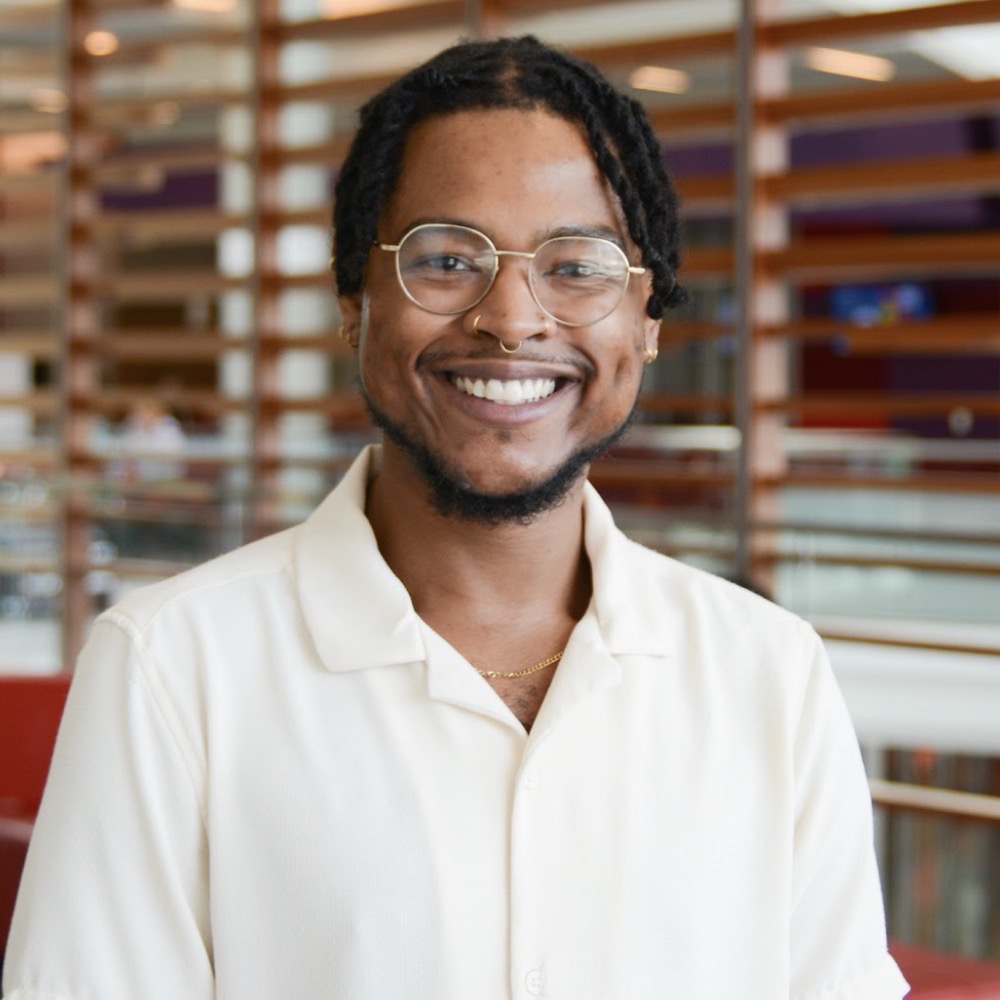
Former NC State LGBTQ Pride Center Assistant Director Jae Edwards said he was fired less than 24 hours after an undercover video surfaced, without a full investigation or a chance to respond. Faculty advocates argue the University’s response has quelled speech and exposed campus workers to politically motivated attacks at a time when system leaders are reshaping how diversity work operates.
A video Thursday, a firing Friday
Edwards said his week began like any other, with a Thursday staff meeting at the Pride Center. He received a call from University Communications informing him that Accuracy in Media had released a video of him.
“I asked for next steps,” Edwards said. “And they said they did not have any next steps for me.”
Edwards’s direct supervisor, he said, “really wasn’t involved in the process” which followed due to a family emergency.
Hours later, Edwards received a call from Carrie Zelna, senior associate vice chancellor, offering support.
“She asked how she could support me, how I’m feeling in the moment, what she could do to help me through the moment as well,” Edwards said. “I really wanted to know what were the next steps, and she said she is going to be meeting with some other people to discuss next steps and how to best support me and that she’ll call me back before the end of the workday.”
Edwards said Zelna called at 5:38 p.m., and he had missed the call, but Zelna left a voicemail promising to call at 8:30 a.m. the next morning.
“I got a call exactly at 8:30 the next morning with Dr. Zelna and HR saying that they are deciding to discontinue my employment,” Edwards said. “I asked if there was a reason of being terminated or if there were any policies that were broken. They said that North Carolina is an at-will employment state and they have deemed that my position is no longer necessary to the University, and that’s it.”
Edwards said termination was never discussed during his first call with Zelna, or at any other moment up to this point. He said no one explained how his comments in the video related to UNC System neutrality rules and that policy compliance was “never part of the explanation” for his termination.
In a statement to Technician, in initial reporting regarding Edwards’s dismissal, University Spokesperson Mick Kulikowski said, “The individual seen in the video had no role in policy or compliance decisions and was not authorized to speak on behalf of the university.” Asked whether he had been speaking on behalf of NC State in the recording, Edwards said he was not.
“I was speaking on behalf of Jae Edwards,” Edwards said.
No request for unedited footage, no questions
Edwards said he recognized the conversation in the Accuracy in Media clip as one that took place more than a year earlier. He remembered the visitor as someone who claimed to be a transfer student seeking volunteer opportunities, and he said he and other center staff eventually realized the same person had been visiting multiple campus community centers under different names and backstories.
“I remember because I figured out what it was as I was speaking to this person, because I was like, these questions are weird,” Edwards said. “Something’s off.”
Once the individual had left, Edwards said he visited other campus community centers and asked about the individual, and they also reported strange questions and multiple personas. He said he immediately reported this instance to Zelna.
What followed the video’s release, Edwards said, was not an investigation but a rapid decision.
“The video came out. I had the phone call the next day. I was terminated. And there were no questions of, ‘Was that the full video?’ It wasn’t actually. You can look and see,” Edwards said. “The president of Accuracy in Media did an interview a couple weeks ago with another media outlet and they were saying, ‘NC State did not ask us for any footage at all. They have not contacted us at all or asked for or requested any unedited footage at all.’ I have not gotten any other questions, any chance to explain myself.”
The only formal paperwork, Edwards said, described his departure as a discontinuation of employment in an at-will position, which allows the employer or employee to terminate the job at any time, with or without any reason, notice or legal liability.
Working under a new language regime
Edwards said he joined the Pride Center in 2023 as assistant director, a job he described as wide-ranging but rooted in student support.
“The role is far and vast with the responsibilities, but a very student-facing role in being able to help and support and show students ways to support themselves as well,” Edwards said.
Edwards said he never received PR or media training or how to handle politically motivated encounters like the one that led to the undercover recording. What he did receive, he said, was a list of words not to use.
“Just words not to use, not words to use,” Edwards said. “If it had anything like equity, advocacy or marginalized, anything like that, then we weren’t allowed to use it, and we didn’t.”
Edwards traced that change back to NC State’s decision to dissolve the Office for Institutional Equity and Diversity and move campus community centers back under the Division of Academic and Student Affairs. He said the Pride Center had not received much initial guidance from DASA on how to comply with new system rules.
“There was not a log of feedback on things,” Edwards said. “It was never a, ‘So what if this happens? What then?’”
Edwards said he ran programming plans through Zelna and asked repeatedly what might happen if an approved event fell out of favor later.
“I cannot speak for any other employees or any other centers, but I know when I was an employee, what I did, and I was very careful of doing this, is every time I had an event or a program, I ran it through Dr. Zelna, made sure that everything was good to go and that things were still uniform and this was okay to do,” Edwards said. “I would always ask, ‘Hey, now that I’ve gotten this approval, is there a chance that something could happen?’ They were like, ‘Yeah, it could all just be, you know, like one day, not approved.’”
Those constraints, Edwards said, reached into long-standing celebrations like Lavender Graduation, which used to represent an additional graduation ceremony where members of the LGBTQ+ community on campus can feel comfortable being out, where they might present themselves differently in front of family or peers at larger graduation ceremonies.
“There’s no longer Lavender Graduation, it’s Lavender Celebration of Graduates,” Edwards said. “Lavender Graduation is not the name we gave it; it’s a national thing. So it’s even going against something that was already pre-established as well. There’s also the explanations of things I can talk about. I was allowed to talk about the great things about Lavender Celebration of Graduates, which I love to do, but I wasn’t allowed to talk about the reasons why Lavender Celebration of Graduates exists in the first place, which is because of homophobia.”
Edwards’s firing hit an already overburdened staff
The firing landed on an already small staff, Edwards said, just a week after the Pride Center’s embedded counselor left for a job outside the University.
“For example, it’s hard to even have the one work-from-home day when there’s only four of us,” Edwards said.
Edwards said he lost access to his email the day he was fired, cutting off a backlog of planning documents and community contact, especially regarding planning items for the Lavender Celebration of Graduates.
Edwards said the Pride Center cannot promise absolute safety, but strives to be “an accountable space and a brave space” that confronts harm when it happens. He said Accuracy in Media used the supportive, no-questions-asked nature of the Center to take advantage of it.
“I think media outlets like [Accuracy in Media] use people in these types of situations to see what they can accomplish and how far universities and institutions, what their reactions will be,” Edwards said. “And to test that because then they know the power they have over an institution and university … and it shows.”
Edwards is at least the fourth UNC System employee whose employment has been terminated after appearing in Accuracy in Media’s recordings.
“We aren’t going to take it lying down”
For history professor and NC State American Association of University Professors chapter president David Ambaras, Edwards’s firing is not just about one staff member, but the students and community they support.
“At one level, we were shocked by what happened at NC State, but also, we know that things like this could happen, but we aren’t going to take it lying down because staffers like Jae Edwards are crucial to the life of this university,” Ambaras said. “They’re crucial to making sure that our students feel welcome and thrive, and those are Jae’s words.”
Following Edwards’s dismissal on Feb. 5, the AAUP wrote two open letters to university administration calling for Edwards’s reinstatement, gathering co-signers from the organization, the chair of NC State’s faculty senate, the Graduate Student Worker’s Union and members of Student Government, among others, which were published in Technician and The Nubian Message. The first letter was then turned into a petition and was delivered to the Chancellor’s office with over 700 signatures.
“It’s about the vulnerability of our staffers in general and more broadly, it’s about the vulnerability of a lot of people working in the state of North Carolina being dismissed at the drop of a dime for something that is not their responsibility,” Ambaras said. “So we see this as an issue that affects our community as a whole. It affects the situation of labor in the state as a whole.”
Ambaras said Edwards’s firing comes as part of a larger attack on education.
“These attacks that we’ve seen with Accuracy in Media, they’re part of a broader landscape of attacks on higher education,” Ambaras said. “Faculty, librarians, all kinds of people are under attack. The fact that, listening to Jae talk, what have we come to when university employees are given a list of words that they can’t use?”
Ambaras connected Edwards’s firing to a new system rule that will require all course syllabi to be uploaded to a public database starting this fall, something he said could have a chilling effect on teaching and threaten safety.
“Will somebody go into that database and search for certain words that they don’t like and then come after those faculty whose syllabi are in the database? We’ve seen other universities where people — outside actors — have entered classrooms and disrupted classes,” Edwards said.
“When we talk about academic freedom, this is a critical issue. It also involves the personal safety of faculty, staff and students,” Ambaras said. “We don’t want to see anyone hurt because somebody who really doesn’t know what’s going on in the classroom, what’s going on in an educational setting, decides to get outraged over certain words and then take action.”
In the weeks since his firing, Edwards said he has seen an outpouring of support through petitions, statements and mutual aid.
Asked if he wants his old job back, Edwards framed his answer in terms of what message NC State sends to its community.
“I want justice as well,” Edwards said. “I want the University to show that it stands with its campus community and that supporting students is not something that should be punished, but that is something that should be uplifted and encouraged.”
Edwards said his case is not just about one assistant director.
“I’m not special,” Edwards said. “If this is shown that could happen to an assistant director at a university, it can happen to any of the employees of the University, but to not base your worth on one day having a career and then the next day packing up the office and leaving the box while your students help you carry things out.”