

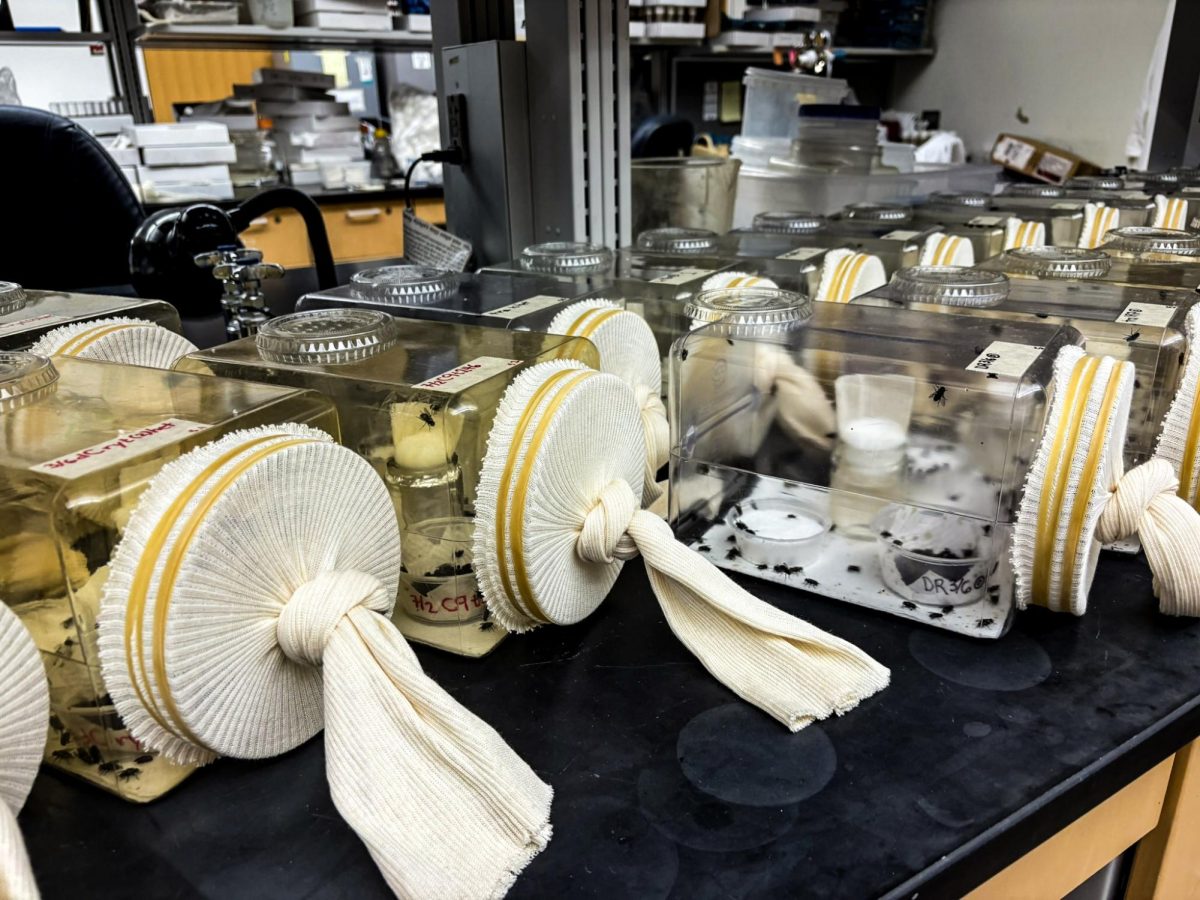
The New World screwworm is an unknown species of insect to most of the general public — yet the screwworm is a devastating pest that can cause significant harm.
The insect works by targeting living organisms — primarily cattle. It burrows or “screws” a hole into the animal to lay their eggs, helping secure nutrients for the protein-focused insect. When left untreated, the mortality rate for organisms infected is extremely high.
Screwworms were once very present within the United States, but in the 1950’s the USDA was able to begin pushing the insect out of the country — by 1966, the screwworm was declared eradicated from the United States. This was achieved by mass-rearing, or the use of sterilization via radiation, as well as releasing large amounts of the insect to mate. The release of these reared insects caused the population to drop significantly. A biological barrier was established in the Darién Gap, located in Panama, afterwards.
Max Scott is a professor in the Department of Entomology and Plant Pathology and is leading the research into screwworms here at NC State. When asked about the state of screwworms, he explained that many of the screwworms were able to break through the barrier.
“At some point in 2022 or 2023, the barrier failed. They were keeping the flies from coming back by releasing around 10-15 million sterile screwworms per week along the border between Panama and Colombia … But, and they successfully kept it out for … maybe 20 years, but then it did, the barrier broke, and the fly quickly moved through Panama and Central America, Southern Mexico, to where we are today,” Scott said.
Scott added that the approach to screwworms has become more efficient over time.
“One of the good things about this program is that the National Agricultural Library has a rich documentation on the history of this program … [Jeffery] Moore pointed out that the procedure would be much more efficient if you’re only released to sterile males. Because they’re the control agent … if you can release only males, your system’s gonna be probably much more efficient,” Scott said.
Research at NC State centers around ensuring the worms would produce only male offspring, Scott said.
“Our charge was to develop a method so they could produce only males. And that’s what we did with classical engineering. We engineered a gene that was female lethal, which we could keep switched off by adding an antibiotic to the diet, Tetracycline,” Scott said.
Scott explained that there were multiple challenges to the ongoing research.
“We’re not allowed to work with New World screwworm in our labs. So the biggest challenge has been evaluating our systems in primary screwworm. This is due to the United States’ precaution to not let the screwworm escape and possibly begin reproducing within the area,” Scott said.
When asked about the potential effects of the screwworm on the United States if the insect were able to reenter the area, Scott explains that the risk would be widespread, affecting many different organisms.
“This will attack any animal. If you look at the cases in Mexico, the number one cases are cows. That’s why they’re a major economic pest. But the number two is dogs. So in the areas where it comes, if it does come back, people need to be aware that their pets can be attacked by this fly. So they should be looking for wounds that have maggots in them. And a lot of people don’t realize that, although not the primary target of the screwworms, people as well can be burrowed into,” Scott said.
Sarah Hudadoff, a graduate student in the Department of Biological Sciences working with Scott, said screwworms would have an immense impact on agriculture.
“Screwworms entering the US would have the most impact on agriculture. People who work with livestock, because livestock, mostly cows [are most vulnerable], would see most of the damage from screwworms reentering the US. It would be really tough. Ranchers would lose cattle. Probably other animals, too. I know that in Texas, there are a lot of recreational hunting ranches. That industry would also see a hit,” Hudadoff said.
Scott added that the research team has made significant progress in reducing the amount of female screwworms that advance into adulthood.
“Initially, we made strains where the females died quite late in development at the pupal stage. Just because that was technically easier. And then later on, we further refined the system so the females died at the embryo stage or maybe very early level. So that’s an advantage for the plant because one of the big costs is the larval diet. One of those strains we’ve taken all the way through testing in terms of measuring by characteristics looks good. More recently, a former member of my lab is now with the USDA and has been getting it ready for potential use in the field,” Scott said.
Hudadoff said she has also been successful in some of her own work on the research.
“In my own projects, I’ve had some success. I built some genetic constructs that you can use to separate male and female screwworms. As embryos, so very early in the life cycle. Separating males and females is very useful for genetic pest control strategies, because the females mate just once, the males mate many times, so the males are doing most of the work for containment,” Hudadoff said.