

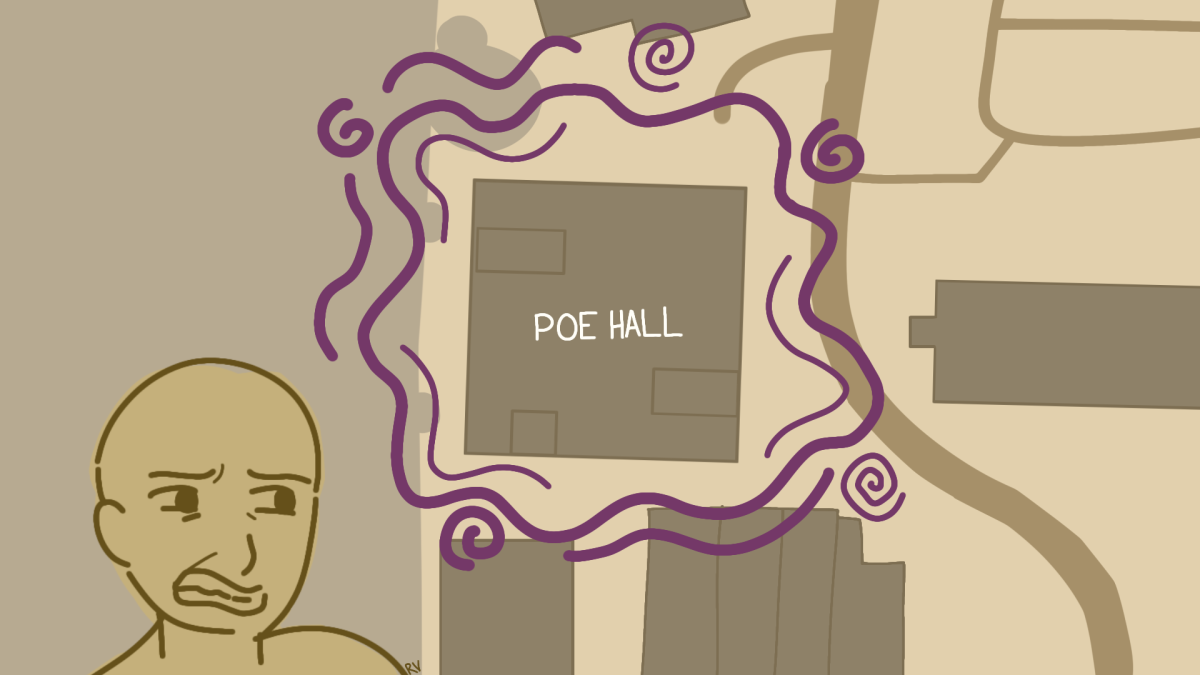
Poe Hall stands out among its peers. Compared to the other buildings surrounding the Court of North Carolina, it’s noticeably taller and has a square footprint. Not only that, but it is made out of concrete rather than brick.
Poe Hall has never had that sidewalk appeal. Its elevation off of pedestrian level means that passersby are mostly faced with the pebbled concrete walls. Looking back, its ominous, misaligned construction almost seems like a curse that sealed it to its terrible fate.
Ruby Grove, a third-year studying psychology, said the closure of Poe Hall has impacted her studies, making navigation and accessibility more difficult as her professors are scattered across campus. But she also emphasized that Poe Hall isn’t just an academic inconvenience, it’s also an aesthetic one.
“One thing I always loved about NC State is how pretty the architecture and the brick is,” Grove said. “Park Shops is right there, and that’s a beautiful building. And then you see Poe Hall and it’s taller than everything and concrete.”
Park Shops, though not initially a classroom building, is constantly active with student activity. With several lecture halls, a cafe with diverse food and drinks and a huge outdoor patio, it is an integral community hub on North Campus. The use of large windows creates a connection between the indoors and outdoors and invites patrons inside.
“Everything that’s around Poe Hall speaks a different language, if you will. A different architectural language. So, it makes it stand out,” Hill said. “For some people, through history, the fact that Poe Hall stood out was a good thing. It was unique.”
Poe Hall, as it stands, feels the same as it did since it was first built — daunting and estranged. The addition of toxic chemical emissions and indefinite closure only added to that reputation.
“I love NC State and I love the campus, so it does feel like a blip on what otherwise is a beautiful space,” Grove said.
David Hill is a professor of architecture and the head of the architecture school. He said the use of brick at NC State is not frivolous — it is connected to the environment of North Carolina. Hill also said brick lends itself to humanizing and grounding buildings.
“I can look across the street, see a brick building and understand how it was put together. How it took people to do that and how they laid up the brick one at a time to do that,” Hill said. “There’s a real human connection to brick.”
The material makeup of Poe is a testament to the time it was built. Constructed in 1971, the building was a result of trends towards brutalism. The style focused on the ideas of heaviness and permanence, but it also lent itself to the most important characteristics of campus buildings.
“Architects were really testing out the capabilities of concrete to build buildings. And they were interested in concrete for a lot of the same reasons we’re interested in brick — it’s a sturdy, durable material that will last a long time,” Hill said.
Brutalism is a controversial movement and its look is generally more foreboding than welcoming. Concrete is often stained by its environment, darkening the material. This might be part of the reason why the most notable brutalist buildings are governmental or civic in nature, not academic.
Hill said academic buildings are oftentimes no more than a backdrop to the vibrancy of campus life. Spaces like courtyards are emphasized as gathering places where community and school pride are built. The buildings around those green areas must serve their purposes, but aren’t asked to do much more.
“They’re wonderful buildings,” Hill said, referring to the surroundings of the Court of North Carolina. “They’re sturdy, they have a certain size and scale. But there aren’t too many features of those buildings that you would say are just remarkable and memorable. What you remember is the Court of North Carolina, and the landscape and the trees and how things are well maintained within that space.”
Hill explained that walkability is also an important part of campus architecture. NC State is located in an urban center, and campus-city integration has made outdoor spaces all the more important to the culture and approachability of the area.
“It amplifies those wonderful outdoor spaces that we have, especially in the older part of campus,” Hill said. “I’ve mentioned the Court of North Carolina, but we can talk about the Brickyard on Centennial Campus, we can talk about the Oval — how those spaces are formed by buildings that really are not trying to say, ‘look at me.’ Those buildings are trying to say, ‘look inside.’”
Hill said that welcoming image, the ‘come inside’ look, is essential to modern campus architecture. The campus architects, who set the guiding principles of new projects, emphasize ‘hearth space.’ Using fireplaces as a guiding principle, they aim for every building to have a space where people can come in and gather.
The outside appearance of a building is one of the most important factors of that goal, as they need to look inviting and communicate to passersby that they are welcome. The visibility of the campus community, what we can see by walking down the sidewalk, sets that tone.
“We’ve all been to cities where storefronts are closed down, a shop didn’t make it or a restaurant, or maybe entire blocks are not doing well,” Hill said. “People tend to stay away from those places until they’re revitalized.”
Now, Poe Hall has become one of those places. A gloomy, desolate void in an otherwise green and community-centered space. While its unique architecture could have become an iconic testament to its vibrant classroom environment or location in the heart of campus — instead it is a lingering reminder of its dark stain on NC State history.