

When Sandy Alford saw the word “Poe” in a WRAL headline on her phone, she was already halfway to bed.
“I was in my pajamas,” Alford said. “I was going into my bedroom to go to bed, and I, for some reason, opened up my phone and leaned against the wall before I turned the lights out, and I looked at the story and I saw Poe Hall. It took my breath away.”
The January 2024 story tied a growing cancer cluster to NC State’s education building. Alford, who finished her master’s in adult education at NC State in the early 1990s and later worked on campus, recognized the implications for her as soon as she saw the name.
“I leaned against the wall, and I yelled into the bedroom to my husband and I said, ‘Jeff, this is the building that has cancer on NC State?’ And he said, ‘Yeah,’ because he was half asleep. And I said to him, ‘It’s Poe Hall.’ And he said, ‘Okay.’ And I said, ‘Not okay. That was where I did my master’s work.’”
Alford is now one of 12 named plaintiffs suing NC State over alleged PCB contamination in Poe Hall and the cancers they say followed. Alongside her is former faculty member Linda Dillon Jones, who said she spent thousands of hours in Poe over 13 years, only to learn decades later that the building may have contributed to a lifetime of health problems.
For both women, the lawsuit is as much about being heard as it is about any eventual ruling.
“This is not about a lawsuit to me,” Alford said. “It’s certainly not about money. I’ve had people approach me and say, ‘Are you being compensated?’ It’s like, I don’t care. I need to find people and let them know that they were exposed to horrible amounts of chemicals in that way.”
Years in Poe, years of symptoms
Alford arrived at NC State in 1989 to pursue a master’s degree, packing her schedule with spring, fall and “many summer classes” to finish in about two and a half years. She said she spent long stretches of that time in Poe Hall. After graduation, she returned to campus as manager of NC State’s training and development department, a position that brought her back to Poe.
While she was still a student, Alford developed what she now recognizes as a classic PCB symptom.
“I talked about a skin rash that I had, and that’s known as sort of the canary in the coal mine when you have PCB poisoning, because the chloracne is what it’s called,” Alford said. “I got it on my hands, but it’s typically something that shows up on the face, and I got that as well.”
Alford said the rash began “right over my thyroid and then just spread” to the point where a coworker confronted her before a presentation, asking if she was nervous since she was “breaking out in hives.”
Alford also developed asthma while she was still in school.
”From the time that I was in Poe and post-Poe, I had breathing treatments, I had the nebulizer, I had pleurisy, I had pneumonia, I had bronchitis, I had all kinds of health issues regarding breathing,” Alford said. “I never smoked, didn’t smoke ever in my life and didn’t live or work with anyone that smoked either.”
In 2018, doctors diagnosed non-cancerous thyroid nodules on both sides of Alford’s thyroid. Not long after, she learned she had breast cancer, which led to surgery and radiation in 2021.
“The depression started to set in,” Alford said. “ … I just kept thinking, I’m getting older, but I’m not old, and I’m in decent health. I’ve taken pretty good care of myself.”
In 2025, an MRI ordered for symptoms concerning metastatic cancer revealed a tumor in her pancreas. Although benign, it’s one that “could turn into something else” and now has to be monitored.
“It’s deadly,” Alford said. “They call them zebra cancers because they are really rare. And so I know if this thing flips, I have probably six to eight months.”
Jones’s story begins earlier. She joined NC State’s faculty in 1979 and stayed until 1992, teaching classes, advising graduate students and spending most days and many nights in Poe.
“I was there two or three nights a week, sometimes from four to seven, sometimes from seven to 10,” Jones said. “I went in at 8:30 in the morning, never left before 5:30. And then I was there both Saturday and Sunday …”
While she was working in the building, Jones said she had repeated sinus infections and a “terrible cough.”
“I had a terrible cough that it felt like somebody was stabbing me with a knife,” Jones said. “If I was on a phone call, I might start coughing and people would become troubled that I couldn’t stop coughing and thought I was choking, and they’d be like, ‘Oh my God, are you okay?’”
Near the end of her time at NC State, as Jones was preparing to move to Washington, D.C., she suddenly developed vestibular neuritis, a condition that affects balance.
“All of a sudden, [it was] just like somebody flipped a switch,” Jones said. “I was stumbling around; if I put down a glass, I would drop it like an inch over the table. I was spilling water, I was knocking things over. I would ruin all my clothes because when I would go to drink, I would tilt the glass before it was at my mouth.”
Doctors told Jones it was a virus that would pass in two weeks. Instead, she said it “began four months of real terror” and derailed job interviews during a pivotal moment in her career.
“When the dean [at Georgetown] took my arm in his and walked me to my next interview, I knew there was no way they were going to hire me,” Jones said. “You’re never going to hire somebody who’s critically ill and hope they recover by September.”
It would be almost three decades before Jones connected these illnesses to Poe.
“My grandmothers lived till their 90s, my mother lived to be 94, my sister is totally healthy — I come from a line of strong women,” Jones said. “I should not have five major things wrong with me. It just doesn’t make sense to me that I should be.”
After leaving NC State, Jones went on to work at Johns Hopkins and other institutions. Along the way, she was diagnosed with Hashimoto’s disease and endometrial cancer, which has returned twice. Treatment included a hysterectomy, chemotherapy and more surgery to remove a tumor on her abdominal wall, also resulting in her suffering from ulcerative colitis, forcing her to spend nearly two years mostly confined to her home due to severe, unpredictable symptoms.
“I really pretty much had to sit in my bedroom and watch television for two years because I would just have spontaneous diarrhea five or six times a day,” Jones said.
Now, Jones pays about $900 a month for a biologic drug.
“What would I like to do with $900 a month?” Jones said. “I could give that to my grand girls to go to college with. I would love to know what my alternative life would have been.”
Once the news broke, Jones said the building offered an explanation for the myriad of rare and debilitating illnesses she’s had over the decades. “And it was comforting to suddenly realize it could be Poe Hall. You know, there could be a reason why I’ve had all these issues over the years,” Jones said.
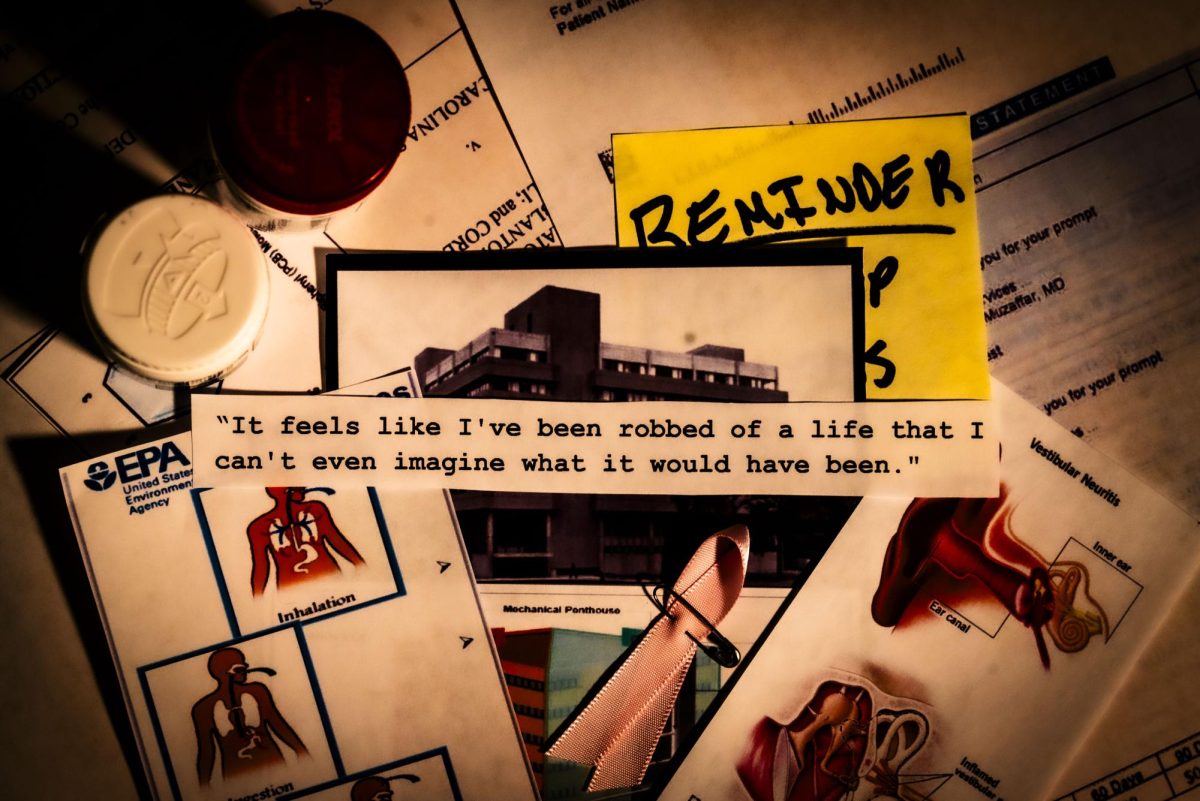
“It feels like I’ve been robbed of a life that I can’t even imagine what it would have been,” Jones said.
Patterns and “penny drops”
Alford said it wasn’t just her own diagnosis that made Poe feel like the common denominator. It was what she began to hear from others once Poe’s name went public.
When WRAL’s Keely Arthur invited her to participate in a panel, Alford walked into a room with seven other women with ovarian cancer, thyroid cancer and breast cancer.
“That’s when the penny dropped,” Alford said. “I think that this could be the trigger that started all of this. And then the more we talked in that panel with Keely, the more convinced I was that was probably the case.”
Another “penny dropping moment,” Alford said, came when she thought back to her former boss, Mark, who had completed his doctorate at NC State and spent six years in Poe.
Mark died at 48 from a rare brain cancer, leaving behind a wife and two daughters. After the WRAL panel, Alford decided she had to find and contact his widow.
“She actually said to me, ‘Thank you for contacting me because we couldn’t figure out why Mark died.’ And I said to her, ‘What do you mean? And she said, ‘Well, the doctors told him he had a very rare brain cancer and they couldn’t figure out why he had it.’ They sent him to Johns Hopkins, they couldn’t figure out why, and they couldn’t treat him.”
Alford said that response “gave me courage to keep looking” for other victims.
“Word of mouth” and lack of warning
Jones learned about the lawsuit not from the University, but from a friend. She said that she had to rely on personal networks to find out about potential exposure and says a lot about NC State’s response.
“It is still all word of mouth,” Jones said. “I think an ethical response would be to send out some kind of a statement saying here’s what’s going on to everyone who’s ever worked in Poe Hall, wouldn’t you think? Doesn’t that seem reasonable? That hasn’t happened.”
Alford described a similar frustration. She said when she first reached out to then-Chancellor Randy Woodson by email after seeing Poe named in the news, she heard nothing back.
Alford said she offered to share her medical records and dates of exposure with the University and was never asked to provide them.
“One of the questions that I asked Chancellor Woodson at the time is where do you want my medical information? Because, just assuming you’re concerned, you want to know that I’m sick, you want to know the dates that I was there, you want to know what kind of cancer I have, what kind of health issues,” Alford said. “Nope, never. Never asked me for it. I offered it and they never asked.”
According to Alford, multiple cancer patients tried to give the University similar information.
“Multiple cancer patients that were in Poe did the same thing and NC State did not want that information,” Alford said.
Two and a half years later, Alford said, she has yet to sit down with a University leader.
Holding on to hope
Both Alford and Jones said they often think about current students and recent alumni who passed through Poe without knowing what may have been in the walls and air.
“If students currently on campus were exposed in Lampe or Dabney or Gold Residence Hall, Poe Hall, wherever they were, they’re going to be in our shoes,” Alford said.
Every time someone new calls her, Alford said, the feeling is bittersweet.
“The strange thing is that you sort of hope that you don’t see [them] at the same time,” Alford said, describing nights spent searching obituaries. “You kind of hope that you do so that you can have that same conversation and say, let me talk to you, because I’ve got some information you might need to know.”
For Jones, hope looks like the small acts of care and a community she has rebuilt since moving back to Raleigh from California after the recent death of her husband, even as she copes with loss and chronic illness.
Jones said discovering a network of former colleagues and friends who were willing to help her through something as routine as a colposcopy is a reminder that she is not facing Poe alone. She likened it to a “snow home” — a concept in which children in Minnesota are assigned the homes of families living near their school to stay during severe snowstorms.
Alford said she still believes there is a path forward.
“It’s not for us. It’s for the current students that are on campus. I mean, every students walk by this corridor, they’re being exposed to toxic chemicals, and that just isn’t right. And how this university’s administration can justify that, I don’t know. And so the hope is that someone will do the right thing. Someone here in this university will wake up and stop looking at this as litigation and just do the right thing. So I’m not quite giving up hope on that, even yet.”