

Editor’s note: This article contains mentions of sexual assault.
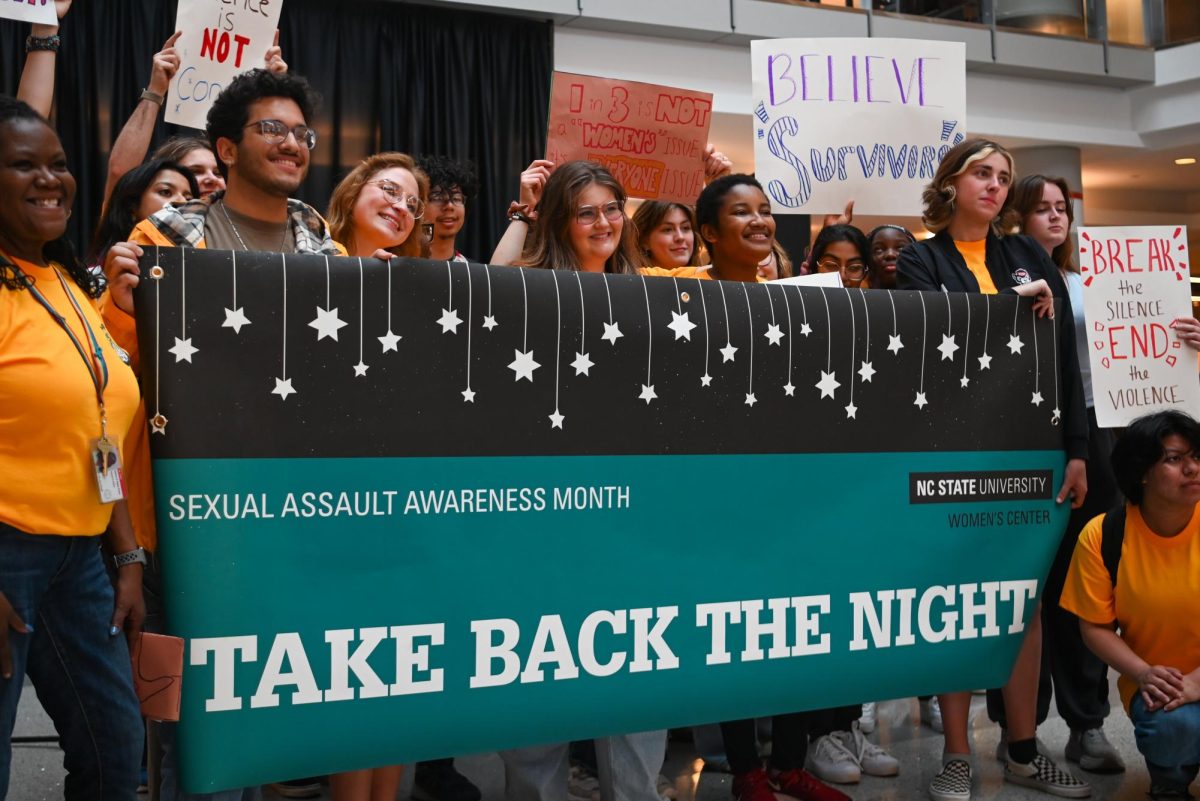
The Women’s Center will hold its annual Take Back the Night event in honor of sexual assault awareness month, focused on uplifting and highlighting the voices of survivors of sexual assault. The march will kick off in Stafford Commons on April 8 at 4 p.m. with a resource fair, followed by the march and rally.
Take Back the Night began in the late 70s at the University of Southern Florida as a way to demand resources and safety for survivors of sexual assault. It has since made its way to the NC State campus to share that awareness and to uplift and support these survivors and allies.
The Movement Peer Educators is a student-led organization focused on educating the community on interpersonal violence. The Women’s Center and The Movement traditionally team up to co-host the annual Take Back the Night event.
Jordan Abernathy, a fourth-year studying anthropology and the director of communications for The Movement, said Take Back the Night is rooted in certain fears that women face every day.
“With Take Back the Night, [it started with] the idea that women are unsafe in the darkness, and nighttime is kind of like this evil,” Aberathy said. “So it started off on that, and that was really focused on sexual assaults and rapes that were stranger assaults. Like, ‘Oh, there’s somebody in the bushes that’s going to come out and grab you.’”
Indigo Weaver, a fourth-year studying nutrition and director of outreach for The Movement, said Take Back the Night has evolved since then to not only support and encourage, but also provide survivors of all demographics with resources and a safe community.
“It’s growing to encompass, not only more ideas of what rape is, but also more people and more groups. And that’s something we try to address in Take Back the Night. It started out as a women’s movement, a women’s protest, but as we’ve gone through the years, we know that women aren’t the only people who can be survivors,” Weaver said. “Men can be survivors, non-binary people can be survivors, people have all races and sexualities, and that’s something we really try to hit on. Because it’s difficult enough for survivors to report already.”
It can be scary for survivors to speak out about their experiences for fear of stigma against their experience or the worry of not being believed, Weaver added.
“Women face the idea that people won’t believe them because it’s kind of this bias against reporting in the police system,” Weaver said. “But men, of course, who report also face a bias that they won’t be believed because they’re men and they’re supposed to enjoy it, and it’s just a horrible system for everyone involved. So we want to make it inclusive for all people and all survivors.”
NC State’s Take Back the Night march includes multiple forms of resources for survivors. The kick-off for the march is the resource fair, where pamphlets, hotlines and even counselors are present to support survivors.
Abernathy said at this year’s march, the Women’s Center is expanding the resource fair to include off-campus resources in addition to the usual on-campus ones.
“Something we’re doing this year [differently than other years] is expanding our resource fair. It’s gonna be the longest we’ve done it. A full, true hour of resource fair. This resource fair is huge because we invite a lot of external community members from our campus,” Abernathy said. “We’re aware that not all sexual assaults happen on our campus. So, how do we include when you graduate, when you become an alumnus, when you become a community member? How do we set you up for success to continue to cultivate this culture that is against sexual violence and is aware of how that society plays into the role?”
Weaver said that in addition to the resource fair, the march route is altered every year in hopes of reaching all members of the community.
“We tweak the march route every year so that we have this little march around campus, and we want to make sure that we’re going by areas where as many people as possible can see and join the march,” Weaver said. “We try to hit Hillsborough Street, the Bell Tower. That gets updated every year, and we try to keep people together and able to join for anyone who wants to.”
The Take Back the Night event ends with the Survivor Speak Out. This is a confidential event where survivors are encouraged to share their experiences if they have something to get off their chests, or just listen to those around them.
Counselors are present throughout the event and are non-mandated reporters, allowing survivors and allies space to share.
Abernathy said the Survivor Speak Out is empowering for survivors because it provides a safe, unprejudiced place to be heard without pressure to report.
“At the end of our rally to finish off the evening, we have a Survivor Speak Out, which is in the [Talley Student Union fourth-floor ballroom]. It’s in a closed-door room, and it’s the one night a year that all the Women’s Center staff are not mandated reporters, and we have so many counselors,” Abernathy said. “It’s a way for survivors who don’t want to report, aren’t ready to report, but would like to be in a room with other survivors, to talk about their experience. We have counselors, people from the Women’s Center and Student Care Educators. None of us has to report, which is so nice for that one evening. I think that’s a way they can feel heard.”
Weaver said the Survivor Speak Out is meant to encourage survivors to share and to help break the stigma against speaking about sexual assault.
“The Survivor Speak Out is the place to actually talk about the sexual assault. And then we always try and kind of reduce that stigma in our speeches that we write, as well as the speeches that are done by our guest speakers,” Weaver said. “We want to address the crowd in a way that makes it very clear that this is not something that should be stigmatized, people who are victims of sexual assault should never have to feel shame, and unfortunately, they do because that’s what we’ve been taught to feel.”
Abernathy said this event is shame-free and is led with the hope of cultivating community and support.
“I think a lot of times, sexual violence feels very isolating, and it feels very much so, because it’s so unique, depending every single time, it’s not a car theft. It can be cut and dry. It’s so personal. There are so many emotions. It feels so heavy,” Abernathy said. “The healing from that is never linear, and I think that’s something where the visibility of it is just so powerful on this campus that you can see that community. You can feel that community, and it’s there.”
Take Back the Night is also about educating the community. Weaver said Take Back the Night is a learning experience for everyone involved, and showing up is the first step to better understanding exactly what sexual assault is.
“It’s absolutely a space for everyone. Both Take Back the Night, the Women’s Center and The Movement. It is for every single person on this campus. You don’t have to have a certain experience to qualify. There’s no requirement to get through the door,” Weaver said. “We want everyone to be a part of this, to feel welcome in this community and to feel like they have people they can rely on and people they can learn with, because we are all learning, and we’re doing the best that we can to make campus a better place. We’re so grateful to every single person who was a part of that.”
Abernathy said everyone is welcome, whether they are a survivor, secondary survivor or an ally; everyone can come and be a part of Take Back the Night.
“It’s a great community to be a part of. We deal with a lot of heavy topics sometimes, but it can be very approachable, especially the way The Movement Peer Educators approach it,” Abernathy said. “The space is always open. It’s always available. And you don’t have to know everything as peer educators; we’re also developing education, educating ourselves constantly.”