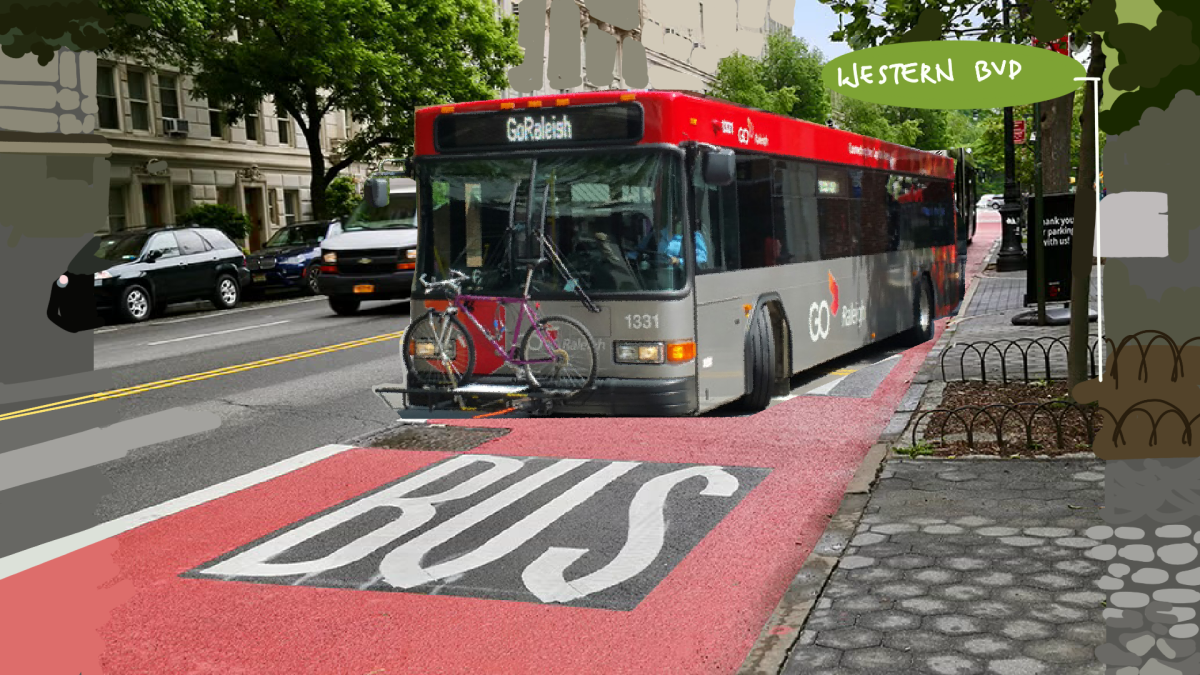
GoRaleigh is eyeing Western Boulevard for a new bus rapid transit system, aiming to connect the NC State community with Cary and downtown Raleigh more easily and effectively.
The agency has also expanded service, along with GoTriangle, launching a new, frequent Route 9 coming every 15 minutes along Hillsborough street, along with expanded service for Route 11, also coming every 15 minutes through campus.
NC State University Transportation has cut back on proposed service cuts for fall 2026, following significant public backlash including a petition garnering over 800 signatures.
The University is planning for the elimination of up to 2,000 parking spots over the next five to ten years as well, and is currently gathering feedback for the proposed changes.
Bus rapid transit on Western Boulevard
Raleigh is planning for the construction of four bus rapid transit corridors: the western corridor, traveling along Western Boulevard past NC State University, the southern and northern corridors and the New Bern Avenue corridor, to the city’s east.
The New Bern Avenue route is currently under construction, while the western corridor is in the design and planning phase with expected completion in 2032, providing service between downtown Raleigh and Cary.
Bus rapid transit is an improvement over existing bus service, aiming to speed up transit trips by improving efficiency and implementing features such as dedicated lanes, off-board fare collection on platforms and communication with traffic signals.
Gabriel Wilkins, a senior transit planner for the City of Raleigh, said many of these features will be included in future BRT service.
“Some of the most visible [features] are your dedicated lanes … usually painted bright red. You’ll also see larger vehicles. There’s 60-foot articulated buses, which are actually more maneuverable in some cases than the normal 40 foot buses you see … and they have more capacity, particularly standing room capacity,” Wilkins said.
Dedicated lanes can be combined with right-turn lanes on the right side of the road, or placed towards the median — which is the plan for Western Boulevard past NC State, Wilkins added.
Other features include level boarding, with bus platforms for BRT routes raised 14 inches to match the height of the bus floor, improvising accessibility. Routes are also planned to include traffic signal priority, allowing buses to communicate with traffic lights to make routes more efficient.
“[Transit signal priority] is just a way for the bus system with GPS and things like that to talk to the system that manages traffic signals, so that if a bus is particularly full or running a bit late … it might come to the intersection right as it’s going to switch to red, it can ask, ‘give me five more seconds of green so I can get through the intersection, get to the station and keep going,’ or that can work in reverse,” Wilkins said.
Station platforms will be significantly improved over regular bus stops, including off-board fare collection on the platform. Articulated buses used on the route will have doors on both the left and right side of the bus, allowing them to use stations placed in the median of the road.
Currently, stations around NC State are expected to include a stop at the Pullen Road bridge, one at either Varsity Drive or Dan Allen Drive and an additional stop at Gorman Street.
Buses are planned to run every 10 minutes during most of the day, and every 15 minutes earlier in the morning and later in the evening. Service is expected to run from 4 a.m. to midnight.
Raleigh is also planning for transit-oriented development in conjunction with BRT routes, aiming to ensure proper accessibility for individuals walking or biking to stops, coupled with increased density and mixed-use development around stops, incorporating residential, commercial and office uses to encourage ridership.
“[The city] knows the population is increasing, it would prefer not to continue expanding beyond its extraterritorial jurisdiction and city limits,” Wilkins said. “It wants to see more of what’s called ‘infill development,’ near existing roads, networks, sidewalks and all that. And so it wants to cluster and focus development near transit.”
Over the years, communities across the Triangle have envisioned expanded rail service such as through the failed Durham-Orange County Light Rail Transit project or commuter rail, with projects proposed in the Wake Transit Plan and funded by a half-cent sales tax approved by voters in 2016.
Transit agencies are now focusing on using funding for increased and expanded bus service as costs have increased for rail projects, Wilkins said.
GoRaleigh has also expanded standard local bus service in the NC State area, including through the launch of Route 9 in September 2024, part of its frequent service network encompassing 11 routes coming at least every 15 minutes.
The route travels along Hillsborough Street past the University to Raleigh Union Station and downtown Raleigh, supplementing Route 4 and Route 12 on the street in addition to GoTriangle Routes.
Route 11 also recently gained increased service, joining the high-frequency network. The route travels from downtown through the University and across Western Boulevard onto Avent Ferry Road.
Wolfline and parking changes
Wolfline changes are also coming for the fall semester, though many harsher cutbacks have been reversed by University Transportation.
Amanda Simmons, transit planner for the Wolfline, stated plans such as discontinuing Route 52 or the realignment of Route 41 were cancelled following public input.
“We had posted changes, including eliminating Route 52. But based on the feedback we received from students, we brought Route 52 back with two buses. In addition, when we had taken away 42, we had moved 41 over to Dan Allen to kind of take up or make up for some of that missed service that 52 was providing,” Simmons said.
Now that Route 52 is not being eliminated, the realignment of Route 41 is no longer necessary, Simmons added.
Route 50, currently serving Avent Ferry Drive and the Food Lion near the intersection of Gorman Street will still be eliminated. Route 42 will gain weekend service and also expand service to the Food Lion.
“[Route 50] is basically the same route that GoRaleigh Route 11 is providing service. And then also with Route 52, we only have two buses, but that’s because GoRaleigh Route 12 is providing that service,” Simmons said. “We are really hoping since student fees pay for the GoPass that more people will be inclined to use the GoRaleigh buses and GoTriangle buses.”
The GoPass allows students to use GoRaleigh and GoTriangle buses free of charge by requesting one from the University and using the Umo app on their phone.
Route 20 will also be rerouted behind Engineering Building II to alleviate crowding on Route 40.
Andrea Neri, transportation planning manager for NC State Transportation, stated planning decisions are made with other regional transit agencies, such as GoRaleigh, in mind.
“We are fully integrated within our planning with what happens at the city level and regional levels. We managed to get … GoTriangle Route 305 in a few months to be routed through Centennial Campus, meaning that there’s going to be a direct connection from Holly Springs, Apex, all the communities in southeast, South Raleigh,” Neri said.
Neri stated that University Transportation has received money from Wake Transit funding for improved shelters and bus stops outside of campus.
The University has also proposed eliminating up to 2,000 parking spaces on campus. Demar Bonnemere, communications manager for NC State Transportation, stated the proposed elimination is largely due to additional buildings on campus, such as the Cates West Development.
The northern portion of Coliseum Deck has reached the end of its life, eliminating roughly 1,100 parking spaces, Bonnemere added.
“Do we just do away with those spaces we lost? Do we try to get some of them back?” Bonnemere said. “We kind of want to get the campus appetite for that because there’s going to be a cost for any of those options. You know, for some it’ll be a minimal cost involved in the parking prices to a significant increase in parking prices if we decide to bring back all 2,000 or more spaces.”
The university is also working on encouraging other methods of transportation, such as through a multimodal network plan and the WolfTrails program. Students are encouraged to provide feedback on the Parking Action Plan.
Wilkins encouraged Raleigh residents to utilize the bus system and emphasized the need for “human-scale” and mixed-use development incorporating a variety of methods of transportation.
“If folks have never tried the bus, it’s not as scary as you think,” Wilkins said.