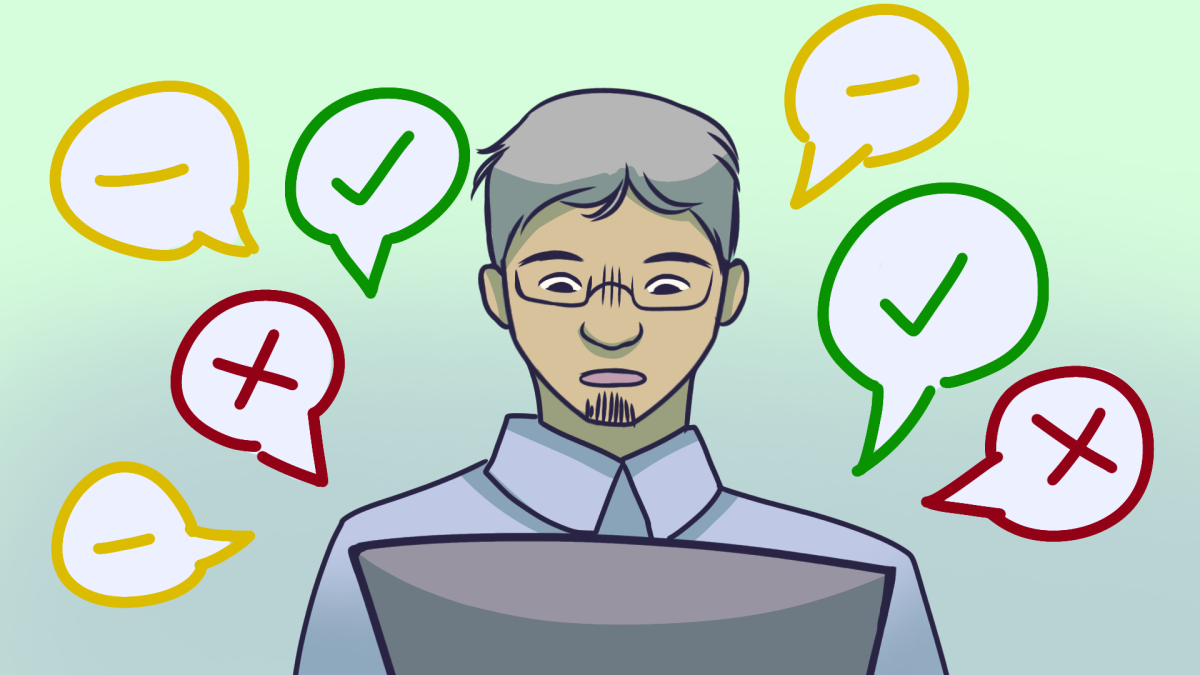
As the semester comes to an end, ClassEvals are sent out via email to students. However, many students know this is not the only option for evaluating a professor with the popularity of sites like Rate My Professors.
Rate My Professors is an online site where students can leave an anonymous review on their professor or evaluate their experience with a course in a matter of minutes. While the site is not endorsed by any university, students may still look to the site as a tool when deciding what section of a class to pick.
Rate My Professors was designed for students to get a preview of what the courses they sign up for will be like, from how difficult they are, the amount of work they entail or if attendance is mandatory.
But some faculty argue the website may skew insight into what professors are actually like when only the most extreme opinions are the ones most commonly voiced.
Lincoln Larson, an associate professor in the Department of Parks, Recreation and Tourism Management, and a member of the Evaluation of Teaching Committee that manages ClassEval at NC State, said Rate My Professors can negatively affect faculty members and put them in a bad light for any student who might think of attending their class.
“I know a lot of faculty members who have been really frustrated, upset, emotionally hurt by reviews on there that they’ve asked to have removed and haven’t been. So it can be traumatizing for faculty members to get negative reviews on there, knowing it’s public facing and knowing it could impact the way other students experience their classes,” Larson said.
Larson talked about his experience with various forms of evaluating teaching and how that inspired him to get involved with the teacher evaluation committee at NC State. He hoped to help fix the problems of the system not working as expected and teachers not getting the feedback they need.
Larson explained how the evaluation of teaching committee functions at the University and how it works to improve courses.
“Evaluation of teaching at NC State has two required components. First, it is the classic ClassEval’s that all the students fill out at the inner class, and that’s one component that is kind of mandated in the NC State policies that we have to do. The content of [ClassEval] is something that we can decide to change or update on an annual basis,” Larson said. “The other way the classes are evaluated, or the teaching is evaluated, is peer reviews of teaching, which is also a required part of promotion and tenure.”
Fernada Duarte, an associate professor in the Department of Communications, said ClassEval is one of the most helpful tools for improving her class, especially through dialogue with students.
“For me, it’s a very important constructive tool for dialogue between my students and the experience that we have together, learning with one another, and it’s one that is also serious. It’s taken very seriously by not just by instructors, but by departments and by colleges and the entire University and affects our evaluation, internal evaluation directly,” Duarte said.
Larson said he believes the reason reviews from Rate My Professors are skewed, either positively or negatively, as it is often the students with the most extreme opinions that feel the need to leave a review, leading faculty members to not put much thought into the site.
“Because it’s completely voluntary to contribute, it’s always going to be more extreme, and it’s really hard to gauge the efficacy of someone’s teaching when you just have the loudest voices on either side joining the conversation. So that’s why faculty members don’t put much stock in it and think it does more harm than good,” Larson said.
Duarte said she found the site to be quite one-dimensional, focusing on things like how easy a course was rather than its actual learning outcomes.
“It felt very limiting what people had to say, and it was clearly focused on easiness. Like, ‘How easy of a class does this professor make it? How easy of a pass will this professor make it?’ Which is such an accidental outcome of a teaching and learning experience. If you pass, or the grade, that shouldn’t be the focus, but it should be the natural consequence of the learning,” Duarte said.
Duarte said Rate My Professors almost feels like a customer service experience where the bulk of reviews are negative outliers.
“If you have a bad customer experience, it’s more likely that you complain about it than you will pay compliments when you have a good customer experience. The reports tend to skew negatively, but the biggest problem here is treating education as transactional,” Duarte said.
Duarte said when looking for resources to learn about a course or professor prior to meeting them, the best course of action is to talk with that professor or other students face-to-face.
“I think talking to students who have taken that class or have had an interaction with that professor before is very helpful. Often, instructors will also have websites online or will have other materials online about the courses. So basically, try to get information from the source directly, and people should also be aware that you should not be intimidated. You just come and talk to the instructors themselves,” Duarte said.
Larson agreed with Duarte that the best course of action is to talk to people like the professor or students who have real experience with a course.
“I would discourage students from putting too much stock in what can be learned from Rate My Professors. If you want to know about a course or what the requirements will be or what the expectations will be, email the professor directly or talk to students who have taken it before,” Larson said. “Do not trust a website like that to make decisions about your educational future.”