

The recent federal immigration enforcement presence in Raleigh has left some Latino students at NC State feeling unsafe, angry and abandoned by institutional leaders, as student organizations scramble to fill what they see as a vacuum of support. While some student leaders have pushed for resolutions and resources, others say the University and top student officials have moved too slowly to meet the moment.
Unverified reports indicate a potential new operation deploying 50 officers may be taking place in Raleigh, although the City of Raleigh told Technician in a statement that they were aware of such claims, but “there is nothing we can confirm from our end.”
In a statement to Technician, the U.S. Border Patrol said they “do not discuss future or potential operations.”
“It’s predatory.”
For some students, the fear began before federal agents reached Raleigh on Nov. 18. Edith Tenesaca-Mejia, a second-year studying fashion and textile management and student senator, first heard about raids from her family in New York. She said the situation became real when her mother texted her as reports of enforcement in Raleigh spread the day prior.
“I had gotten a text message from my mom, saying, ‘Hey, make sure you have your identification with you. Do not leave anywhere without having identification.’ I just remember being in utter shock,” Tenesaca-Mejia said.
The deployment followed a recent Supreme Court ruling that has allowed federal immigration agents to initiate enforcement based on perceived race, language or location. A change David Suarez, a fourth-year studying construction engineering and president of the Gamma Sigma chapter of Lambda Theta Phi Latin Fraternity, said has opened the door to profiling.
“It’s insane to think that in 2025, racial profiling is a legal thing that these agents can deploy and it’s predatory. At the end of the day, it’s dehumanizing,” Suarez said.
Suarez said that fear does not stop at immigration status.
“These injustices aren’t happening just to those that are undocumented, but they’re coming after those who are documented as well, who are citizens of this nation,” Suarez said. “And that’s why it’s of the utmost importance to stand against these immigration agents and not let these things happen.”
Tenesaca-Mejia said that as a U.S. citizen, she now feels unsafe doing everyday tasks due to the risk of arrest by racial profiling.
“I am a citizen, I’m born and raised here, I have a right to be here,” Tenesaca-Mejia said. “But it’s so freaking frustrating that I’m terrified to even go to class. I’m terrified to even do simple things.”
Suarez said that fear now shadows his routine campus commutes, especially after seeing videos of citizens being pulled over, windows broken and dragged out of vehicles.
It’s scary because I could be riding my skateboard down the street, and just because one [officer] thinks that I’m undocumented, they’re gonna go ahead and use force against me,” Suarez said. “That’s not the way things should be whatsoever. Just based on the color of our skin and the language we speak, it’s not right whatsoever.”
The “Defend the Pack Act” stalls, as students step into a “leadership void”
Liam Barry, a first-year studying environmental science and vice president of the NC State College Democrats, said his organization began planning the night they were told agents were coming.
“While we’re an extension of the Democratic Party, our commitment really is to the people here at State,” Barry said. “And my initial reaction was, ‘What can we do?’”
Liam said the organization began working as soon as they left a meeting where they were briefed on the agents’ planned presence.
“We got out of it, and we made content immediately. We got red cards, we got whistles. And we just are trying to do everything we can from an organizational perspective,” Barry said. “We don’t have any power over what Border Patrol does and doesn’t do. So our initial reaction was to get resources and give them out as quick as possible.”
College Democrats and allied groups distributed “Know Your Rights” red cards in multiple languages, along with whistles and information about reporting suspected immigration activity through community networks.
Suarez said his fraternity and partner Latino organizations have focused on mutual aid and mobilization.
“Firstly, we want to make sure that every single brother is putting their family first, making sure that they’re okay and then putting their immediate friends, making sure that they’re a priority as well,” Suarez said. “But other than that, we always kind of hope that, and encourage every single one of our members who are documented help out with their privilege to come out and help organizations such as Siembra, such as Brava, to combat during this time of oppression.”
Suarez said sharing concrete resources has been a top priority.
“Reposting stuff on social media is not a substitute for real action at the end of the day, and just trying to share resources with people has been the one thing that we’ve been trying to do and put out the most,” Suarez said. “We’re trying to organize on campus to show that we have a voice. We have a voice at the end of the day and we should use it, especially as educated Latino men here on campus.”
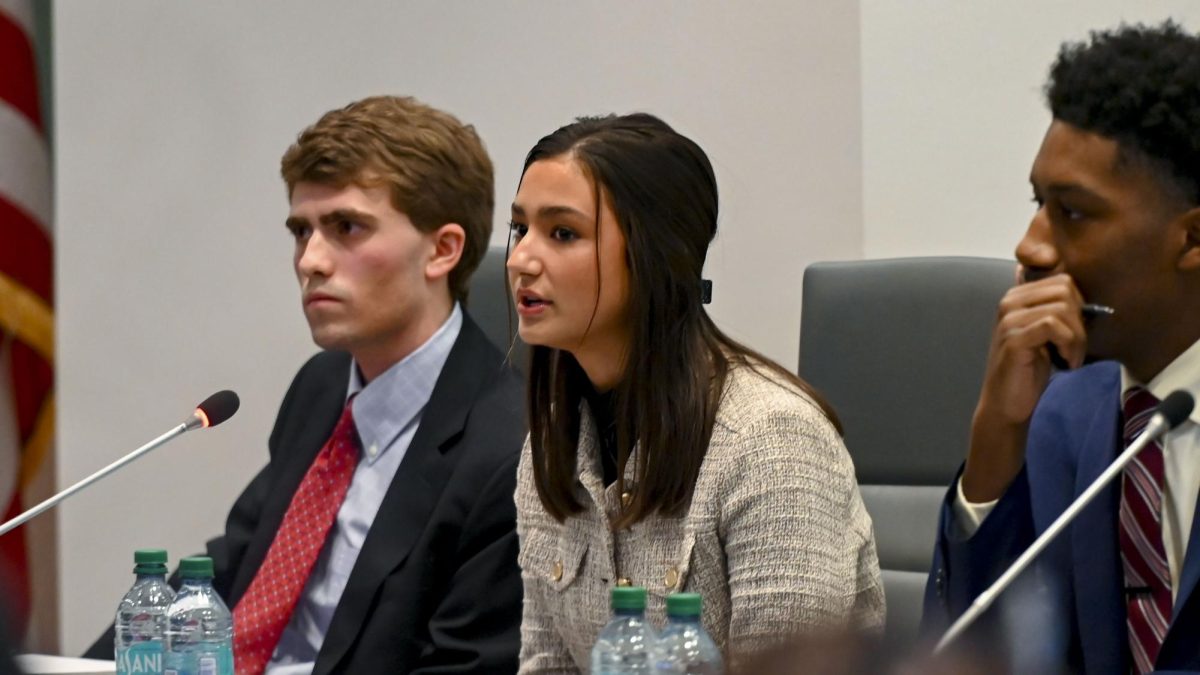
Student senators introduced the “Defend the Pack Act,” a resolution that would officially condemn federal immigration enforcement operations and call on the University to protect students’ rights, on the morning of Tuesday, Nov. 18, the first day of deployment in Raleigh. Judson Avery, a second-year studying political science and philosophy, College Democrats communications director and the bill’s primary author, said the legislation intended both to support current university practices and to send a clear message.
The resolution passed the Student Senate with broad sponsorship, but it has not yet been signed by Student Body President Isaac Carreno.
“Unfortunately, that has gotten held up. We got it through the Senate, but it’s at Isaac. It’s on his desk, and it hasn’t been signed yet, which I’m pretty disappointed,” Avery said. “It’s really unfortunate that it’s still caught up.”
Avery said the bill arrived on Carreno’s desk on Wednesday, Nov. 19. He has ten class days to sign or veto the legislation before automatic passage. Holidays and winter break push the deadline into the spring semester’s first week.
Barry said the delay sends a damaging message to students who came forward to share their fears.
“People shared their stories of why they’re afraid, and to see the SBOs just roll over and be afraid of what this may have as an effect on the reputation, they’re choosing their professional appearance over the students that they represent,” Barry said.
Barry said that in his view, student organizations started doing work that he believes Student Government should have led.
“This is a big moment for us as a university and as leadership, and to see the most known and respected student leader in Isaac, not passing this and not releasing this statement, has pushed us as Dems, and probably YDSA as well, to get these resources together, step in place of Student Government when they’ve been weak,” Barry said. “I think that’s really important to understand about the work we’re doing right now. We’re doing it because there’s a leadership void.”
In a written statement to Technician, Carreno, a fourth-year studying political science and social work, said he is monitoring the situation and intends to sign the legislation.
“I have been concerned about the increased presence of federal immigration enforcement agents in Raleigh and the impact this has on our campus community,” Carreno wrote. “As soon as I learned of the surge, I immediately connected with campus administrators and have maintained clear lines of communication as we navigate this moment. My top priority remains equipping students with useful resources and ensuring the University is responsive to concerns. I carefully review all legislation sent to my desk. As for the Defend the Pack Act, I intend to sign the legislation.”
The delay in signing the Defend the Pack Act has fueled tensions in Student Government, including an anonymous email to Technician from a student senator alleging conflicts between Student Body Officers and other senators over the response.
The email accused Senate President Naila Din, a fourth-year studying microbiology, of shutting down immigration-related motions through last-minute procedural rulings, private deliberations with conservative senators and refusing to join a joint SBO statement, actions the writer said contradicted her prior advocacy for transparency on human rights issues.
Din and Senate Parliamentarian Preston Spencer, a fourth-year studying agronomy and crop science, disputed the claims in a joint statement to Technician, calling the meeting routine procedural coordination in the Student Government suite to interpret statutes and Robert’s Rules of Order.
“We are concerned about the allegations brought forth by an anonymous Senator claiming we held a ‘secret meeting’ and acted outside the scope of our statutory responsibilities,” Spencer and Din wrote. “ … We stand by our decision to meet and will continue to do so as needed to ensure a productive, rule-abiding Student Senate. If someone finds routine procedural coordination “secret,” we suggest they familiarize themselves with proper governance.”
In a separate statement, Din said that no senators contacted her directly for guidance, though she informed one drafting the “Defend the Pack Act” that it was ineligible for fast-track. She said she prioritized academic commitments, including a Tuesday exam, which restricted her availability, but supported the SBO statement drafted by Carreno.
“I am always open to discuss our rules and procedures with any Senator or student, and I encourage people concerned about my decisions to email me directly where I can explain my reasoning,” Din said.
The email further highlighted Student Body Treasurer Lance Williams’ public criticism of the SBO statement as “lukewarm at best” during a senate meeting.
In an email statement to Technician, Williams, a third-year studying agricultural sciences, said his public criticism was aimed at strengthening the response.
“Speaking with raw emotion, my statement came off as harshly criticizing my fellow Student Body Officers,” Williams wrote. “However, it was meant to encapsulate my overall dissatisfaction with myself, my team and a promise to always stand up for our most vulnerable populations here at NC State.”
University response and institutional neutrality
Beyond Student Government, organizers described what they see as a limited or muted response from university leadership. Suarez said he has not seen direct outreach to affected students.
“I have seen nothing whatsoever about the current situation that we’re in,” Suarez said. “I don’t know if it’s because we’re a minority. We’ve been getting programs taken from us every single week ever since the shutdown of DEI, and we most recently got the shutdown of the Black Student Board.”
NC State released a statement on the presence of federal immigration enforcement sent only to faculty, staff and administrators, underscoring the need to protect student privacy under the Family Educational Rights and Privacy Act.
The memo urged international students, faculty and staff to carry proof of immigration status at all times and listed resources like the Counseling Center and 911 for emergencies. The statement said the University is monitoring the situation, but offered no public statement to the broader student body.
Suarez connected this response to broader cuts to diversity and cultural programming.
“It seems like since we’re not a whole lot to their business model, it’s not of importance to them until they start losing money because of the situation, such as what’s going on right now, that’s when they’re going to care about it,” Suarez said. “ … Right now, I don’t see a single statement from the school. Everyone’s acting like everything’s completely normal, everything’s okay.”
Avery said he believes university leadership is constrained by institutional neutrality, but that those limits underscore the importance of student voices, particularly in Student Government.
“Even though they have to stay out of the way with their speech because of institutional neutrality, that’s where Student Government should be stepping in, because we should be speaking up for students that don’t feel that they’re empowered to speak, but the University, who is legally prevented from speaking, we have a great kind of middle ground where we’re allowed to say things that the University is not and speak up for those students,” Avery said.
“Lucha”: Fighting through fear
Despite feelings of fear, students said community solidarity has been a powerful counterweight.
Tenesaca-Mejia said she drew strength from seeing her mother and friends hold up flags and signs as she addressed the Senate on Nov. 19, delivering a speech to address the moment and give words of empowerment to the Latino community.
“They were there, so the support is there, whether it’s back home and even at NC State, there are people who want to see me succeed,” Tenesaca-Mejia said.
For Tenesaca-Mejia, that support fuels a commitment captured in a single Spanish word.
“There’s a Spanish word for it called Lucha,” Tenesaca-Mejia said. “Which means you have to keep fighting. It’s honestly a common saying that you’ll hear a lot when it comes to the protests that are happening right now.”