
When introduced to the term asexuality, many think of their middle school science lessons on asexual reproduction. However, the label also applies to more than just single-celled organisms, and has been used for decades to describe people who do not experience sexual attraction.
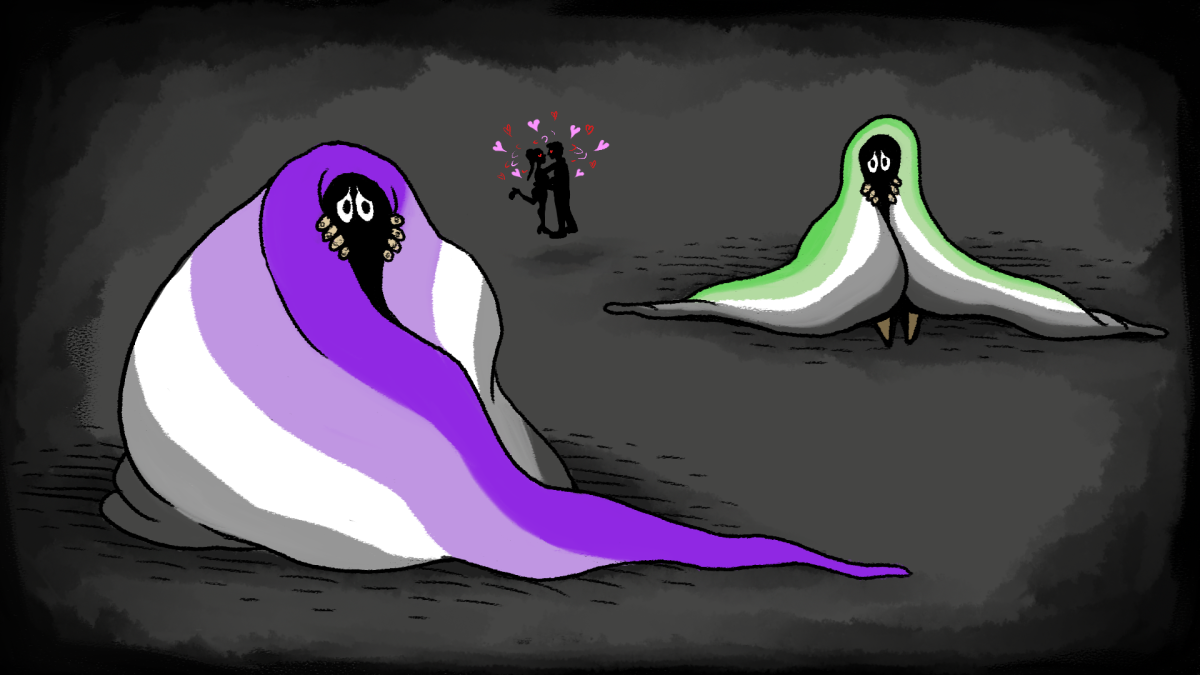
Aromanticism is another umbrella term for people who do not experience romantic attraction in ways that are “typical.” Both terms cover a wide range of experiences, such as whether an individual is sex repulsed, neutral or positive. Some asexual people still enjoy sex, but do not actively seek it out for their own pleasure. Others may desire long-term relationships that do not involve any intimacy. Someone may be aromantic but still have sex regularly. Generally, the labels are used by people whose experiences of romance and sex are “non-normative” in some way.
Lisa Paciulli, a primatologist and senior lecturer in the Department of Biological Sciences, teaches BIO 444,The Biology of Love and Sex. According to its course description, “the need to find and seduce a mate is one of the most powerful forces in biology.”
“When we look at sexuality and romance evolutionarily, the idea is that they formed in humans and other animals with the genetic goal of having your genes be in that next gene pool,” Paciulli said.
Pacuilli explained that as asexuality becomes more socially acceptable in humans, it is being studied more, such as a 2023 paper that found asexuality and aromanticism are less common labels for men. As the identities are studied more, scientific and social understanding will improve, although a still-evolving topic.
Jeremiah Gibson is a licensed family and marriage therapist and a certified sex therapist who co-owns the relational and sexual health business Let’s Heal Together. He said that his work involves not only sex, but the communication that happens between people sexually and non-sexually and how that impacts their relationships.
Gibson said that sexuality and romantic experiences are ingrained in every aspect of our lives, and the expectation to find a mate hasn’t progressed past its basic evolutionary understanding.
“From media to the social systems that favor marriages — that’s an element of a compulsory sexuality,” Gibson said. “That you’re more valuable as a human being when you’re in an ongoing sexual relationship with somebody.”
Intentionally or not, Gibson said, the message is clear: If sex or dating are not important to you, you are outside of the norm.
“That pervasiveness of sexuality informs or creates the expectation that we should want sexuality to be an important part of our decisions, and the idea that if sexuality isn’t something that you prioritize or something that you even want, there’s a problem with you,” Gibson said. “That’s a dysfunction in some way.”
Gibson also said these expectations are often tied to gender, like how men are more successful if they have more sexual experiences while women are the opposite.
“It’s all about putting you into a box and suggesting that you were successful if you perform sexuality in this particular way,” Gibson said.
Josie Lacey is a fourth-year studying communication and is the social media manager for the Aces and Aros Club, which serves as a bi-weekly gathering place for students who identify with asexuality or aromanticism. Lacey identifies as asexual and demiromantic, only feeling romantic attraction to someone after she has gotten to know them well.
When she was single, Lacey said she never felt drawn to dating apps or social events for meeting people. Her experiences with dating were motivated by obligation rather than passion.
“I tried stuff like that a few times, but it does not work like that for me,” Lacey said.
Now that she is in a long-term relationship, Lacey said she deals less with the discomfort of the dating world. Still, she said that she often finds herself explaining aromanticism and asexuality to other people, and she is not always met with acceptance.
“I do understand why, because it can be kind of confusing if you don’t know much about it. But it happens quite a lot,” Lacey said. “I have had some weird interactions with a few people about it who just kind of just refused to get it.”
Asexuality is one of the less visible identity groups in the LGBTQ community. According to GLAAD’s “Accelerating Acceptance 2025 report,” only 10% of non-LGBTQ adults say they personally know someone who is asexual. Alongside pervasive expectations surrounding romance and sex, this leaves little room for people with non-normative experiences to feel welcome.
“[Stigmatizaton] forces people who have outside-the-norm identities underground. It forces a sense of secrecy,” Gibson said. “It also creates a culture of criticism, of diagnosing and in worst case scenarios the queer community has seen homophobia, transphobia and acephobia.”
Gibson said that more open conversations about our relationships with romance and sexuality would result in a world that is more accepting of everyone. It also invites more open conversations about sexuality among people who may not have considered themselves “deviant” in any way.
While society remains apprehensive about sex education, several studies show that prioritizing these conversations actually decreases the likelihood of risky sexual behavior, STIs and unwanted pregnancy in teens.
The general idea behind sex therapy and education is to recognize that every experience is different and that no one option is correct, Gibson said. Openness and discussion is the surest way to increase sexual communication, which in turns leads to more sexual satisfaction.
“The more that we talk about sexuality and sexual health the more equipped people are to make choices that work best for them,” Gibson said.
Not everyone may understand how it feels to live in a world built around romance and sex while feeling disconnected from those emotions. Not everyone will meet or have a relationship with an openly asexual or aromantic person. But the more we talk about non-normative experiences and dispel the idea of sexual deviancy, the more potential there is for relational satisfaction all around.