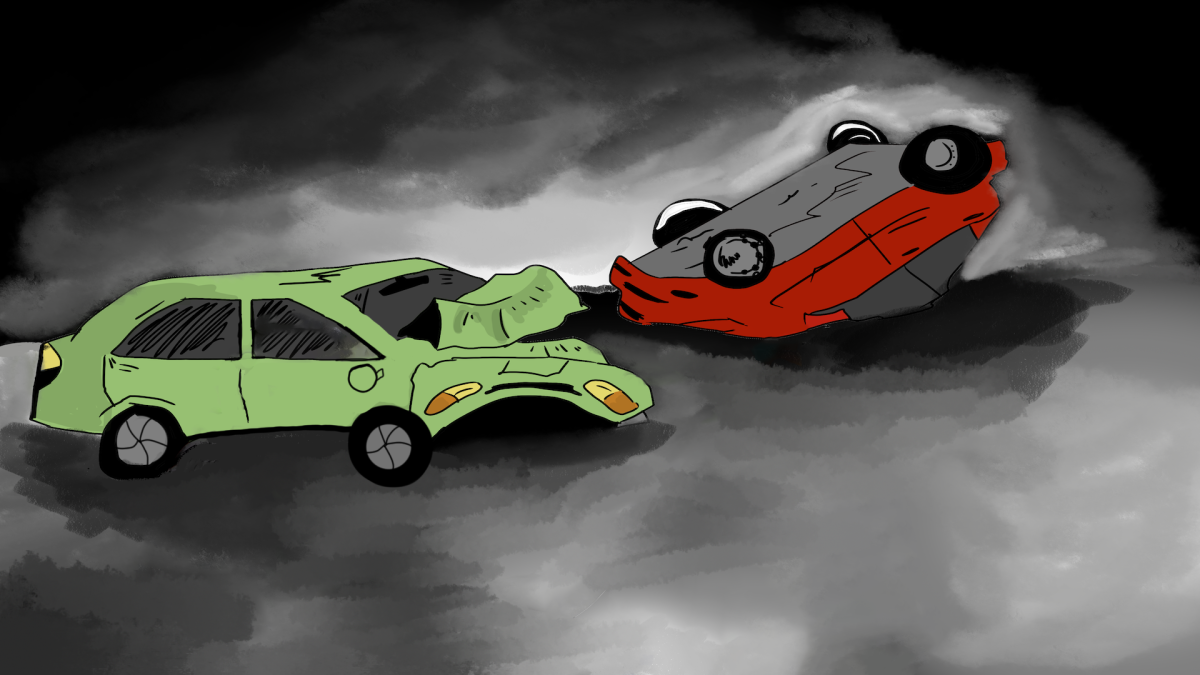


“There’s a bomb in my car!” screams lead singer Cameron Winter over the noisy, ambitious opening track “Trinidad” which sets the tone for Geese’s third studio album “Getting Killed.” The song starts like rolling down a wide-open country road with the windows down but takes no time in delivering the tension of, well, a bomb sitting in the backseat.
Geese is an alt-rock band formed in 2016 in Brooklyn, New York. In previous efforts, they’ve dipped into indie, country and funk. In this album, style is even more diverse: a sincere shout in Bruce Springsteen fashion. Crooning over acoustic guitar out of a Neil Young folk rocker. Warm crescendos like a cathartic Radiohead finale. Then the piano picks up and takes us back to Springsteen.
The amalgamation of former rock sounds with inspired experimentation is seamless. Samples from a Ukrainian choir. The trombone pictured on the album cover. JPEGMAFIA-contributed background vocals, or screams.
But what makes “Getting Killed” most special is its lyrics, which tackle problems faced by modern twenty-somethings, or at least channel the feeling of them. The in-focus revolver that headlines the out-of-focus album cover is just waiting to go off. Like a bomb, in a car. If tension and distress aren’t for you, turn away.
After the violent opening track, Winter sings about love on the softer “Cobra.” He sounds at first like Elvis and then a dazed Jim Morrison, going on about an ex-lover cobra charmer. The gentle rolling of beads in a shaker back a lush, dreamy song that wouldn’t be out of place on “Abbey Road,” but Winter soon faces reality. “You can make the cobras dance / But not me, yeah.” He is above the reptilian class of man.
Winter goes back on his word in “Husbands,” straining as he sings “There’s a horse on my back / And I may be stomped flat.” The work of love is more intense than ever. Is a crushing threat worth an escape from loneliness? Winter thinks so, for now: “Oh, this horse on my back / Gives me all that I need.” The song gets looser and crescendos as it repeats itself. “Will it wash your hair clean / When your husbands all die?” This is the stark accusation posed to the other party. Of course, both people carry a horse in a relationship.
Drummer Max Bassin’s rhythmic intro frames the titular track. The lyrics are more direct. “My love takes a long time / Longer than a lover can survive,” Winter drags on. The futility of love, the battle for attention in the 21st century. “I’m trying to talk over everybody in the whole world.” His voice has something else in it now: self-pity, loathing. One for himself, the other for the world that pits us against each other. “I’m getting out of this gumball machine,” he declares.
After the bleak account of modern life, a steady drum beat and a melancholic cry, the song culminates with: “I’m getting killed by a pretty good life.”
Layers of metronomes kick off “Islands of Men,” a metaphor for our isolated society. Disillusioned seekers sticking to the only shore they can call their own. “You can’t keep running away from what is real,” Winter repeats over and over, giving you time to wonder if he’s talking about more than just the pursuit of love. It’s hard to make friends when you have to swim to your next-door neighbor. The background vocals blend into a sparkling, rising outro that sounds like a Coldplay song until Dominic DiGesu’s groovy bass reminds you that this is something new.
The bass carries on in “100 Horses,” a funky comedown in intensity, but the lyrics don’t take a break. “All people must smile / In times of war.” On top of self-inflicted isolation, we are faced with a barrage of lines that are ever more absurd. “There were 100 horses dancing / Or maybe 124.” Besides rhyming with “floor,” it doesn’t matter how many horses there are, and some people won’t pay attention to that anyway.
Winter mocks those people: “He said that I would never smile again, but not to worry / For all people stop smiling once they get what they’ve been begging for.” What is it that you’re asking for? What are you doing to get the right pages turned? “All people must die scared or else just die nervous” he warns, howling at his audience from behind a chaotic wall of percussion and guitar.
But past the bedlam, there are quiet, sincere moments too.
On “Half Real,” Winter reveals that he cares, desperately, about the way people see who he used to be. He sardonically considers surgery to forget about the whole thing. “I’ve got half a mind / To just pay for the lobotomy.”
On another Beatles-inspired track, “Au Pays du Cocaine,” or “The Land of Cocaine,” Winters says softly: “You can stay with me and just pretend I’m not there.” He’s ready to step into a stimulant-induced deception if it means peace and begs his lover to do the same: “Just come home, please.” His voice is clingy and desperate now. A small price for a warm bed, I guess.
Emily Green’s jazzy guitar shines at the end of “Bow Down,” where Winter shares “I was in love, and now I’m in Hell.” Maybe you can relate to that, or be glad that you “Don’t know what it’s like to bow down… To Maria’s bones.”
If there was any doubt earlier in the album, it is made clear now that love is pain.
“I will break my own heart from now on,” Winter finally decides on “Taxes.”
Still, Winter sounds about as sure of himself in that declaration as when he announces “I have no idea where I’m going” in the closing minute of the album, and maybe that’s the point. “Like Charlamagne in Vietnam,” he wanders. “Like Charlamagne on the midnight bus,” the people around him don’t even know his name.
Most of us are no Charlamagne, anyway. But for all that stands against us, we should keep moving, and Winter leads by example:
“Here I come.”