“Project Hail Mary,” the new science fiction film based on the novel of the same title by Andy Weir, is here to remind us what genre film is all about. With the masterful technical execution of an already fantastic script, alongside excessively charming performances, “Project Hail Mary” is a work bound to unite audiences of all ages and interests through a scientifically-sound exploration of what it means to make sacrifices.
The release was highly anticipated, following the success of the adaptation of “The Martian” starring Matt Damon, also based on a novel by Weir.
In “Project Hail Mary” Ryan Gosling plays the reluctant hero, Ryland Grace, a middle school teacher thrust back into his life as a molecular biologist when Earth is posed with an existential threat.
Essentially, tiny organisms called “astrophage” are eating the sun, chipping away at its energy and light. Within the next 30 years, Earth is slated to cool by 1o-15 degrees and a third of the world’s population will die of starvation (that being an optimistic estimate).
The movie opens on Grace exiting an induced coma, with an intubation tube being pulled from his throat and a nursing machine poking at him to access his cognitive functioning. Alongside Grace, you learn that he is alone on a spaceship impossibly far from Earth and tasked with an unknown mission. His crewmates are long dead from coma complications, and he is woefully alive and well.
The movie follows two parallel storylines: Grace on his ship thousands of lightyears away, and the events that led up to him being on the mission. Transitioning from highly tense space action to a middle-school science class could seem jarring and difficult, but through the use of seamless camera movement and sound, there were no problems moving from one scene to the next.
With works of art meant to portray complex scientific topics, there are two paths script writing can usually follow: pretentious over-explaining or condescending dumbing-down. Weir’s novels have found such large and loving audiences because of their ability to balance technical knowledge and storytelling, allowing the science to live within a larger narrative, and perhaps even more importantly, with relatable characters.
When you are learning about astrophage and sun death from a handsome, dead-end school teacher, complex scientific ideas become approachable. Even if you don’t fully grasp them, Screenwriter Drew Goddard always leads the audience to what is important.
“Project Hail Mary” is blessed with Ryan Gosling, who gives an unquestionably compelling performance. His charm is palpable, both when we see him in his element as a school teacher, when he is out of his depth as a governmental agent and when he is alone and scared.
Grace is the perfect vessel for audience members to learn about this world — a down to Earth guy who wants to do what is right, but has reservations about his own abilities. Side-by-side with him, we feel the triumphs of the good moments and the devastation of the bad.
His relationship with Eva Stratt, the project manager of the international effort to save Earth, is characterized by snarky comments and a shared belief in their work. The wonderful Sandra Hüller gives Stratt, a monotone and harsh woman, just the right amount of intrigue. It’s refreshing to see an extremely smart and driven woman on screen who is never undercut, trivialized or sexualized. She was fun to puzzle out, not even mentioning her karaoke solo.
Then there is the matter of the incredible technical work done throughout every aspect of this film. The score, composed by Daniel Pemberton, was powerful and versatile, flitting from hopeful to playful to menacing. The integration of environmental sound and dialogue was stunning. Sound design is often overlooked as an important storytelling tool, both by audiences and filmmakers, but “Project Hail Mary” felt infused with intention.
A big selling point is also the visuals. With an entirely practical spaceship set, Gosling had so much room to play and humanize any otherwise sterile space. Truly, that single set piece transforms itself multiple times throughout the runtime.
Director of Photography Greig Fraser showed off his chops with endless shots of the ship, space and Gosling that never failed to amaze. His creative use of reflections and camera rotation made even the most mundane transitions jump out, and his work will surely serve as a masterclass in space-based visuals for future film-makers.
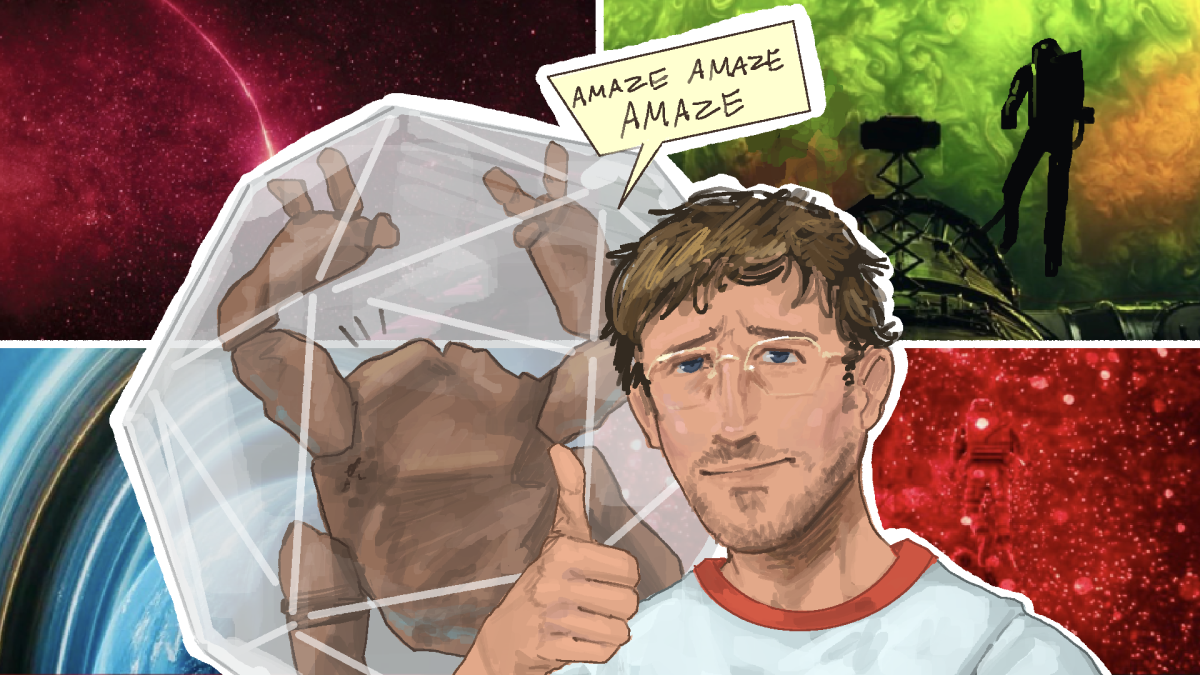
And finally, Rocky, the alien companion Grace encounters and befriends, is an incredible feat in puppeteering. This little creature is the core of the film’s emotional climax and functions as the main catalyst for the plot. He becomes a literal partner to our protagonist, an equally important actor and thinker in solving the problem of star death via astrophage and he is also a monster that looks like a large tarantula made of rock.
Somehow, the artists behind Rocky made this puppet feel like a living, breathing being. It’s a lot to ask audiences to invest in a faceless creature that is unrelatable on the surface. But at risk of being repetitive, the outstanding script and execution of these characters makes it work. With James Ortiz puppeting and Rocky’s voice, a mix of echolocation and cat-like mews, the character comes to life.
Gosling also had the challenge of working with a puppet as his primary scene partner, but as an audience member, you forget that reality entirely. Their connection is fostered in such an organic way, and the few dialogue heavy scenes are rife with meaningful exchanges, despite the communication barriers.
Overall, the hype for “Project Hail Mary” is not misguided. It’s a technical masterpiece bound together by charming dialogue and even more charming characters. Themes of bravery and personal autonomy ground what may seem like an out-of-this-world scenario, and the performances are sure to draw both laughter and tears from audience members. Go see it in theaters as soon as you can, because you probably will want time to return for round two.