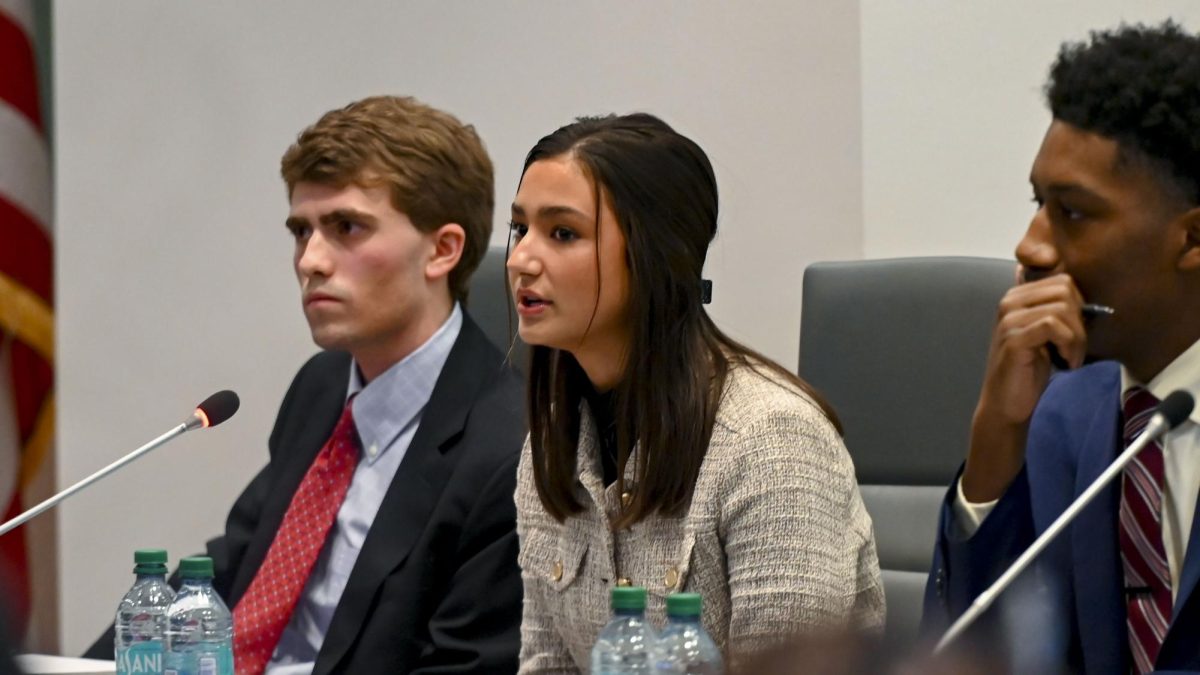

Student senators overwhelmingly rejected an attempt to remove Government Relations and Oversight Chair Tan Francis on Tuesday night following tense discussions throughout their meeting that highlighted deeper frustrations over priorities, culture and communication in Student Government.
The vote to remove Francis failed 0-52 with six abstentions after more than an hour of debate.
Initiation of Francis’s Removal
Student Senate President Naila Din, a fourth-year studying microbiology, initiated the removal of Francis, a fourth-year studying political science and communication, on Jan. 12, citing what she described as uncommunicated absences from November committee meetings and failure to participate in regular “touchpoint” meetings with her. In her report, Din said she learned from GRO Vice Chair and Sen. Preston Spencer, a fourth-year studying agronomy and crop science, that Francis would be absent for roughly a month and felt concerned that she was not directly informed.
Din told senators she attempted to reach Francis by email, then by text and said Spencer reported feeling unprepared to serve as interim chair because he did not receive committee details, reports or agendas from Francis. She grounded her decision around two issues: missed meetings and neglected chair duties, including missing “touchpoint” meetings, which she described as the “ultimate driver.”
Francis and several senators disputed Din’s account. During queries and deliberations, multiple members of the GRO committee said Francis missed only one committee meeting in November, having communicated that absence in advance to Student Senate President Pro Tempore Taquan Dewberry, a third-year studying philosophy and applied education, and Vice Chair Spencer. Francis said she had to take a step back from her position because of Divine Nine initiation and was unable to share extensive detail regarding her separate commitment due to organization rules.
In a statement to Technician, Dewberry said Francis communicated her November absence “proactively” and asked Spencer to assume her responsibilities.
“That communication occurred prior to her stepping back, and it reflected an effort on her part to be as transparent and responsible as she could in her role,” Dewberry wrote.
Dewberry said he found out about the removal effort through the Senate listserv at the same time as the rest of the Senate, despite his role as the chair of the All Chairs Council.
“There was an abundant lack of communication from the Senate President with anyone on the matter outside of Preston Spencer, the Vice Chair of the Senate Committee Tan chairs,” Dewberry wrote.
Various senators expressed concern that Dewberry was not notified of Din’s intent to initiate removal.
Press Secretary and Student Senator Judson Avery, a second-year studying philosophy and political science, brought attention to an email sent by Din on Jan. 12 to Francis. Vice Chair Spencer was BCC’d on the email, which concluded with “If you fail to sign up for the touchpoint meetings by this Wednesday and have regular attendance at these meetings, I will have to remove you from your position as Chair for failing to uphold your responsibilities.”
Sen. Avery recited a portion of the president pro tempore position description: “The president pro temp shall also act as an advocate for senators by supporting their work, addressing their concerns and ensuring their effective participation,” Avery said. “I don’t really understand why you didn’t feel the need to CC the pro temp in any of this communication.”
Din said her decision to inform Spencer but not Dewberry was due to the vice chair’s position being “more direct to the matter” and that “if Chair Francis felt as though she needed an advocate on her behalf, she could very well have CC’d the pro temp herself.”
Senators question removal process
During questioning following Din’s recitation of her removal report, senators asked Din why a new removal process she introduced in December was presented as a general policy when concerns about Francis’s performance dated back to October.
Katie Stennette, a graduate student senator in the College of Sciences and a member of the GRO committee, said they felt “lied to” and that Din’s argument failed to speak on Francis’s ability to lead the committee.
“I really feel that we were lied to in December, and I feel like we’ve been lied to again today,” Stennette said. “I overall find the call for this removal baffling and disappointing. I find the hyperfixation on touchpoint meetings very flimsy. I think they say very little about how a chair performs their duties. We have not even had a chance to have a GRO meeting yet this semester. We’ve had no chance to see whether or not she [Francis] can continue to chair. Personally, I believe that she will be an excellent chair as she was in September and October. I urge my fellow senators to say no to the proposed removal of Chair Francis so we can all go back to normal and maybe finally move on from whatever the hell this is.”
Senators also challenged Din’s emphasis on “touchpoint” meetings as a primary justification for removal. DEI Chair and Senator Bella Echiburu, a third-year studying psychology, noted that chairs had previously asked for those meetings to be optional because they were “redundant” and that this feedback was shared with leadership. Din said she was not present when that discussion occurred and still considered the meetings essential for accountability.
“I just find a little bit of inconsistency because I believe I only attended two touchpoint meetings the whole semester and I have never been told that I would lose my chair position or anything like that,” Echiburu said.
Din said that in the future, she will be holding herself and other chairs accountable for attending touchpoint meetings.
“Political theater”
The effort to oust Francis came at the climax of a meeting already dominated by reflections on Student Government’s tone and direction. In their regular reports, multiple student body officers criticized what they described as a culture of infighting, ethics complaints and internal disputes overshadowing work that intends to benefit the students they represent.
Student Body Vice President Anil Gordon spoke on last semester’s ethics board hearings, saying he had opposed the board’s creation out of concern it would be “weaponized to pursue personal disagreements” rather than address serious conduct.
Student Body President Isaac Carreno echoed that frustration. In his report, he said recent ethics proceedings were “not about ethics” but about “gaining points and wins against individual opponents” and urged senators to “do the jobs that you were elected to do” instead of using their roles to “take down your opponents.”
Dewberry, in his report, pointed to the recent loss of initiatives like the Black Male Initiative and Native Space and contrasted that with the amount of energy spent on internal disputes and fee increases for Student Government itself.
“This week, hundreds of students across our system, including some right here in this very room, had their funding taken away, and some have had trouble staying in their classes. But we’re debating personnel,” Dewberry said. “We didn’t put this much initial effort in when ICE was present on our campus, but we brought dozens of students out [tonight] to watch their student government, which they pay $14.20 a year out of their student fees, debate personnel.”
Board of Elections Chair Joseph Attanucci asked senators to view their conduct from the perspective of a student on the outside.
“Do they see a body delivering solutions on transportation, affordability, safety and access? Or do they see a body consumed by internal conflict, public disputes and an endless cycle of outrage that seems to go nowhere? Because from the outside, it doesn’t look like leadership. It simply looks like dysfunction. We’ve passed more than 100 pieces of legislation this session. That sounds impressive until you look closer. A huge share of this work has been inward-facing appointments, confirmations, restructuring ourselves, revising our own processes. This is necessary, but it’s not transformational.”
Attanucci said that, on top of Student Government’s lack of passing legislation that could positively impact students and senators using their positions to engage in “political theater” with one another, the body approved greater funding for itself.
“And then, unbelievably, in the middle of all this, we voted to raise the fees students pay for this very organization. We struggled to deliver visible results. We spent weeks fighting internally. And our answer was to charge students more.”
Din addresses “hostile” environment claims
Francis said her decision not to communicate directly with Din about her November absences stemmed from how uncomfortable she felt in their working relationship, not from a desire to hide information. She described remarks Din allegedly made about Dewberry and the broader Senate “culture” as creating a hostile environment, and she chose instead to send updates and concerns through Dewberry, whom she trusted.
Din told senators her “door is always open,” pointed to social events and office hours as efforts to build morale and said she had not received “tangible” feedback about specific behaviors.
Francis said Din had received an SSP review in the fall that underscored these points. Din said this review was conducted in the first two months of her term and it was impossible to receive an “all-inclusive” report in that timeframe.
Zainab Aleem, legislative secretary and a fourth-year studying chemistry, said Student Senate’s “hostile” environment has existed long before Din’s tenure, particularly in disregarding legislation supporting students who were concerned about the Israel-Palestine conflict, and that senators were attempting to pin this culture on Din.
“The way the SSP has been treated, then spoken about behind her back, disrespected, discriminated against, has played a significant role in contributing to this tension,” Aleem said. “Despite this, she has made genuine efforts to humanize the Senate.”
Technician and The Nubian Message attempted to ask Din questions regarding her assertions that senators’ claims of a hostile work environment were “misinformation.” Din stated that she would answer questions from Student Media after the senate meeting, but one senator made a motion to allow questions from Student Media later in the meeting, which was approved.
Meeting concerns and tensions
Senators sparred throughout the entire meeting, directing comments to each other and new appointees of the Senate during the removal process and appointment deliberations.
Joseph Thomas, a student senator and fourth-year studying parks, recreation and tourism management, said Francis was prioritizing the Divine Nine sorority over her duties as GRO Chair.
“As established, the main issue for removal was because she was missing the meetings, which Francis herself said were like five minutes long,” Thomas said. “If she can’t make time for that, but she can make time for a sorority, that is blatantly a priority issue.”
Ava Butler, student senator and a graduate student studying education, said that as a member of another Divine Nine organization, Thomas’s comments were disrespectful.
“Saying that the sorority is somewhat frivolous and that the process of joining a sorority is also frivolous is widely uneducated and a falsity,” Butler said.
During deliberations for new appointees to the Senate, senators made comments on the character of the candidates based on what they would hope to improve as senators.
Bridget Dale, a senator and graduate student studying marine, earth and atmospheric sciences, suggested that an appointee may have “poor time management skills” after he had expressed a concern about student mental health concerns on campus, particularly regarding DELTA testing.
Other senators made comments about other appointees being “underprepared,” and senators subsequently criticized each other for the treatment of potential new members to the Senate.
Jodie Roberson, a former doctoral student senator who sat in on the session, expressed her sadness for the state Student Government finds itself in.
“Frankly, it’s disappointing, y’all. I feel like you’ve lost your way a little bit. It’s not just one person, or two people or a group of people, I feel like y’all gotta stand up for each other, not against each other,” Roberson said. “What I’m seeing from the outside is division. That’s just looking in from the outside. Just know people are watching. You can do better.”
During the removal proceedings, Din briefly tried to move into a closed session and asked student media and the public to leave, prompting Technician Editor-in-Chief Skye Crawford to point out that a formal motion and majority vote were required under open-meetings rules. Din then asked an advisor how to proceed, and when the vote to enter closed session failed, the body remained in open session with observers still in the room.
Nevaeh Sturdivant, Hail Zulueta and other staff from The Nubian Message contributed to this reporting.