
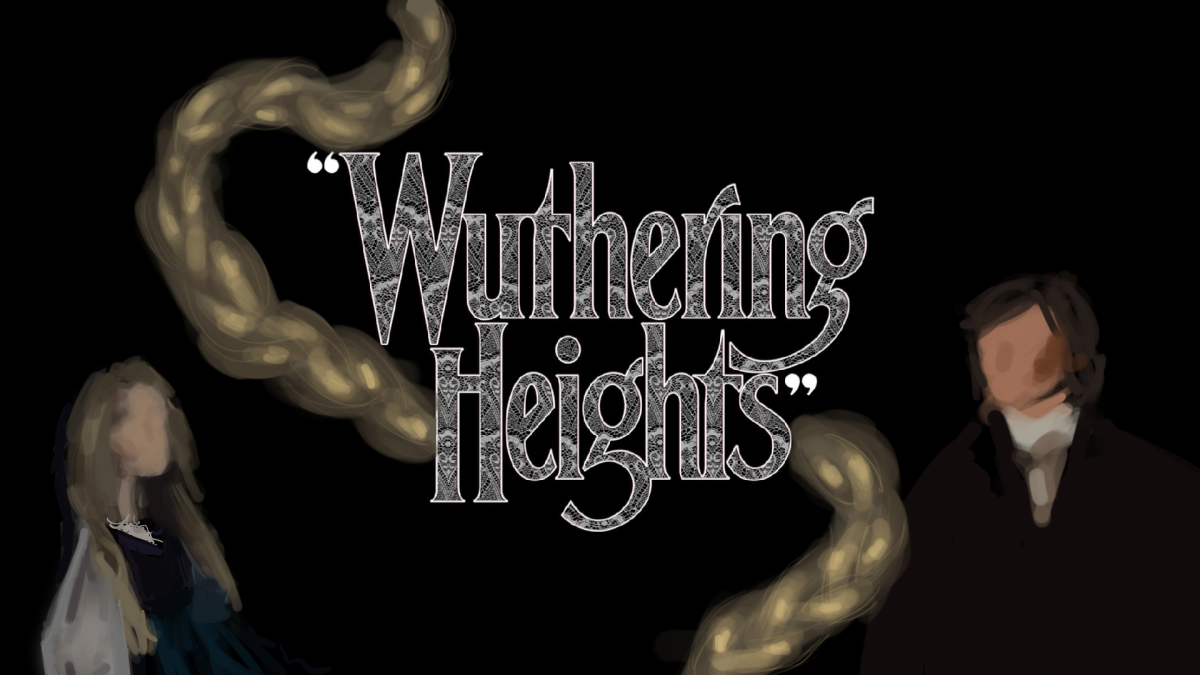
“Wuthering Heights,” directed by Emerald Fennell, was released in theaters on Feb. 13. The movie was adapted from Emily Brontë’s Victorian-era novel and features a star-studded cast, with Margot Robbie and Jacob Elordi in the main roles of Cathy Earnshaw and Heathcliff.
The movie has been subject to much controversy, with historical inaccuracies and excessive creative freedom often cited as the reason.
In particular, many fans believe that casting such recognizable actors takes away from the historical appeal of the film. As an avid fan of the original novel, I was very excited for the release of this film. However, I echo the sentiment that Elordi and Robbie were not the best choices for the roles of Cathy and Heathcliff.
Aside from Elordi having a serious case of “iPhone face,” Heathcliff was notably a person of color in the original novel, and white-washing him removes an integral and complex layer from his and Cathy’s forbidden love.
In the book, Heathcliff is an abandoned outcast who is adopted off the streets of Liverpool. Heathcliff and Cathy’s romance is largely hindered by the fact that Heathcliff is not white, an extreme social barrier in 18th century England.
By removing this crucial element to the plot, Fennell makes it clear that she is not interested in tackling the complex themes of class struggles, race and identity which made Brontë’s “Wuthering Heights” relevant and groundbreaking.
Instead, she invents her own watered-down and misshapen version, trying to make a radical tale of power, abuse and manipulation into “The Kissing Booth 4.”
Aside from ignoring the complexities of race in a story that is inherently dependent upon them, another disappointing aspect of this film was the costume design. Costuming was far too modern and flashy to look like something that would belong in the late-1700s.
Regardless of these critiques, there were many scenes I enjoyed, such as those where Cathy and Heathcliff were children.
The scene where Heathcliff is beaten by Cathy’s father was particularly emotional and added a necessary level of depth to their forbidden love story and Heathcliff’s character development in the absence of racial examination.
While neglecting Heathcliff, the film did explore the complexity of Nelly Dean (Hong Chau), Cathy’s paid companion. Chau brought a stoic jealousy to Nelly that I hadn’t seen in previous adaptations of the novel. Interestingly, she’s positioned as the film’s main antagonist, although there is much to be desired when it comes to unpacking her motivation, especially as her character in the film is so vastly different from in the novel. While certainly not an angel, Brontë portrays Nelly as a generally reliable narrator and loyal servant of the Earnshaws — a stark contrast to her role in the film, where she is particularly manipulative and a clear-cut villain.
As for Cathy’s character, the portrayal in the film was another inconsistency with the novel. Robbie is an extremely talented actress who has starred in many successful films, namely “Suicide Squad”, “The Wolf of Wall Street” and “Barbie.” However, her portrayal of Cathy resembled nothing of the spirited tomboy described in Brontë’s classic text.
Instead, Robbie and Fennell’s take on Cathy comes off as whiny, annoying and entitled, rather than fiery and determined. You can see this fire and determination in Cathy’s childhood scenes in Fennell’s adaptation, but they disappear as Robbie’s character gets older.
In tandem with these character choices, Robbie’s British accent leaves much to be desired. It’s hard to place, and words sound garbled at times, making her speech difficult to understand.
A final odd feature to note in this movie is the soundtrack.
Charli XCX created music for the film, leaving me with a lot of questions. As a fan of Charli XCX, I believe she has an impressive range and can certainly do complex projects outside of her traditional realm, and I enjoyed the album independent of the film. However, she was not the right artist for this film’s soundtrack. The music does not fit the film’s aesthetic, and her distinct voice took attention away from scenes already weak in their complexities.
I would’ve liked to have seen something similar to the “Bridgerton” soundtrack, which features instrumental versions of popular songs. If Fennell wanted to introduce modernity to this adaptation, this could’ve been an interesting way to do it while still keeping the aesthetics of a period piece and avoiding distraction.
Overall, many aspects of this film fell short and left me feeling conflicted. It was still enjoyable, but I left the theater feeling disappointed. This film would’ve been better off as an entirely new story rather than a “Wuthering Heights” adaptation.