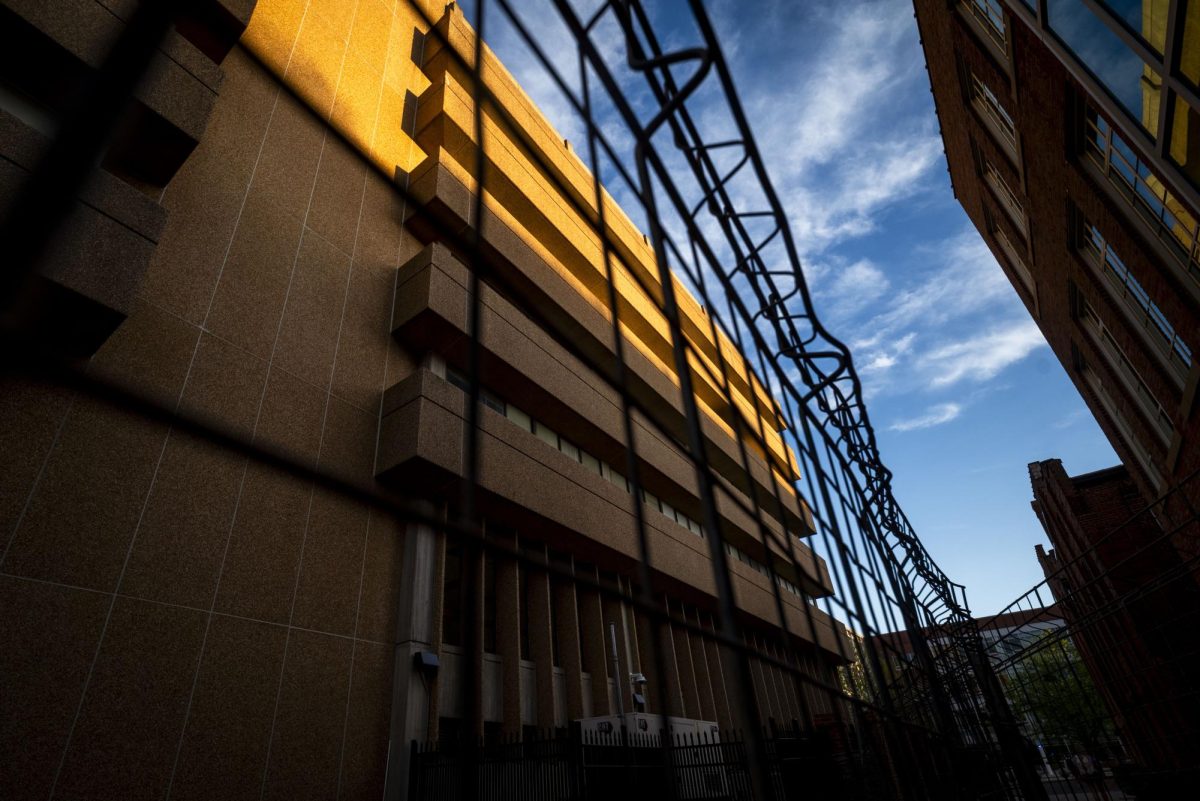

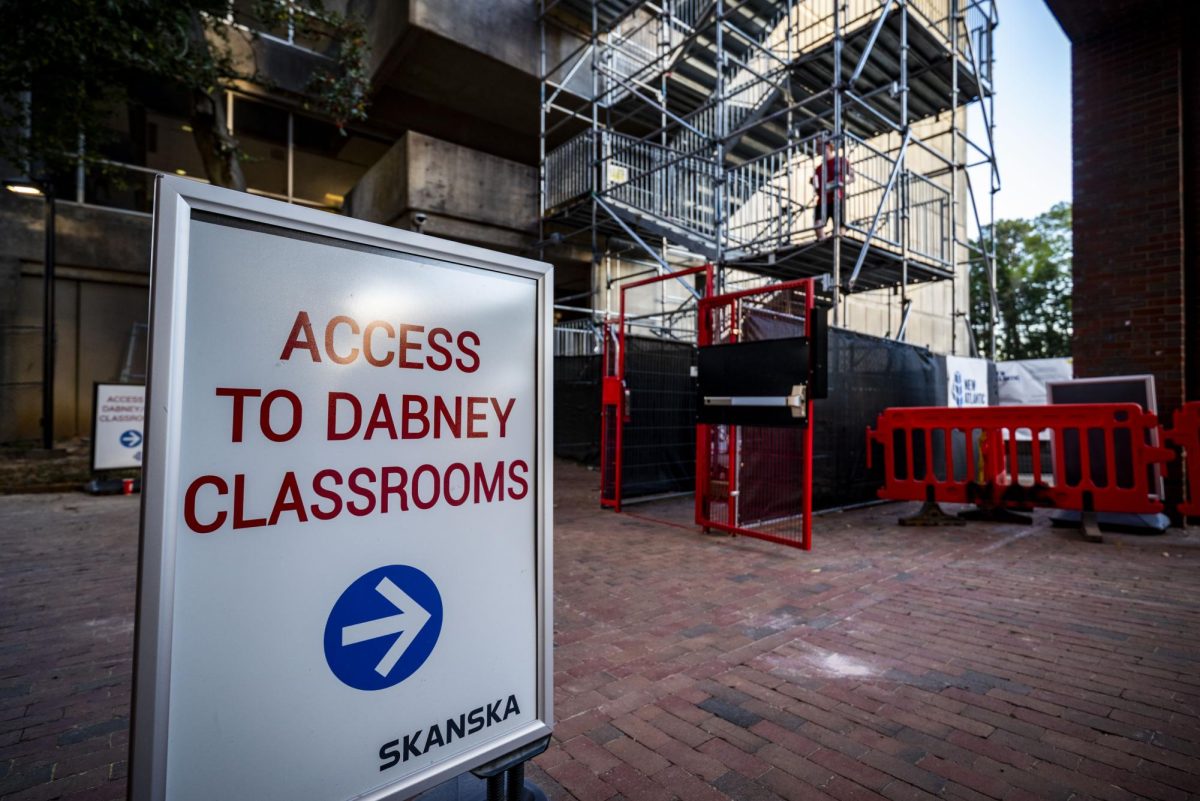
The first phase of the Dabney and Cox Hall renovation, a roughly $140 million project expected to stretch through 2028, began last year with abatement and demolition on the seventh and eighth floors. It’s the first major overhaul since the building opened in 1969. NC State says new HVAC, electrical and life-safety systems will make it safer. But critics question why workers disturb known carcinogens with hundreds of students and faculty still inside.
“It’s frustrating. We don’t have access to that [information] at all,” said Katie Stennette, a fourth-year PhD student in biological sciences who teaches in attached Cox Hall. “If it’s there, it’s so buried I don’t even know where to find it.”
Contractors are removing old fume hoods, ductwork, lab casework and other infrastructure flagged in a 2023 hazardous materials report by engineering firm S&ME. That assessment documented asbestos in materials ranging from drywall joint compounds and lab benchtops to thermal system insulation and roofing felts, along with lead-containing paint, mercury contamination in some sink drains and polychlorinated biphenyls, or PCBs, in caulks and light ballasts.
While S&ME emphasizes that its assessment is “limited” to areas in the first phase and represents conditions only at the time of sampling, the report states that identified asbestos-containing materials “may be impacted by the upcoming phased renovation project” and should be removed by a licensed abatement contractor before any work that could disturb them.
For student senator and Campus Community Alliance for Justice organizer Evie Shackles, a fourth-year studying psychology, the decision to proceed with the removal while people remain in the building crosses a line.
Shackles authored the Dabney Hall Environmental Testing Act, a resolution passed unanimously in the Student Senate earlier this semester that calls on NC State to pause occupied renovation work, commission independent testing and prove it is safe for students.
“There are PCBs, asbestos, lead, mercury,” Shackles said. “There’s all of this stuff in there, and it’s all getting stirred around by this renovation, and people are inside having classes and they have no idea of the danger.”
The S&ME report, public records previously accessed by Technician, added to Shackles’s concern. She said she had to “go digging” to find the document, which lists several PCB-impacted building components with a “potential for disturbance” during Phase I and confirms the presence of regulated asbestos and mercury above action levels in some lab drains.
“[The university hasn’t] told any of us. They haven’t warned us,” Shackles said. “And I find that really shady. I feel like we, as students who have classes in the buildings, the faculty who teach there, the staff who work there, I think we all have a right to know, at the very least know that there is this possibility of contamination and this possibility of being exposed to these hazardous chemicals. And we didn’t even get that. We didn’t get that kind of warning. I find that report very concerning.”
Stennette said instructors in Dabney and Cox received some briefings last fall about the renovation schedule and asbestos abatement, but graduate TAs who are not instructors of record did not. They said some faculty left those meetings feeling somewhat reassured, while others felt they still did not have clear answers about what contaminants were present, how work areas are being sealed or what is being monitored in the building’s HVAC system.
Inside the classroom, Stennette said the most obvious reminder of nearby construction is often noise. The side of Cox where they teach faces the construction of the new Woodson Hall, and jackhammers and heavy equipment can shake the room. But they said Dabney work has also reshaped the way students move through the core of campus, with rerouted entrances and blocked corridors around the attached buildings.
“I think they’re so aware of it just because it’s like a maze to get to where you need to go,” Stennette said.
Stennette said they usually wear a mask when they teach in Cox and is candid with students who ask why. When students raise concerns about PCBs or asbestos, they said they encourage them to talk with their doctors, especially if they have health conditions that might make them more vulnerable, but they emphasized that they do not feel equipped to give definitive medical advice.
Dr. Arthur Frank, a physician and occupational health researcher who has studied asbestos dating back to the 1960s, said the presence of asbestos and other legacy contaminants in a building does not automatically mean it is unsafe to occupy. He said it is technically possible to perform asbestos abatement while parts of a building remain in use, but only if strict controls are in place.
“Theoretically, yes, you can do removal work while people are in the building, but it really has to meet the very high standards of proper asbestos abatement. And one of the problems, of course, is it was very cheap and inexpensive to put the stuff in, and it’s horribly expensive to take it out,” Dr. Frank said.
Dr. Frank said proper abatement requires plastic barriers enclosing working areas, negative air pressure to prevent dust migration, high-efficiency vacuum systems with HEPA filtration, worker respiratory protection and careful handling of waste that is sealed, labeled and disposed of in proper landfills rather than municipal trash. He also emphasized the importance of ensuring that contaminated dust does not enter a building’s air handling system and spread to other floors.
Dr. Frank said that, in his perspective, the greatest long-term concern in Dabney is asbestos, even though S&ME’s sampling did not report airborne concentrations and was focused on identifying materials to remove. He said asbestos fibers can cause a wide range of diseases, including noncancerous scarring of the lungs and pleura as well as lung cancer, mesothelioma and other malignancies. While chronic, high-dose exposures in workers carry the highest risks, he said even relatively short, intense exposures can increase cancer risk.
“It doesn’t take it very much to cause cancer,” Dr. Frank said.
Dr. Frank said he could not evaluate NC State’s specific procedures without more information, but he said basic questions are important for any occupied renovation: whether air monitoring is performed before, during and after abatement; whether the university or contractors are using negative air machines and HEPA vacuums; and how debris is stored and hauled away.
Technician has filed multiple public records requests asking for updated environmental testing of multiple buildings, including Dabney, and additional information about the renovations. These reports have not been fulfilled and Technician has only heard back from university spokesman Mick Kulikowski to ensure that already-released files used in reference in one of the requests are redacted if published online. Kulikowski and other university representatives have not responded to Technician’s inquiries into why records requests have not been fulfilled.
“I have no insight into the records response timeline,” Kulikowski wrote to Technician.
Shackles said this debate also centers around who bears the risk of decisions made decades ago and how NC State chooses to communicate about that risk now. Shackles said she sees a pattern in the university’s handling of Poe Hall, Dabney and other buildings where PCBs and asbestos were used in mid-20th century construction.
“As much as I want to believe that the university has our best interests at heart, looking at the facts, it seems to me that they don’t,” Shackles said. “Their actions are not saying that they care about us and they care about protecting our health. Instead, their actions are saying they care more about the university’s reputation and their own reputation and their money.”
Stennette said they also understand that most of the hazardous materials inside Dabney were installed long before current administrators took office but argued that does not erase the university’s responsibility now.
“I do think they still have a responsibility to respond now,” Stennette said. “I understand that legal issues can make things challenging, but also student health matters, too. There’s thousands of students on campus that are potentially being exposed to these chemicals that they don’t even know. I just think that even if the short run, it might make things challenging; in the long run, we have a healthier campus. And I think that should be the ultimate goal, is a healthier, safer campus. And we can’t do that without testing. We can’t do that without considering every building that might potentially have an issue.”