
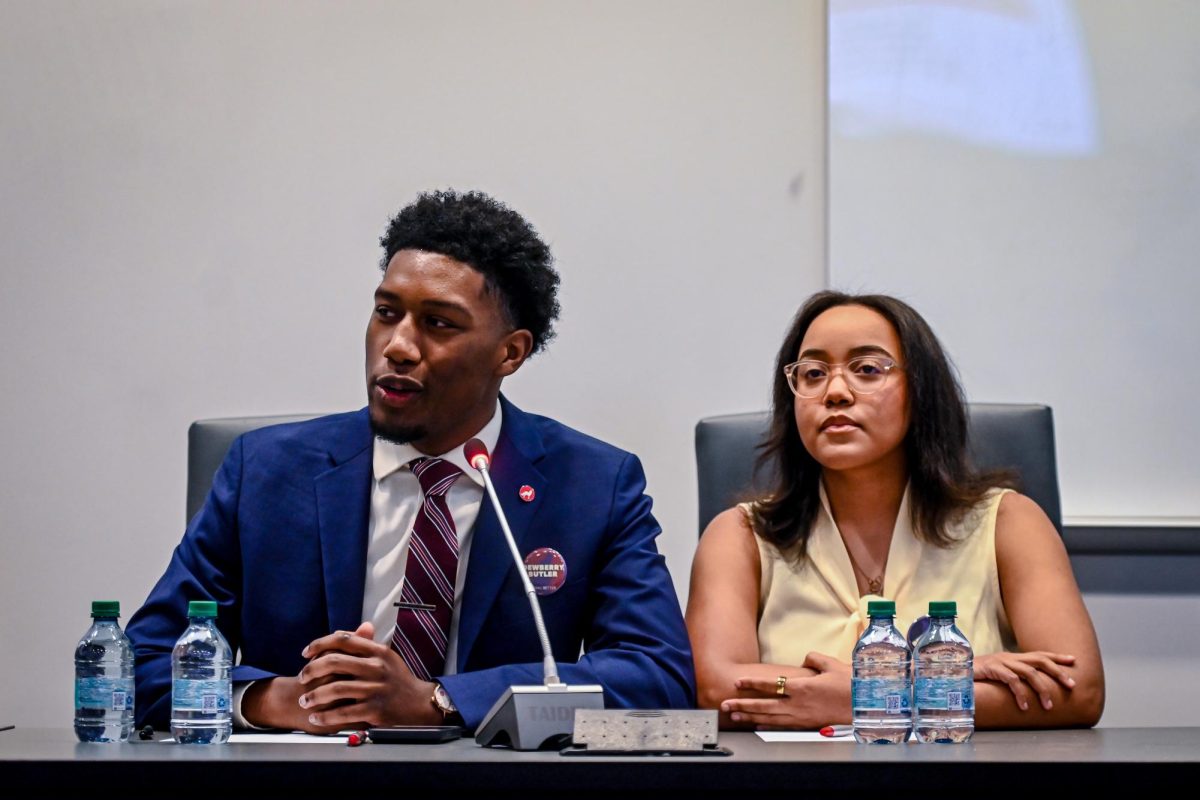
Taquan Dewberry, a third-year studying philosophy and applied education and senate president pro tempore, is running for student body president for the 106th session of NC State’s Student Government. His running mate is Ava Butler, a first-year master’s student studying higher education, an advising graduate assistant in the Poole College of Management and a student senator.
Dewberry, who ran for the same position last year, is centering on a campaign he said is focused on making Student Government “active, relevant and effective” in students’ daily lives.
Dewberry said he framed his campaign as an answer to what he sees as a growing disconnect between Student Government and the people it is supposed to represent.
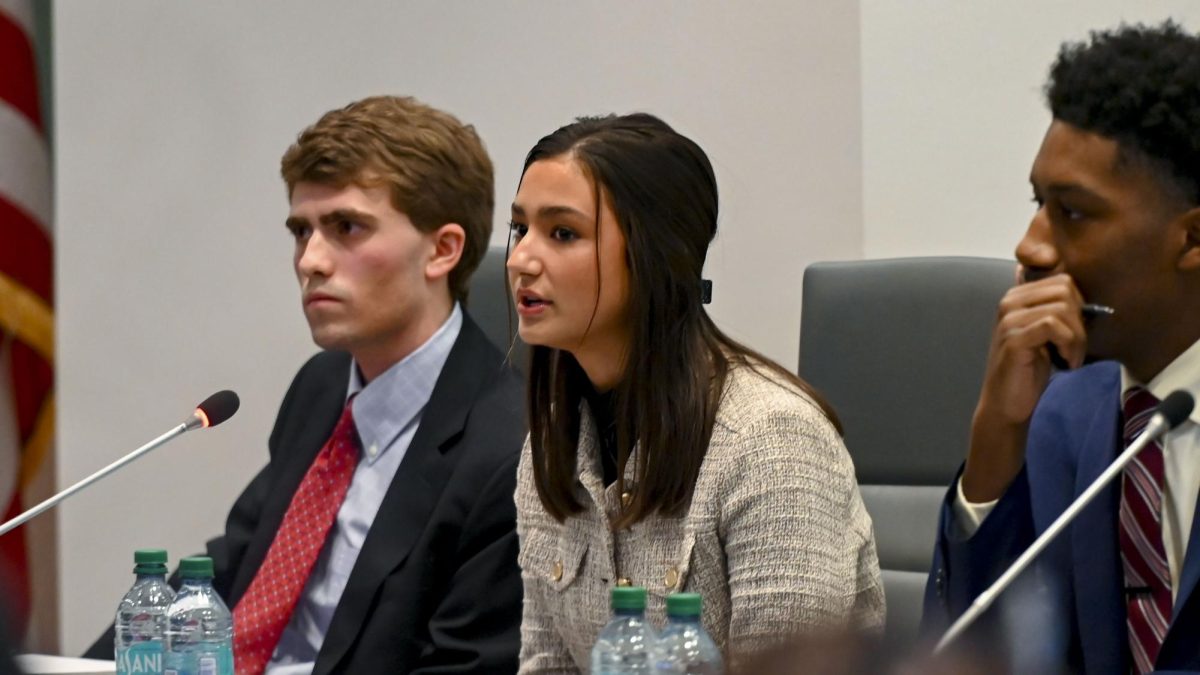
In Monday’s Student Government debate, Dewberry said his top priority is “bringing student government back to the students” by tackling affordability, transparency and communication.
“It feels like there’s a large disconnect between Student Government and our students on campus,” Dewberry said in a separate interview with Technician. “We feel like the organization should be doing a lot more to support everyone.”
Dewberry and Butler said campus affordability is the “number one” issue that Student Government should address, pointing to rising costs of tuition, food and basic needs for students across all three campuses.
Butler drew a clear line on student fees in the debate, stating their ticket would oppose any increases that are not “absolutely necessary and beneficial” to students, particularly graduate students whose stipends are already strained.
To address immediate barriers for students, Dewberry said his platform calls for creating a Student Futures Fund, a pooled source of scholarships and emergency grants to be awarded by Student Government. Dewberry said the fund would be designed for students and organizations with ideas or needs but lacking the funding to make them a reality.
Dewberry and Butler said they see student disengagement from Student Government as both a symptom and cause of the current disconnect between the institution and students.
“There’s a low vote rate, and I think it’s indicative of where the institution is right now,” Dewberry said. “We don’t do much to engage students, but I think this year there’s so much behind that goes into who you vote for this time, because next year there are so many important decisions that are going to be made.”
“Our state has the opportunity to go back to recognizing student organizations that are DEI-affiliated or go back to having an Office of Institutional Equity and Diversity. Instead of just equal opportunity, we have the opportunity to make sure that campus actually is more affordable because we will be asked to vote on fee increases next year,” Dewberry said.
The two also emphasized their belief that, as a group, graduate students have been left out of Student Government.
“There are 10,000 graduate students across all three campuses here at NC State, even some completely virtually online and also lifelong learners as well,” Butler said. “So we want to also re-engage that group and make sure that group knows that [Student Government] is for them.”
Dewberry said his approach to accountability begins with Student Government leadership, particularly in how it communicates progress.
“We focus too much on the structural accountability and not as much on the accountability we have to our students,” Dewberry said. “I think our biggest issue right now is focusing too much inward.”
One of Dewberry’s proposed fixes is to turn the “What to Fix” submission form into a transparent reporting system that lets students see who is handling their issue and what progress is being made.
Dewberry said he wants a public checklist on the Student Government website tracking each campaign promise from day one.
“We’re trying to make sure Student Government is more active, relevant and effective, to make sure that we’re doing better by putting students first always — and our aim is to make sure that we’re being accountable in that,” Dewberry said. “Have a checklist on the website from day one about where we are in each of the priorities we promised and how far we are in circumventing them.”
The student body president position is twofold: In addition to representing the student body, they also serve as a member of the NC State Board of Trustees.
In approaching this role, Dewberry said he is willing to oppose administrators and trustees when he believes student interests are at stake.
“If it ever comes down to the administration or our students, my first answer is always in our students first,” Dewberry said.
In the lightning round of the debate, Dewberry said the student body president should take public positions on controversial issues when they directly affect students.
“At the end of the day, it’s not about what I believe or what anyone at SGA believes,” Dewberry said. “It’s about what matters most to our students. And that’s what we’re going to prioritize every day of the administration. I just want to clarify: Student Government is not nonpartisan. It is all partisan.”
Dewberry said he also wants to use the role of student body president to press state lawmakers and university leaders to restore recognition and funding for DEI-affiliated organizations that lost their status under recent policies.
“Now that we’re back at the state level, the question is, what can the largest institution in the state do to help advocate to get these organizations recognized again and get their funding back?” Dewberry said. “… We talk to the General Assembly all the time. Let’s go down there and let’s ask how can we get our student organizations supported.”
After losing last year’s election to Student Body President Isaac Carreno, Dewberry said he entered this cycle with a different mindset and a sharper focus on what he believes students need.
“Last year, Adam [Womble] and I ran because we wanted to see something different in Student Government,” Dewberry said. “This year, we’re running because something needs to be different. We’re getting to a point where the institution is focusing only on the institution and students are disillusioned with Student Government. I can’t blame them.”
NC State students can vote in person in the lobby of Talley Student Union, the Engineering Building II breezeway and online on March 9 and 10.