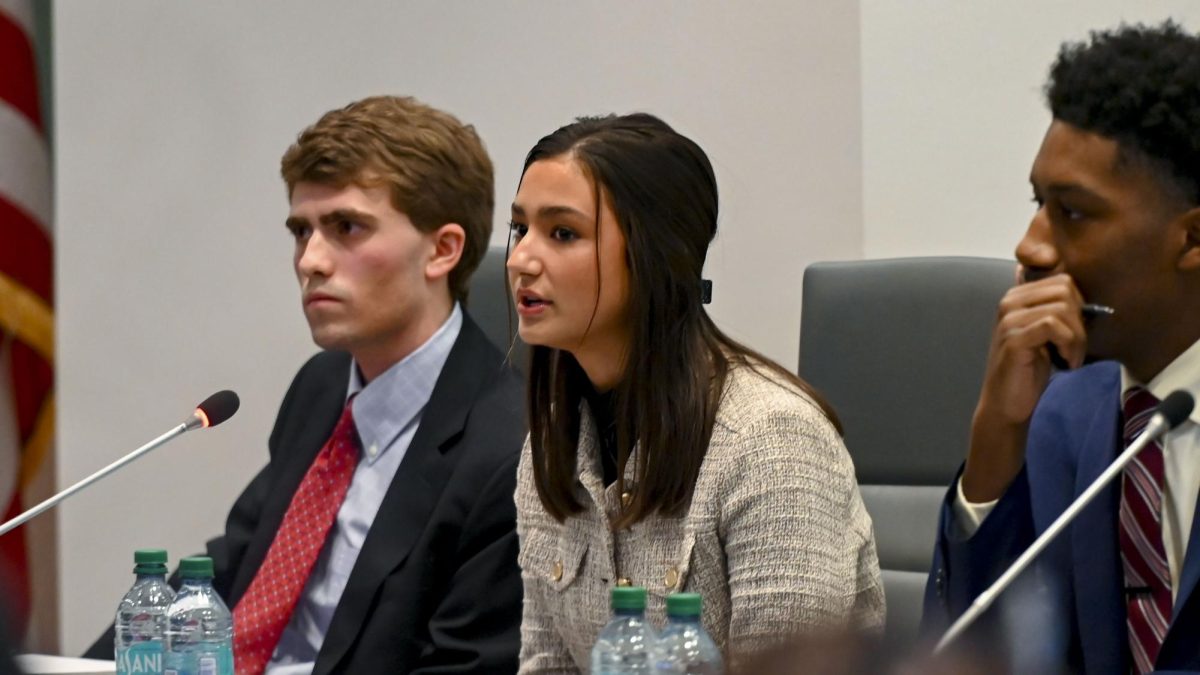
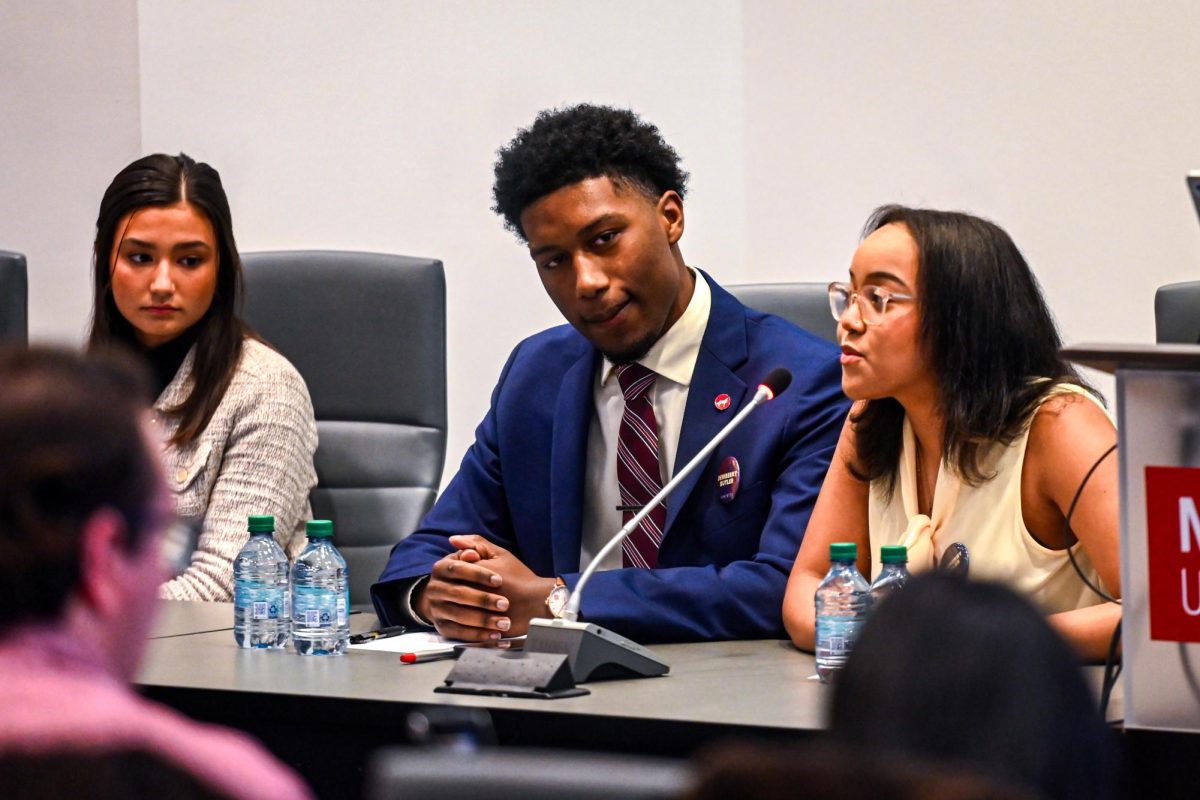
As Student Government elections approach, Monday evening’s Student Government debate hosted candidates for student body treasurer, student senate president as well as student body president.
Candidates sparred over student engagement, transparency and accountability and Student Government culture.
Student senate president debate
“One thing stands clear. Our culture and unity are falling through the cracks,” Lalith Nandula, a student senator from the College of Sciences and chair of the rules committee, said during the debate. “If Student Government’s culture and internal struggles get in the way of giving people the chance to do that, we are not only failing our campus, but we’re also failing ourselves.”
Mordecai Mengesteab, a third-year studying computer science, focused on making Student Government more effective during the debate and on balancing political action and student focus, citing the example of former Student Body President Cathy Sterling.
“We’re frequently presented with this false dichotomy of whether or not Student Government should be doing action for students or whether we should be taking action on political issues,” Mengesteab said. “[Cathy Sterling] didn’t have to choose. She led protests against the Vietnam War, and was still able to lead in their audit of their fees and where their money is going.”
Mengesteab cited the creation of Student Legal Services and the development of the Wolfline as examples of effective Student Government in the past, stating that his leadership would aim to continue delivering similar outcomes for students.
When asked by moderators about the process for removing a committee chair, Nandula emphasized open communication and understanding while balancing the needs of the Student Senate and the individual’s circumstances. Mengesteab focused on leading by example as senate president, ensuring that a chair can live up to the expectations placed on them.
Nandula rebutted by stating that the senate president would be a tough job to emulate due to the scope of their duties, while Mengesteab countered that he didn’t expect senators to perform the duties of the president, instead having the senate president set a clear example of their goals.
Nandula presided over the Student Senate in place of the current student senate president, Naila Din, during the controversial and raucous hearing to remove committee chair Tan Francis. Nandula made a failed effort to remove student media from the hearing, against senate rules.
Mengesteab focused on increasing transparency in Student Government to ensure student voices are heard and represented. Highlighting his passage of the Senate Transparency and Safety Act, Mengesteab emphasized the need to ensure senators are held accountable.
“It’s just as important to make students feel represented as it is to make sure that they are represented. Despite the work that we do, if students can’t see it, then our purpose has not been fulfilled,” Mengesteab said.
Nandula and Mengesteab disagreed on opposing the chancellor and administrators. Nandula aimed to highlight a balanced approach and maintain positive relationships with administrators, while Mengesteab took a more combative approach, stating that his goal was to represent and fight for the interests of the student body.
“I believe navigating that has to be complete with balance, balancing what the administrators expect of us and want of us and are able to do, as well as what the students expect of us,” Nandula said.
Mengesteab again highlighted the example of Cathy Sterling, stating despite her combative relationship with the chancellor at the time, the chancellor appreciated her fighting for students.
“The most important goal that we have is our north star of fighting for the students,” Mengesteab said.
Both candidates stated they would oppose a fee increase even if supported by the University administration.
Mengesteab stated his primary goal while working with the UNC Association of Student Governments would be to ensure access to voting rights and to keep voting locations on campus following the recent controversial closure of sites at NC A&T and UNC-Greensboro, while Nandula highlighted discussions of tuition and fees.
“I think discussion of tuition and fees from university to university [would be my main goal], important conversations that will help us gain perspective as well as be able to bring back substantial evidence on whether and how we vote in the Senate,” Nandula said.
Mengesteab, potentially alluding to the recent divisive firing of Jae Edwards from the LGBTQ Pride Center after an undercover investigation from a conservative media watchdog, Accuracy in Media, also emphasized protecting the rights of staff.
“I think we can keep protecting students’ rights. We can protect staff against undue recourse due to issues from the UNC System. We have the potential to do all these thing and we’re choosing not to,” Mengesteab said.
In closing statements, Nandula highlighted correcting previous wrongs in the Senate, while Mengesteab focused on delivering results for students, highlighting the Wolfline and Student Legal Services once again, as well as engaging in activism on behalf of students.
Student treasurer debate
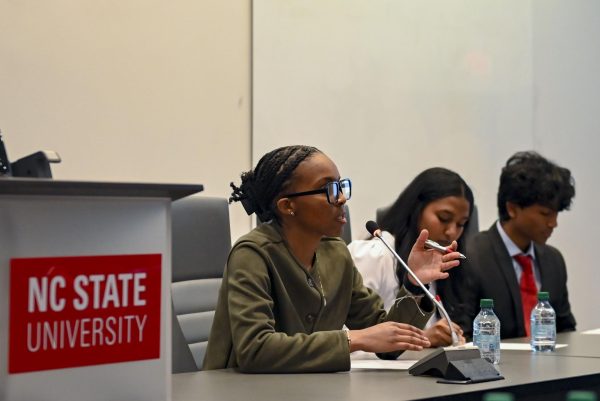
In the race for student treasurer are candidates Mikiya Hedgepeth, a third-year studying political science and Student Government director of athletics, Aleena Kollu, a third-year studying computer science and chair of the committee on tuition and fees and Pranav Akki, a third-year studying business administration .
Akki’s platform focused on increasing transparency between student organizations and Student Government regarding funding, aiming to provide personalized feedback for student organizations and establish an app through an unpaid internship program and partnership with engineering colleges within NC State.
Akki stated the app would allow the organizations to receive this personalized feedback, upload receipts to the cloud and track the status of appropriations requests.
“[Engineering students] will have the opportunity to gain some experience and also say on their resumes that they directly contributed to a project that goes out to 800 student organizations,” Akki said. “So you know what, who wouldn’t do that?”
Kollu countered Akki, arguing that providing feedback for hundreds of organizations would be infeasible, while Hedgepeth argued the creation of the app and its implementation would be difficult.
Akki highlighted collaboration across Student Government branches in his response and argued that personalized feedback would be done through a team of treasury officials.
“I believe it’s necessary. We have a 10% ineligibility rate. That means 10% of clubs and organizations can’t get the funding they need to make an impact,” Akki said.
Hedegepth highlighted increasing transparency and accountability in her responses through acknowledging the importance of spending money ethically while communicating standards and requirements accurately. Her response also argued that communication was a key shortfall during the current Senate session.
Kollu stated she would increase transparency through an initiative entitled “The Treasurer’s Roundtable,” which would meet with different college councils to explain the appropriations process. She also highlighted student input, such as through town halls and tabling, and produced a report explaining funding decisions and line-item budget expenditures.
“I believe that the treasurer’s roundtable initiative, as well as treasury on wheels, it kind of focuses more on us going to the student body,” Kollu said.
Hedgepeth emphasized the importance of streamlining processes and eliminating redundancy, while also highlighting transparency.
“In terms of reform I would implement my first semester … having a treasury that is open to review. Hosting weekly office hours so people know that they are welcomed in the suite,” Hedgepeth said.
When asked about affordability and tough budgetary decisions, Akki highlighted efforts to increase philanthropic giving to student organizations, while Hedgepeth highlighted communication and input from the student body. Kollu emphasized that she would not hesitate to turn down a fee increase if necessary for students.
In closing statements, Kollu emphasized student engagement, efficiency and modernization. Akki highlighted his approach of expanding education and access to tools for student organizations, while Hedgepeth advocated for being a voice for students and for increasing transparency and accountability.
Student body president and vice president debate
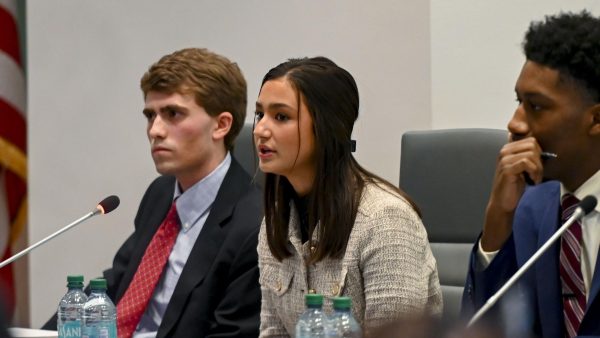
During the student body president debate, student body president candidate Taquan Dewberry, a third-year studying applied education studies and philosophy, and vice president candidate Ava Butler, a first-year graduate student studying higher education, mentioned their “ARE” initiative, as seen in their platform, aiming to create an “active, relevant and effective” Student Government.
Candidates Zach Eddinger, a third-year studying political science, and Alexander Rivas, a third-year studying political science, highlighted the “Odyssey Initiative,” aiming to increase student engagement and input in Student Government, as well as the pillars of advocacy, transparency, freedom of speech and safety on campus. Candidates Knox Trask, a third-year studying agricultural business, and Hubbard Stack, a first-year studying fashion and textile management, focused on centering students’ experiences.
Stack stated they would prioritize expanding access to advising during the first 100 days of their administration.
“We’re both from smaller colleges being [the College of Agriculture and Life Sciences] and Textiles, so our advisors are extremely hands-on,” Stack said. “And I have a brother in the Poole College of Management. He has great advising as well, but he doesn’t get as much one-on-one time with his advisor as we do.”
Dewberry stated a potential Dewberry-Butler administration would focus on transparency and engaging students and organizations in Student Government during the first 100 days.
“Over the past year and a half, or the past few years, we’ve seen student interest in Student Government decline because frankly, we’re just not reaching out and doing enough for our students,” Dewberry said.
A potential Eddinger-Rivas administration would focus on implementing the aforementioned “Odyssey Initiative,” aiming to advocate for students and also increase engagement with Student Government.
“On day one of the Eddinger-Rivas administration, there will be an executive order put on my desk and signed into motion. It’s going to be creating … a department that’s going to specifically carry out the initiative that we call the ‘Oddysey Initiative,’” Eddinger said. “Right now, Student Government has the mindset that people need to come to us to advocate — we’re going to reverse that.”
During the lightning round, candidates differed on whether they should take stances on controversial political issues. Candidates should not take stances on these issues, Eddinger said, because they need to represent the diverse interests of the student body. Trask agreed, stating that unless the campus was directly impacted, these issues were outside of the scope of the office.
Dewberry disagreed, adding that candidates should address these issues if students are affected.
“At the end of the day, it’s not about what I believe or what anyone else in the student body believes. It’s about what matters most to our students,” Dewberry said.
All candidates agreed they would vote against the Board of Trustees if it were in the best interests of students. Ed Stack, chair of the Board of Trustees, is the father of student body vice president candidate Hubbard Stack.
Candidates also disagreed on whether they would veto legislation that they found irresponsible or administratively unworkable. Stack stated she and Trask would veto legislation they found difficult to implement.
“We would take the initiative to veto something if we thought it was irresponsible administratively and fiscally, because while students might like it, it might not be in their best interest,” Stack said.
Eddinger stated he would only veto legislation that was entirely infeasible, but would work to ensure that legislation supported by the student body would be signed into statute overall.
“If a bill is popular and the students want it, but it’s not feasible by administration, I will work with senators in the Senate and we will make sure that we will make a piece of legislation that can work, so that students will be satisfied,” Eddinger said.
Dewberry stated he would not intend to veto legislation, instead working proactively with bill sponsors and the administration to determine whether the legislation would be feasible.
As candidates declined to rebut other candidates throughout the debate, the moderator and chair of the Board of Elections, Joseph Attanucci, encouraged them to use rebuttals to differentiate themselves from their opponents.
Candidates were unable to differentiate themselves from others or rebut specific points due to the general nature of the questions, Dewberry said in a post-debate interview.
“We just wish that the questions were more … actually about our record and what we’ve done in Student Government, and less general questions that anybody can answer the same way,” Dewberry said. “I think the only one where we really differed from everyone else was whether or not Student Government should take political stances. And obviously the answer is yes, because there’s way too much that is intertwined with politics.”
You can read the full profiles for Dewberry and Butler here, Eddinger and Rivas’ profile here and Trask and Stack here.
NC State students can vote in person in the lobby of Talley Student Union, the Engineering Building II breezeway and online on March 9 and 10.