
Environmental attorney Bryan Brice has worked on coal ash, Superfund cleanups and contaminated drinking water. He said Poe Hall is different.
”This is literally the worst environmental catastrophe regarding human health that I’ve come across,” Brice said. “Particularly for one building. It’s just a nightmare.”
Brice now represents more than 500 people who spent time in Poe Hall and allege they developed cancers and other illnesses after being exposed to polychlorinated biphenyls, or PCBs, in the building.
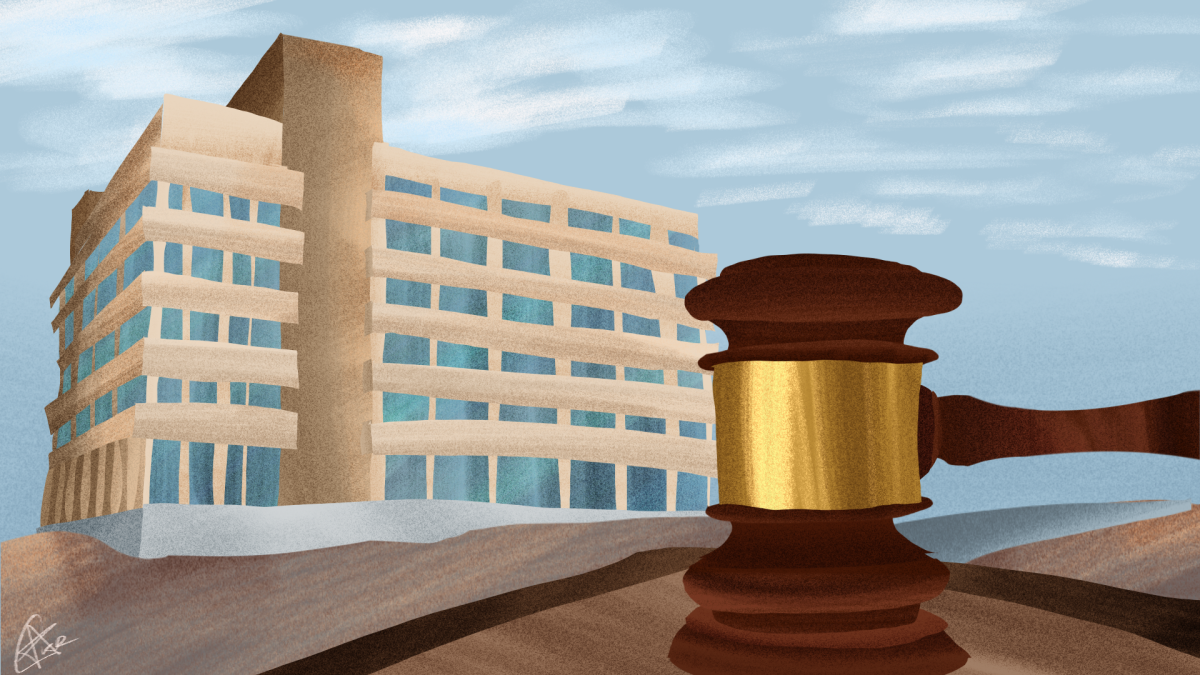
Breast cancer plaintiffs have sued NC State in Superior Court under the state constitution. The University is asking a judge to throw the case out, arguing their claims belong in workers’ compensation or tort proceedings before the state Industrial Commission. Separately, two groups have filed lawsuits against Monsanto, the company that manufactured PCB products used in Poe Hall: one filed by NC State alumni and former faculty alleging harm from PCB exposure, and another brought by NC State seeking to recover the cost of demolishing and rebuilding the structure.
Brice and his clients said those positions cannot all be true at once.
Constitutional claims versus workers’ comp
The main Poe Hall case against NC State was filed in Wake County Superior Court on behalf of 12 named plaintiffs and several estates. It relies on a 1992 North Carolina Supreme Court decision, Corum v. University of North Carolina, which allows plaintiffs to sue the state directly for violations of the North Carolina Constitution when there is no “adequate” remedy under other state law.
In their complaint, filed in January, the plaintiffs allege NC State violated four constitutional protections: the right to bodily integrity, the right to the enjoyment of the fruits of one’s own labor, the right to life and the pursuit of happiness and the right to a safe environment where learning can take place.
Brice said his team did not begin with a constitutional theory. They arrived there after a year of investigating how long NC State knew about PCBs in Poe and what it did in response.
Brice pointed to recent appellate decisions that, in his view, broaden how courts view state actors’ responsibility for citizens’ rights.
NC State is urging the court to reject that framing. On Feb. 20, 2026, the university filed a motion to dismiss all claims in the case.
“Plaintiffs have not stated any colorable constitutional claim because they fail to demonstrate that they have suffered the deprivation of any right protected by the Constitution,” NC State attorneys wrote. “Rather, Plaintiffs’ alleged injuries sound in negligence and workers’ compensation, not in violations of constitutional rights, and, according to the Amended Complaint, the alleged source of this injury is NC State’s alleged failure to warn and protect Plaintiffs from exposure to contamination.”
Under Corum, NC State argues, plaintiffs cannot bring constitutional claims when “adequate state law remedies” already exist. For employees, they point to the North Carolina Workers’ Compensation Act, which provides a limited waiver of sovereign immunity and exclusive jurisdiction in the Industrial Commission for work-related injuries. For students and non-employees, they point to the State Tort Claims Act, which covers negligence claims against state agencies, also in the Industrial Commission.
“Plaintiffs’ claims are, in fact, tort claims or workers’ compensation claims,” NC State attorneys wrote. “Any assertion that NC State’s alleged conduct rises to a constitutional level is not grounded in fact or law. A plaintiff may not elevate negligence claims by way of Corum to bypass governmental immunity.”
Sandy Alford, a plaintiff who was a graduate student when she first used Poe and later a university employee, said that argument leaves out a key group.
“Well, that would work, except that not everybody who is in the breast cancer case to begin with was employed here,” Alford said. “They were graduate students, so they can’t file the first comp claim.”
Brice said that gap is one of the reasons his team turned to the constitution.
Decades of complaints and “deliberate indifference”
Brice said his view of NC State’s legal duties in Poe is shaped by long-running “indoor air” complaints from people who worked and studied there.
“We’ve got some emails between folks at Poe Hall and the administration begging to please fix the indoor air problems, and the administration saying we’ve come and tested and there are no problems; everything is safe,” Brice said.
Brice said when faculty and staff asked for those test results, they hit a wall. Beyond air quality, he pointed to what NC State knew about PCBs on Poe’s exterior and how it responded.
“How can a university … be told by an environmental consulting company, who they hired, that there are very high levels of PCBs emanating from the window caulking on the outside of the windows, like super high levels; how can you not then immediately test inside the building?” Brice said.
NC State closed Poe Hall on Nov. 17, 2023, and hired consultants to perform two phases of testing. On June 13, 2024, the U.S. Environmental Protection Agency wrote to NC State confirming that Poe contained PCB “bulk products” at or above 50 parts per million, which are levels federal regulations do not allow to remain in use.
Public records accessed in March 2024 found that NC State had testing done in 2018, where caulk samples collected on the exterior of Poe Hall recorded PCB levels up to 17,000 parts per million.
Plaintiffs allege that NC State altered conditions in the building before some testing occurred. The first amended complaint includes photos of a dumpster outside Poe filled with air filters and what appears to be construction debris.
Debris removed from Poe Hall sits in a dumpster outside the building. Photo from Wake County Superior Court filing.
“Despite knowing toxic levels of PCBs were in Poe Hall, NCSU deliberately chose not to test these discarded filters and construction materials for the presence of PCBs,” the plaintiffs’ lawyers wrote.
Brice said that, together with NC State’s handling of records requests and communications, shaped his conclusion that the university crossed a line.
“That’s why all of this mounting evidence, even at the same time when NC State is refusing to answer public records requests, refusing to hand over test results, refusing to communicate or cooperate with basic information requests repeatedly over the past year or so, it all came together to where we said and in our complaint believe that this has risen well beyond the level of any kind of mere negligence or gross negligence,” Brice said. “This is deliberate, willful, and in our view, wanton conduct, which includes a reckless disregard for the health of its citizens and the educational opportunity of the citizens.”
Monsanto suit and conflicting messages
NC State has filed its own lawsuit against Monsanto and related PCB manufacturers. That complaint, filed in federal court, alleges that PCB-containing caulking, sealants and other building materials manufactured by Monsanto contaminated Poe Hall and nearby soil, air and groundwater.
In that filing, NC State describes Poe as so contaminated that it may be beyond remediation and in need of demolition.
“Because the PCB contamination is so extensive, NC State must essentially demolish Poe Hall and replace it with an entirely new building,” NC State’s lawyers wrote.
Brice said he expected NC State to pursue Monsanto and agrees with parts of the University’s argument. He said what puzzles him is how NC State talks about Poe in its own lawsuit compared to how it talks about Poe’s impact on plaintiffs and students.
“In regard to our claims and our request for information, it’s almost like State is trying to talk out of both sides of its mouth,” Brice said. “It’s trying to say we had to close this building, and it’s a toxic mess, and it’s unsafe and you’ve got to pay us to tear down a building, but then they try to say that, ‘Oh, it’s not that bad on the inside. People shouldn’t worry about being sick and we don’t need to do anything to help or address those issues.’”
Brice said the conflicting positions have real consequences for those who were exposed.
“That is wholly inconsistent, along with being unfair and wholly unsympathetic to the faculty, the professors, the staff, the students, the grad students and the public in the summer camp kids and the parents who brought their kids,” Brice said. “It’s an absolute travesty for all of the people who have spent time in Poe Hall and they’ve gotten sick, for them to say one thing about the toxicity of building and then out of the other side of their mouth trying to claim nobody should be sick.”
Former professor Linda Dillon Jones, who said she worked in Poe Hall from 1979-1992, said she drew a similar conclusion after reading NC State’s Monsanto complaint.
“They started calling it a toxic cesspool when they made their claim against Monsanto,” Jones said. “So now that they have called it a toxic cesspool, I can’t imagine they can win a lawsuit. Once you’ve admitted that you allowed people to work in a toxic cesspool, that’s pretty much the end of being able to defend your claim that it’s not a problem.”
Causation and a “best team” of experts
Even if plaintiffs can convince a jury that NC State violated their constitutional rights, they will still have to prove a causal link between PCB exposure in Poe and cases of cancers and illnesses. Brice said that is often the hardest part of toxic cases.
“But the evidence is there, and the ability to read medical records, understand people’s health effects and determine what the levels of contamination have been in the building can leave experts to determine whether or not PCBs have caused cancer and other illnesses due to the exposure in Poe Hall,” Brice said.
Monsanto has already signaled that it plans to argue there is “no reliable science” connecting low-level PCB exposure to many of the cancers alleged. Plaintiffs will counter with their own experts and cite federal and international studies of PCB toxicity, including a recent National Institute for Occupational Safety and Health (NIOSH) investigation of Poe that found elevated cancer rates among people who spent time in the building.
Brice said his team has spent the last year assembling experts for the case.
“We have assembled what I think is maybe the best team of industrial hygienists, doctors, oncologists, epidemiologists, toxicologists and experts in their fields regarding PCBs and these types of exposures,” Brice said. “And we look forward to having our day in court.”
More cases on the way
The first Poe Hall complaint focuses on women with breast cancer and related diagnoses. Brice said that choice was strategic.
“We’re about to file another set of breast cancer cases, and we’re expecting to file our first children’s cases soon after as well, along with skin cancer and leukemia cases shortly thereafter as well,” Brice said. “We’ve got numbers of cases still coming.”
Alford said that, from her perspective, litigation only became necessary because other routes failed.
“If they had sat down with us and had conversations with us, if they had shared information openly with us … I think the way that went to a lawsuit is because that was the only avenue we had to get information from the testing of this building that might help us with our oncologists and our treatments,” Alford said.
Currently, the plaintiffs’ constitutional case is waiting on a hearing date for NC State’s motion to dismiss, and the Monsanto suits are in their early stages.