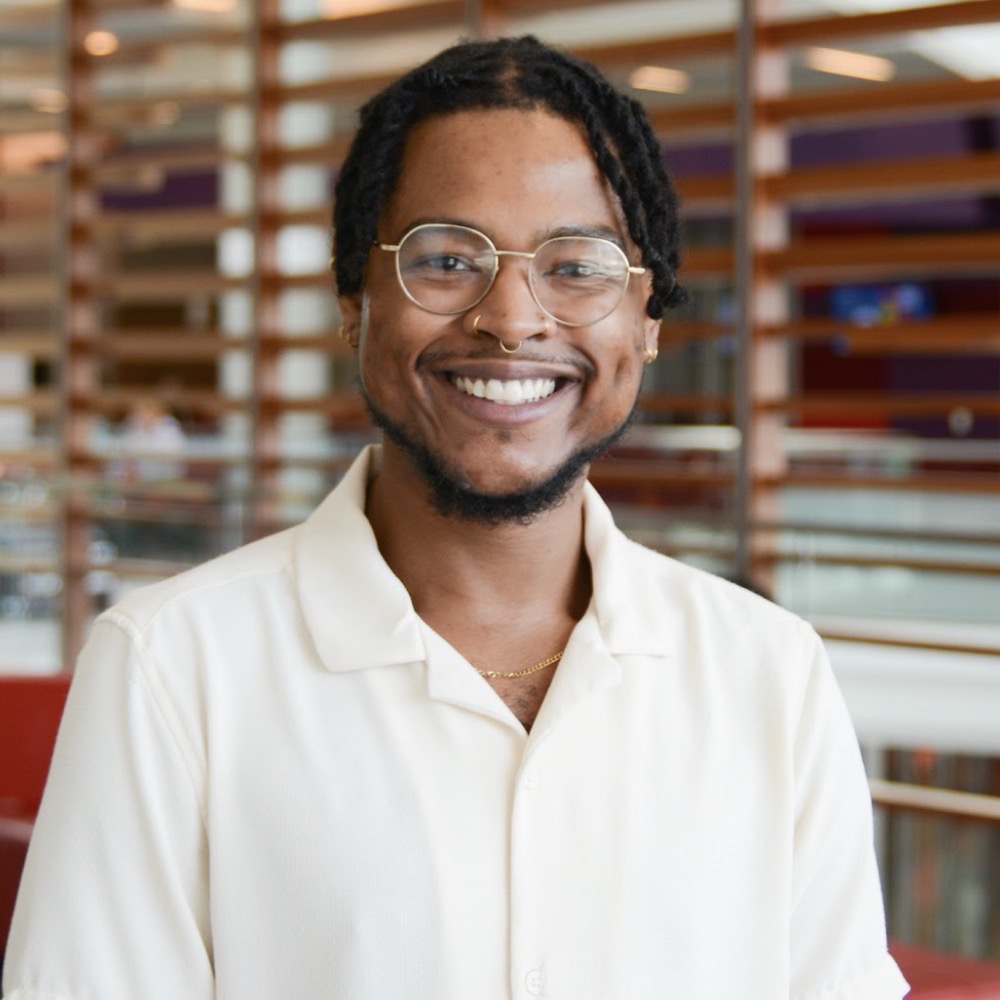
Students, faculty and community members gathered on Stafford Commons on Wednesday to challenge the termination of Jae Edwards, a former assistant director at the LGBTQ Pride Center. The protest highlighted the impact Edwards had on the NC State community and called on NC State Chancellor Kevin Howell to reinstate him.
The group included student organizers from Triangle Dissenters, the NCSU Grad Workers Union and members of the American Association of University Professors. They held pride flags and signs with messages such as “Black queer lives matter,” “queer people belong in the pack,” and “NC State shame on you.”
On Feb. 5, Accuracy in Media, a conservative media watchdog, shared a video of Jae Edwards answering questions about how NC State’s Pride Center was adapting to policy changes in the UNC system.
In the video, Edwards said that the center had to be “little more careful” about their programming and compliance with UNC policy. He emphasized support for student organizations and “finding ways around” the restrictions to continue to support LGBTQ+ students.
The day after it was posted, Edwards was terminated suddenly, the only explanation being that North Carolina is an at-will employment state and administrators had deemed his position no longer necessary.
In a statement given to Technician in initial reporting, University Spokesperson Mick Kulikowski said, “The individual seen in the video had no role in policy or compliance decisions and was not authorized to speak on behalf of the university.”
Edwards stated in an interview with Technician that he was speaking on behalf of himself, not the university.
The protest featured a range of speakers from local labor organizations, student leaders and students who had worked with and under Edwards. Several students spoke through tears about the significance of Edwards’ work and the Pride Center, as well as the growing sense of discomfort in what was previously a safe environment.
A statement from Edwards was also read aloud, expressing gratitude at the community support and crowdfunding in their absence. They said the actions of the university should not be allowed to go unnoticed.
“As a Black queer person working with diverse populations, I’ve become accustomed to unfair treatments due to the identities that I was born with. By growing accustomed doesn’t mean that I will let it continue,” Edwards wrote. “I know the power my community holds and as part of it, I hold that power, too. Let my termination expose the true values of the university, and let our community decide the narrative.”
Bell Boggs, the N.C. chapter president of the American Association of University Professors and professor in the department of English, said Accuracy in Media purposefully plans and edits their videos to attack free speech and instill fear.
“They use hidden cameras, misrepresent their purpose and then they release heavily edited gotcha videos that lack context or the words of these interviewers,” Boggs said.
Several other schools in the UNC System have had faculty targeted by Accuracy in Media, a right-wing nonprofit that conducts investigations into suspected diversity, equity and inclusion (DEI) programs on campuses where such programming is restricted, resulting in at least three other terminations.
“What we strongly oppose is the actions of our beloved universities, which have done the bidding of these shoddy so-called journalists whose methods would never be taught in a classroom at this university,” Boggs said.
Katie Stennette, a graduate student, student senator and member of UE150, a public employees union, spoke about the importance of community and standing united as students and workers.
“There is such a devastating cruelty to the way that Jae’s firing occurred,” Stennette said, citing the university’s lack of request for the raw footage and investigation.
Stennette gave a direct call to action at the end of her speech.
“There is only one person who can fix the situation right now, and that is Chancellor Howell. We call on the Chancellor to reinstate Jae. We call on the Chancellor to protect all members of the Wolfpack community,” Stennette said. “We cannot give into attacks on our most vulnerable on this campus.”
Jaimee Garbacik, a first-year graduate student studying fiction, said that they needn’t be directly connected to Edwards to care about the firing and its larger implications.
“In a moment when national monuments to queer people are being disappeared, we can expect that this is a tip of the iceberg in terms of historical erasure,” Garbacik said.
Garbacik said they found the university’s decision to fire Edwards contradictory. A common sentiment at the protest was that Edwards was simply doing his job in supporting students and did not deserve to be terminated.
“I think that it is completely disingenuous to pretend that there is any cause to fire someone whose position in the first place is to represent LGBTQ+ folks, all under the auspices of going too far with DEI,” Garbacik said.
DEI issues have been under intense scrutiny since before the Trump administration] In May 2024, the UNC Board of Governors issued a statement affirming the institution’s policy to ensure “students of all backgrounds are welcomed, included, and supported” and maintain “principled neutrality.”
In response to this statement, schools in the UNC system were tasked to eliminate and reassign DEI-centric positions. NC State eliminated eight positions, reassigned 29 positions, and eliminated the Office for Institutional Equity and Diversity entirely.
The system further mandated that institutions submitted an annual report on their compliance with the new “principled neutrality” policy signed by the chancellor.
In his first week in office in 2025, President Trump issued several executive orders directing the federal government to end DEI initiatives, which it labeled “illegal and immoral discrimination programs.”
As of Feb. 14, the Department of Education’s directive to restrict DEI initiatives was struck down in court, meaning the UNC system has no obligation to eliminate DEI programs to retain funding.
Jim Rice is a former NC State faculty member who studied and taught applied ecology. He said he thought it was important to attend the protest and show his dissatisfaction with university administration’s actions. He said the university needs to take a stance and defend its faculty, especially those that aimed to uplift students.
“We need to really support our students, and Jae really did that. The university needs to be stronger in its moral and political will,” Rice said. “It knuckled under quickly to a patched-together video that doesn’t really convey the truth.”
Garbacik said it was the job of academic institutions to foster safe and inclusive environments however they can.
“Academic freedom depends on diverse representation and voices,” Garbacik said. “If you don’t cultivate a safe climate for all students, then I’m not sure what exactly we’re here to do anymore.”
Boggs also connected the issue to broader academic integrity. She said the university should be focused on protecting members of the Wolfpack from partisan attacks on free speech.
“Jae Edwards’ firing is an attack on academic freedom, and it’s a message to all of us: be afraid on our campus,” Boggs said to the crowd. “Our message back to Chancellor Howell: You have the opportunity to reinstate Jae Edwards, to choose pride over bigotry, to choose an ethical and truthful and fair due process over partisan attacks.”
The protest in Stanford Commons moved into Talley Student Union and the student governance chambers, where a student senate meeting was held that evening. Members of the protest stood and gave public comment at the meeting in support of the Jae Edwards Act.
The act, written by Mordecai Mengesteab, senator and student senate president-elect, called for the university to give a full explanation of the termination of Edwards, to reinstate Edwards with backpay and to establish procedural protections to protect staff and faculty from external organizations. It passed with thirty-six votes in favor and one against.